Young looks at the stars and chases dreams
Unknowingly, the pace of time has arrived at the door of 2023. Looking back at the more than 300 days and nights we just spent, it seems like one step at a time, each step recording the development of China's aerospace industry. As the New Year's Day is approaching, we have prepared the Science Time Party Season 9 "Young Look at the Stars and Chasing Stars and Dreams" science popularization New Year's Eve event for our readers. Please join us on an exciting journey of chasing stars and chasing dreams!
Reviewer: Zhao Liangyu
Associate Professor of Flight Control Department, School of Astronautics, Beijing Institute of Technology
Whenever we imagine life in space, we always think of the picture in science fiction works, in which human beings in the future will live in a space station full of technology just like they live on the earth. In science fiction works, humans in the universe not only eat and sleep the same as on Earth, but they can even keep cats and dogs as pets just like on Earth.
Although such a fantasy is still a bit far away from the level of human science and technology today, it is not difficult for us to imagine that during the long in-orbit operation of the space station and spacecraft/ space navigation, if there is a furry companion to accompany them, it should be of great benefit to the physical and mental health of the astronauts. After all, who can say no to a space cat?

Source丨postable.com
So, can you keep pets in the space station?
Those animals that have been in space
In fact, before humans went into space, as human substitutes and pioneers in space exploration, animals had already traveled to space early.
The first animal to go into space was fruit flies. In February 1947, the United States used a captured Nazi German V2 rocket to send a group of fruit flies into space to study the impact of space radiation on genetics and immunity.
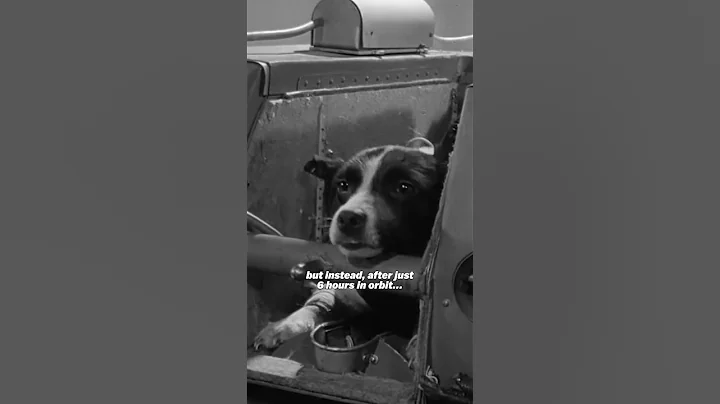
The most famous space animal should be the Soviet Union's space dog Laika . It is also the first animal in the world to enter Earth orbit . On November 3, 1957, Laika was launched aboard the Sputnik 2 spacecraft. At the time, the technology to return it safely to Earth had not yet been fully mastered, so Laika's journey was destined to have a tragic ending.
Space dog Laika Source | NASA
In the plan, Laika was supposed to eat poisonous food and be euthanized after completing a flight around the earth. However, according to some information released in 2002, 4 hours after liftoff, Laika had already died of heatstroke due to overheating of the space capsule . Finally, after five months of orbiting the Earth, Laika's body fell into the atmosphere and burned up together with Sputnik 2.
The first animals to successfully return from space also included two dogs, named Belka and Strelka. They took off on the Sputnik 5 spacecraft in August 1960 and returned to Earth one day later. The spacecraft also carried rabbits, rats, mice, flies, and some plants and fungi. In the end, all the creatures on the spacecraft returned to Earth safely.
Straka the Space Dog Source | Wikipedia
In addition to the animals mentioned above, experimental animals that have been in space also include monkeys, chimpanzees, cats, turtles, frogs, fish and many kinds of insects. In addition, the fossils of Coelophysis and Matrosaurus also went to space with the American space shuttle , and they are considered to be among the few ancient creatures that have "been in space".
What are the problems with raising pets on the space station?
So, what are the problems faced by raising pets on the space station? Let’s analyze it together.
First of all, animals kept as pets in the space station must not interfere with the normal work of astronauts and scientific research tasks. Therefore, animals that are prone to barking and accidentally touching various switches in the space station are obviously inappropriate.
Secondly, animals in the space station need to be able to adapt to the microgravity environment like astronauts, so animals that are more sensitive and prone to stress reactions are not suitable as space pets.
Third, pets in the space station (if kept in the astronaut living area) also need to not cause damage to the space station itself , so space pets should not have the habit of chewing hard objects, nor should they have severe hair loss.
Although cats are cute, the cat hair scattered everywhere may cause the failure of space station instruments. Source丨pixabay
Some friends who saw this have already wanted to say, can't pets realize these needs through artificial training? The answer is difficult. The space dogs we mentioned earlier that have been in space have also received professional training to ensure that they can adapt to the space environment. However, animals are not humans after all, and even trained animals cannot guarantee that they will not behave inappropriately.
Therefore, it is not only too expensive to specially train dogs, cats and other pets that astronauts can raise in the space station, but also has potential risks. Therefore, at this stage, if you want to see space cats, space dogs, etc., the most common pets on the earth, you may still need to wait for technological development and innovation.
Are there any animals that can be kept on the space station?
It would be wrong to say that pets cannot be kept on the space station at all. After all, many experimental animals have been sent to space. From this perspective, it is not impossible to raise space pets. Here we will classify the more common pet animals to see if any of them are suitable to be kept in the space station.
Cats and dogs: After the above analysis, cats and dogs are obviously not suitable pets for the space station. Unless they are confined to a fixed area for a long time, this is not good for the health of the animals, so it is ruled out for the time being.
Pet birds: Similar to cats and dogs, pet birds are not only susceptible to stress, but their innate physiological structure determines that they cannot excrete at a fixed point. As their feathers grow, there will also be problems with feather powder falling off. If you raise birds on the space station, you are likely to see guano and feather powder flying all over the sky.
Parrots’ cries and feather powder are also a problem Source丨pixabay
pet hamster: including hamsters, guinea pigs , hedgehogs and other small mammal pets may be space They are relatively suitable choices for the station. They are not big and can be raised well in a breeding box of several tens of centimeters. Moreover, in the history of space experiments, various experimental mice can be said to be frequent visitors in space. Therefore, if you want to raise furry pets in the space station, various hamsters should be relatively the most suitable.
In space, you may need to keep hamsters in a breeding box with a closed circulation device to avoid litter debris from flying. Source丨pixabay
Reptile pets: From the point of view that they can be kept in breeding boxes, many reptiles, such as pet frogs, turtles, lizards and other animals are also suitable. However, although frogs and turtles have been in space, amphibians and reptiles do not seem to be suitable in terms of their susceptibility to stress. In addition, these animals need to drink water from containers, and the water in space will be spherical, so there is also a risk of drowning, making them even more unsuitable for keeping in the space station.
Fish: Raising fish in space may sound a bit crazy, but there are actually several species of fish that have traveled to space. In 1973, a pair of killifish was sent into space. In subsequent experiments, fish embryos, zebrafish , guppy , oyster toadfish and other fish were sent into space for related experiments.
Zebrafish is a common ornamental fish and a very commonly used experimental fish. Source丨pixabay
Do the fish names above sound familiar? Yes, zebrafish and guppies are the two most common ornamental fish we see in the flower and bird market, so from this perspective, astronauts have actually realized raising fish in space! In short, from a technical point of view, it should be feasible to raise pets such as hamsters and ornamental fish in the space station, but it is probably too early to suck cats and dogs.
In less than a month, the Shenzhou 15th astronaut crew will welcome the Chinese people's first Spring Festival in space at the Tiangong Space Station. In the future, our country's astronauts will also build a research base on the moon to continue to move forward for the Chinese people's dream of "stars and seas". Let us cheer for the development of our motherland's aerospace industry while looking forward to the day when our animal friends can accompany us to travel in space~