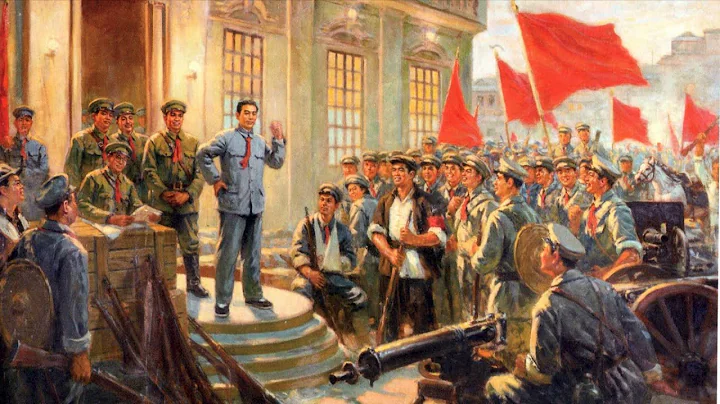
In 1924, the Kuomintang held its "First Congress" and determined the three major policies of "alliance with Russia and the Communist Party to support agriculture and industry." Under this background, the first cooperation between the two parties officially began. During that period, members of our party could also apply for the Huangpu Military Academy, join the National Revolutionary Army, and participate in the Northern Expedition.

The person we are talking about today is a member of our party who studied at Whampoa Military Academy. His name is Zhou Zhongying. It is worth mentioning that Li Dazhao, the early leader of our party, personally recommended Zhou Zhongying to apply for the Whampoa Military Academy. So, what’s the story about Zhou Zhongying?
Zhou Zhongying was born in 1902 in Xiangyang, Hubei Province. In his early years, Zhou Zhongying studied at the Middle School Affiliated to Peking Normal University, participated in student movements, and met Li Dazhao. In 1925, Zhou Zhongying joined the Communist Youth League. In 1926, he became an official party member. In this year, Li Dazhao wrote a letter of introduction introducing Zhou Zhongying to go south to Wuhan and apply for the Whampoa Military Academy.
After that, Zhou Zhongying entered the Wuhan Branch of Huangpu Military Academy to study. In 1927, after the failure of the Great Revolution, our party organized the Nanchang Uprising. At that time, Zhou Zhongying participated in the officer training group composed of students from the Wuhan Branch of Whampoa Military Academy and prepared to go to Nanchang to support. However, Zhou Zhongying missed the sailing date and failed to catch up with the Nanchang Uprising team, so he did not participate in the Nanchang Uprising.
After the failure of the Great Revolution, the Kuomintang's white terror enveloped the country, and Zhou Zhongying's work gradually went underground. After that, he successively carried out revolutionary propaganda work in Shanghai, Peking, and Tianjin. However, during that period, a large number of traitors appeared in the Northern Bureau, which led to two large-scale sabotages of our party's underground organizations in the north. In 1931, Zhou Zhongying was also arrested by the reactionaries while promoting the revolution in Tianjin and was imprisoned in the Peking Military Reflection Institute.
The Peking Military Review Institute is located in Caolanzi Hutong, so it is also called Caolanzi Prison. During that period, Caolanzi Prison imprisoned many members of our party, such as Bo Yibo, Yang Xianzhen, Liu Lantao, etc. They remained steadfast and unyielding in prison, established a party branch, and used hunger strikes and other methods to fight against the reactionaries and fight for their legitimate rights and interests.
After being imprisoned, Zhou Zhongying suffered from severe tuberculosis and often coughed up blood. One day, his throat was blocked by a mouthful of bloody phlegm during the coughing process, and he suddenly fainted. The guards thought Zhou Zhongying was dead, so they moved him to the morgue. Yang Xianzhen (who served as the principal of the Central Party School after the founding of the People's Republic of China) was unwilling to give in. She secretly ran to see Zhou Zhongying during a break and found that Zhou Zhongying still had heat in her chest. She quickly informed the prison doctor and successfully rescued Zhou Zhongying.
In 1936, starting from the great cause of resisting Japan, the Northern Bureau arranged personnel to go to Caolanzi Prison and notify the incarcerated comrades in the prison to "surrender" to get out of the prison. After learning the news, Bo Yibo first expressed his disagreement. He said that the "fake surrender" could not be explained clearly, and he was afraid that the "fake surrender" would turn into a real surrender. Zhou Zhongying also supported Bo Yibo's views and vowed to put him in jail.
Immediately afterwards, another instruction came from the Northern Bureau, telling the comrades in prison that this "fake surrender" was approved by the central government and would be recorded in writing, so there was no need to worry. Against this background, Zhou Zhongying, Bo Yibo and others successively "surrendered" themselves out of prison and joined the anti-Japanese war.
However, in 1966, after the ten-year special period began, Kang Sheng clung to this matter, believing that those who were in Caolanzi Prison were truly surrendering. In 1967, Kang Sheng concocted the "Sixty-One Traitor Group Case" and framed Zhou Zhongying and other people who had escaped from prison through "fake surrender" as traitors. After that, Zhou Zhongying was severely persecuted and was not completely rehabilitated until 1978. After
was rehabilitated, Zhou Zhongying joined the Central Commission for Discipline Inspection and served as a member of the Standing Committee of the Central Commission for Discipline Inspection. In his later years, he mainly lived in Beijing. He died of illness in 1991 at the age of 89.