周自齐
Zhou Ziqi was active in the political arena of the Republic of China in the late Qing Dynasty. He traveled overseas in his early years and later founded Tsinghua Academy (the predecessor of Tsinghua University). In 1912, he served as the governor of Shandong. In 1922, he served as the prime minister and chief of education of the Beiyang government. He also served as the president of the Republic of China.
As an old bureaucrat with Western education, he has a patriotic side, but he also supports Yuan Shikai's restoration of the monarchy. In that special age when warlords were fighting and taking a warrior, this kind of perverse dual personality created his contradictory and complicated life.
has spent more than 10 years in Europe and America
On October 14, 1871, Zhou Ziqi was born in a family of officials in Shanxian County, Shandong. From his great-grandfather to his grandfather, all were born in Jinshi, and his father, Zhou Haoxiu, was a candidate for inspection in Guangdong. At the age of 2, due to the death of his father, Zhou Ziqi was raised by his uncle Zhou Shaotang in Guangdong and continued to educate him. This is an important turning point in Zhou Ziqi's life.
At the end of the 19th century, Guangzhou was a place where various western thoughts met. After Zhou Ziqi arrived in Guangzhou, according to his father's instructions, he was ambitious and worked hard. At the age of 20, Zhou Ziqi was admitted to Guangzhou Tongwenguan (foreign language school) with excellent results to learn foreign languages. Due to his diligence and studious, he quickly stood out from many students.
Zhang Zhidong, the governor of Guangdong and Guangxi, sees his outstanding academic performance and shows his talents. Therefore, he was invited to be a guest of the Governor's Mansion. Zhou Ziqi talked freely at the Governor's Mansion and gave advice on the Westernization. Zhang Zhidong thought that his "children could be taught", so he specially recommended him to study at the Jingshi Tongwenguan in the name of a translator.
After arriving at the Tongwen Museum of Jingshi, apart from studying, Zhou Ziqi also translated the news about Japan for the Qing government at that time for the reference of domestic authorities. It is said that during the Sino-Japanese War of Sino-Japanese War, the ruling Li Hongzhang read the news in major Japanese newspapers, mainly translated by Zhou Ziqi and others.
Zhou Ziqi went to Columbia University to study after finishing his studies at the Tongwen Museum of Beijing Normal University, and was recommended to Wu Tingfang, the Minister in the United States. Since then, Zhou Ziqi has served successively as clerk and counselor of the Chinese Embassy in the United States, and as envoy to the United States, Japan, Peru and other countries.
Zhou Ziqi has been in Europe and America for more than 10 years, focusing on safeguarding national interests and doing a lot of things that benefit the country and the people. In 1898, gentry merchants in the three provinces of Hunan, Hubei, and Guangdong demanded to build the Guangdong-Han railway by themselves and carried out a vigorous campaign to protect the road. However, the Qing government was afraid of foreign powers and disregarded the opposition of the people. Wu Tingfang, the envoy to the United States, signed the "Guangdong-Han Railway Loan Contract" in Washington with the US-China Hexing Company.
This move seriously harmed China's interests. Zhou Ziqi, then consul in the New York consulate, was filled with outrage when he learned of the incident. He immediately became the Guangdong politician Liang Shiyi's plan to redeem the Canton-Han Railway memorial, and strongly supported the redemption actions of the people in Hunan, Hubei, and Guangdong, as well as gentry and businessmen. Under the strong pressure of the people, the Qing court was forced to redeem the ownership of the built sections of the Guangdong-Han Railway and the construction rights of the unbuilt sections.
During his tenure as the Chinese Consul General in San Francisco and the First Secretary of the Washington Embassy in the United States, Zhou Ziqi personally took the lead in raising donations to rescue overseas Chinese in San Francisco suffering from the earthquake. He has repeatedly negotiated with the United States and severely refuted the US government’s abuse of Chinese workers, prompting the Qing The government and the U.S. government signed a treaty prohibiting abuse of Chinese workers, protecting the legitimate rights and interests of Chinese workers in the United States.
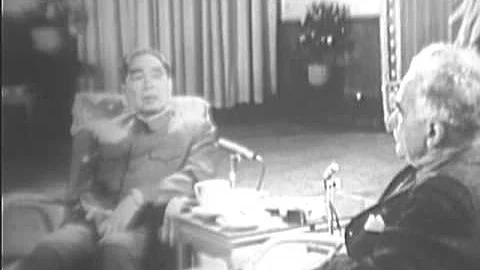
Zhou Ziqi (left)
The first person to establish Tsinghua
In 1908, Zhou Ziqi returned from the United States and worked in the Ministry of Foreign Affairs. This year, the U.S. government decided to refund part of the Boxer Indemnity for running schools and sending Chinese students to study in the U.S. Therefore, the Qing government established the Youmei Affairs Office in June 1909, and Zhou Ziqi served as the general office; he also presided over the preparation of the Youmei Institute (later renamed Tsinghua Academy), hired faculty, and recruited 460 students. Here, according to the United States The standard provides short-term training for students, and then selects the best and sends them to the United States for study.
Tsinghua Academy officially opened on April 29, 1911, and Zhou Ziqi served as the school’s supervisor (principal). From selecting the school site, purchasing land, building the school, to appointing faculty, Zhou Ziqi personally presided over the work.blood.
And Zhou Ziqi’s principles for selecting students studying in the United States are even more stringent. Students must not only be proficient in Chinese, they must have strong bodies, pure conduct, clean family backgrounds, and no shame. After examination and careful selection, a total of 180 students in three batches were selected.
Many of these students studying in the United States later became the pillars of the country, such as Mei Yiqi, Zhao Yuanren, Zhu Kezhen, Hu Shi, etc.
Tsinghua Academy was changed to Tsinghua School after the Revolution of 1911. It was officially renamed National Tsinghua University in 1928. Zhou Ziqi can be said to be the first president of Tsinghua University, and he has pioneered the reputation of Tsinghua University in the future.
During his tenure in the Ministry of Foreign Affairs, Zhou Ziqi also wrote 21 "Diplomatic Lectures", which comprehensively reviewed the 68-year diplomatic history of the Qing Dynasty since the Opium War. In the "Diplomatic Lectures", Zhou Ziqi pointed out the inequality of various treaties, and between the lines revealed his abhorrence for consular jurisdiction, one-sided most-favored-nation treatment, and agreed tariffs.
Acting President with the shortest term of office
In 1911, China went from ignorance to awakening. After various struggles between the Qing court and warlords, the northern military and political power fell into the hands of Yuan Shikai. To further stabilize the regime, Yuan Shikai then began to collect talents extensively. Zhou Ziqi, who has diplomatic experience and American experience, soon entered Yuan Shikai's vision.
In fact, studying abroad, working in the Ministry of Foreign Affairs of the Qing government, serving as a foreign envoy in the United States, and founding Tsinghua University, etc., have made Zhou Ziqi an active member on the political arena of the Qing government at that time.
When Yuan Shikai appointed him as the deputy minister of the Yuan Cabinet Branch (the organization in charge of financial affairs), he thought that serving Yuan Shikai was a way to serve the country. Moreover, being able to serve as the deputy minister of the branch was also the pursuit of ancient intellectuals The higher level of becoming an official, so I readily accepted it.
On February 15, 1912, Yuan Shikai stole the fruits of the victory of the Revolution of 1911 and became the interim president of the Republic of China. Zhou Ziqi was appointed as the governor of Shandong on March 25.
During Zhou Ziqi's tenure in Shandong, it was during the transitional period of the transition between the old and the new. The entire political and social situation in Shandong showed a complex and chaotic situation. He governed bandits, developed the industrial and commercial transportation industry, issued Shandong Bank notes, and issued methods for cutting hair, which brought a new political situation in Shandong. At the same time, he also did a lot of work for Yuan Shikai to restore the monarchy.
After returning to Beijing, Zhou Ziqi served as President of the Bank of China, Chief Transportation Officer, Chief Army Chief, Chief Finance Officer, Chief Agricultural and Commercial Chief, and Supervisor of the Salt Service Department. On December 23, 1914, he participated in the "celebration ceremony" directed by Yuan Shikai at the Temple of Heaven. He also asked Yuan Shikai's constitutional adviser, Goodnow, to draft a memorandum for the Beijing government to provide a "theoretical basis" for China's imperialism.
In 1915, Zhou Ziqi was appointed as one of the responsible persons in charge of national sports decisions and election affairs, and was specifically responsible for the election of representatives of the so-called "National Congress" in various provinces and regions across the country. In December 1915, when Yuan Shikai became emperor, he was appointed as a member of the "Preparatory Office for Grand Ceremony".
After Yuan Shikai's death in June 1916, Zhou Ziqi was listed as one of the imperial culprits and wanted by Li Yuanhong. However, due to the leakage of the news, Zhou Ziqi was lucky enough to go to Japan. It was not until July 1917 that acting president Feng Guozhang cancelled the wanted order for Zhou Ziqi and others, that Zhou Ziqi ended his exile and returned from Japan.
Because of his diplomatic experience and travels to the United States, coupled with the political foundation laid during Yuan Shikai’s rule, Zhou Ziqi continued to be reused by the Beiyang government after returning to China, and held important positions in several cabinets of the Beiyang government.
In April 1922, he was appointed by President Xu Shichang as acting prime minister and chief of education. From June 2 to June 11 of the same year, after Xu Shichang was forced to step down, Zhou Ziqi led cabinet members to act as president, becoming the president with the shortest term in the history of our country. But at the time, China's "anarchy" was avoided.
After Li Yuanhong was reinstated, Zhou Ziqi became a named post in the Financial Management Committee. But at this time, he was disheartened with politics, so he withdrew from politics and traveled to the United States. In the meantime, he inspected the American film industry, organized the Peacock Film Production Company after returning to China, and led the translation of the first film "Lotus"Female", this is the beginning of foreign films with Chinese subtitles.
In addition, in February 1918, Zhou Ziqi also participated in the founding of Tianjin Rotary School; in December 1918, Zhou Ziqi subscribed to raise 400,000 yuan of bonds for the founding of Nankai University; in July 1920, he reorganized Beiyang Baoshang Bank. Chairman; In 1921, invested in ZTE Mining Bureau of Zaozhuang Mining Area.
In October 1923, Zhou Ziqi died in Shanghai and was buried in Jiulong Mountain in Ximentougou, Beijing.