text/ Wang Shuangmei

▲Zunyi Conference Conference Room Display Photo. The photos on the wall from left to right are: Chen Yun, Zhu De, Zhou Enlai, Mao Zedong, Luo Fu (Zhang Wentian), Wang Jiaxiang, Bogu (Qin Bangxian), Liu Shaoqi
What stories does Liu Shaoqi have in the Long March? How did he and Peng Dehuai meet? What did he say at the Zunyi Conference? Not many people know about these issues. Here I will introduce one or two to you.
Mao Zedong introduced Liu Shaoqi to Peng Dehuai
In mid-October 1934, when the Red Army began its long march, Liu Shaoqi returned to Ruijin from his post as Secretary of the Fujian Provincial Party Committee and Central Representative of the Ninth Red Army for more than ten days. On October 10, Liu Shaoqi began the Long March with the main force of the Central Red Army. On the 22nd, he received a telegram from Zhou Enlai and Qin Bangxian on behalf of the Central Committee: "Liu Shaoqi will participate in the leadership of the Eighth Army of the Central Red Army and serve as a representative of the Central Committee of the Communist Party of China."
During the reorganization of Liping troops, the Central Revolutionary Military Commission decided to cancel the establishment of the Eighth Army and merge the remaining units into the Fifth Army. As a result, Liu Shaoqi followed his troops to the Fifth Red Army Corps and served as the central representative of the Fifth Red Army Corps. The commander of the Fifth Red Army Corps is Dong Zhentang , and the political commissar is Li Zhuoran. Here, Liu Shaoqi personally directed the comrades of the Fifth Red Army to clean up documents and discard excess materials.
Soon, Liu Shaoqi received a telegram from Zhou Enlai to him and Li Zhuoran, the political commissar of the Fifth Red Army Corps, asking them to rush to attend the Zunyi Conference. As a result, they rushed to Zunyi City from their respective places to participate in this historic meeting that determined the future and destiny of the Chinese revolution. During the Zunyi Conference, Mao Zedong introduced Liu Shaoqi to Peng Dehuai and said: "This is Liu Shaoqi, who joined the party very early and is a member of the Central Committee." (Peng Dehuai was deeply impressed by this incident, and he specifically mentioned it in his "Autobiography" decades later) Peng Dehuai shook hands with Liu Shaoqi warmly. Unexpectedly, shortly after the meeting, Liu Shaoqi returned to the Fifth Red Army Corps to convey the spirit of the Zunyi Conference, and then was sent to the Red Army Corps where Peng Dehuai was located to replace Yuan Guoping, who was hospitalized due to illness, as director of the Political Department. When Liu Shaoqi conveyed the spirit of the Zunyi Conference to the Fifth Red Army Corps, he enthusiastically encouraged the Red Army soldiers, saying that Comrade Mao Zedong had returned to the Central Committee, there was hope for our Red Army, there was hope for our party, and there was hope for the Chinese revolution. If we listen to the Party and follow the Party, we will definitely win!
▲ Zhou Enlai’s telegram informing Liu Shaoqi and others to attend the Zunyi Conference
In the Third Red Army Corps, Liu Shaoqi was also mainly responsible for the political and ideological work of the army. After the defeat in the Tucheng battle, the central government knew that there were objections among the commanders and soldiers below, "so it sent Comrade Shaoqi to the Third Red Army Corps and Comrade Chen Yun to the Fifth Red Army Corps to understand the situation and convey the spirit of the Zunyi Conference. At that time, the Third Red Army Corps was fighting the hardest, and the following people made the most weird remarks." Peng Dehuai introduced to Liu Shaoqi in detail the thoughts and emotions existing among the soldiers of the Third Red Army at that time, which attracted Liu Shaoqi's great attention. When the troops were marching, people often saw Liu Shaoqi walking back and forth among the troops, doing political and ideological work for cadres and soldiers. When the troops were camping, he came to the headquarters to study the problem and exchange opinions with the regiment commander Peng Dehuai and the political commissar Yang Shangkun.
In March 1935, when the troops arrived in Yaxi, Guizhou, Liu Shaoqi convened a symposium of political work cadres above the regiment of the Red Army to study the ideological conditions of cadres and soldiers. "Comrades reported on the situation, and Liu Shaoqi asked questions and interrupted from time to time. The meeting format was discussion-style, everyone spoke freely, and the atmosphere was warm." He also spoke on the work of the Party branch, cadre work, ideological and political work, and Party building. After a period of understanding, Liu Shaoqi wrote a telegram to the Central Committee of the Communist Party of China and sent it jointly with political commissar Yang Shangkun about the thoughts of the soldiers in the army and his own views on the situation.The situation they reported was of "positive significance for the central government to understand the thoughts of the soldiers at the conference , to overcome and correct the negative and disorganized emotions that existed within the party and the Red Army at that time, and to unify the thoughts and actions of the entire army. At that time, it was very dangerous to waver." At the end of May, after the Red Army rushed to cross the Dadu River, Yuan Guoping, the former director of the Political Department of the Third Red Army, recovered from illness and returned to his post. Liu Shaoqi left the Third Red Army and worked for the National Security Bureau, and soon returned to the Central Committee.
▲ In early August 1937, Liu Shaoqi, according to the instructions of the Central Committee of the Communist Party of China, established a new leadership organization of the Northern Bureau in Taiyuan, with Liu Shaoqi as secretary and Yang Shangkun as deputy secretary. The picture shows Liu Shaoqi (right), Peng Dehuai and Yang Shangkun.
It can be seen that most of Liu Shaoqi’s work during the Long March was mainly ideological and political work, and he did his best to ensure the victory of the Red Army’s Long March politically. This also laid the foundation for him to serve as the director of the General Political Department of the Central Military Commission in the future Liberation War.
supported Zhou Enlai’s initiative at the Zunyi Conference.
The Zunyi Conference was an extremely important meeting in the Long March. It was a life-and-death turning point in the history of the party and an important symbol of the maturity of the Chinese Communist Party. Its outstanding manifestation is that a group of senior leading cadres of the central government have deepened their understanding of the principle of integrating the basic principles of Marxism with the specific practice of the Chinese revolution after more than ten years of revolutionary practice, especially the comparison of successful and failed experiences and lessons learned from five counter-campaigns against "encirclement and suppression". This has enabled leaders represented by Mao Zedong to adhere to the correct line of proceeding from reality in all matters to rise to leadership positions within the party. In this process, Mao Zedong, Zhang Wentian, Zhou Enlai and Wang Jiaxiang undoubtedly played an extremely important role at the meeting, but other comrades including Liu Shaoqi, who was an alternate member of the Political Bureau, also played a certain role.
As Mao Zedong later said when talking about the role of Zhang Wentian and Wang Jiaxiang: "There were many other comrades who participated in the Zunyi Conference, and it was brewing for a long time. Without the participation and approval of those comrades, the two of them would not be able to do it." He also pointed out at the Central Working Conference on October 25, 1966 that Liu Shaoqi opposed "Left" errors at the Zunyi Conference. On May 17, 1980, Deng Xiaoping also pointed out in his eulogy on behalf of the Central Committee of the Communist Party of China at Liu Shaoqi’s memorial service: “In January 1935, at the Zunyi Conference that decided the fate of the Chinese revolution, Comrade Liu Shaoqi firmly supported the correct line represented by Comrade Mao Zedong.” Obviously, there should be no doubt that Liu Shaoqi clearly opposed “Left” errors at the Zunyi Conference. However, due to the lack of historical data and subsequent historical reasons, the party history circle has rarely provided arguments and explanations on this issue for a long time. This article now makes a preliminary analysis based on existing historical data.
Generally speaking, Liu Shaoqi made two achievements at the Zunyi Conference.
First, support Zhou Enlai’s initiative to elect Mao Zedong as leader. Wu Xiuquan, one of the participants of the conference, said: "Comrade Zhou Enlai's initiative (to change wrong leadership and elect Mao Zedong as leader) ——Introducer's note), and received active support from comrades such as Zhu De, Wang Jiaxiang, Zhang Wentian, Liu Shaoqi, Chen Yun..."
The second is "unique", which raised the issue of political line errors made by the Provisional Central Committee after the Fourth Plenary Session of the Sixth Central Committee. Zunyi Conference Memorial Hall scholar Shi Yongyan believes based on relevant data research: Liu Shaoqi spoke on the second day of the Zunyi Conference and said, "Since the Fourth Plenary Session of the Central Committee of the Communist Party of China, the work in the White Areas has made the mistake of 'Left' adventurism, which has led to the employees in the White Areas The disintegration of the movement and even the party organization, especially after the Fifth Plenary Session of the Central Committee of the Communist Party of China, whether the party's line in the white area and soviet area is correct requires the central government to make a comprehensive review and correction.Liu Shaoqi's speech showed that at that time he was at the forefront of the party in his erroneous understanding of the "Left" line of the Provisional Central Committee.
▲ The room where Liu Shaoqi lived during the Zunyi Conference
Regarding the first aspect of Liu Shaoqi’s achievements, it is basically certain based on the existing materials. However, as for the second aspect of achievement, it is limited by the lack of original data and cannot be fully identified so far. However, the author believes that this statement is credible based on the resolutions of the Zunyi Conference and the recollections of the leaders who attended the conference, as well as Liu Shaoqi's consistent thoughts and practices before and after the conference.
According to the author's research, Shi Yongyan's statement is based on Guo Qian, who was the Minister of Local Work during the Long March. 】 description. Guo Qian recalled: At the Zunyi Conference, Liu Shaoqi "criticized the mistakes of left adventurism in the work in the White Areas since the Fourth Plenary Session of the Central Committee, which led to the collapse of the workers' movement and even the party organizations in the White Areas. He believed that since the Fourth Plenary Session of the Central Committee and after the Fifth Plenary Session of the Central Committee, whether the party's political line in the White Areas and Soviet Areas was correct or not required a comprehensive review and correction." Although Guo Qian did not attend the meeting at the time, he had discussed the Zunyi Meeting with Peng Dehuai, Yang Shangkun and Liu Shaoqi in the Third Army Corps, so his memories should be valuable.
Someone raised the issue of "political line"
Someone did raise the issue of "political line" at the Zunyi meeting. Wu Xiuquan recalled many times: "At the meeting, someone once proposed to criticize and correct the political mistakes since the Fourth Plenary Session of the Sixth Central Committee. Comrade Mao Zedong wisely stopped this approach." Mao Zedong also said at the Politburo meeting on November 13, 1943: "Why did the Zunyi Conference Can't we raise the issue of line? It's just to divide their sect. This is the scene where I implemented internal division in Zhujiazhuang. If the political line was raised at that time, the three-person group would be divided." Wu Xiuquan's recollection is consistent with Mao Zedong's speech and the resolution of the Zunyi Conference.
The resolution of the Zunyi Conference clearly affirmed that "the political line of the Party Central Committee is undoubtedly correct." This assertion was clearly affirmed tit for tat in response to someone who raised contrary opinions at the meeting. This point can also be confirmed by Bogu's review report at the Seventh National Congress. When Bo Gu mentioned the Zunyi Conference in the review report of the Seventh National Congress, he said: "At this meeting, I personally did not recognize the mistakes, and at the same time I did not understand the mistakes. I only admitted that there were individual errors in the policies for working in the Soviet area, and in military guidance, there were individual policy errors. I did not admit that they were errors in the line." Liu Shaoqi said in mid-1959 At the Eighth Plenary Session of the Eighth Central Committee of the Communist Party of China, it was also mentioned: "Bogu stood up after the Zunyi Conference. I talked to him and I saw him. He did not admit his mistakes and made line errors, which put the Red Army in such a difficult situation."
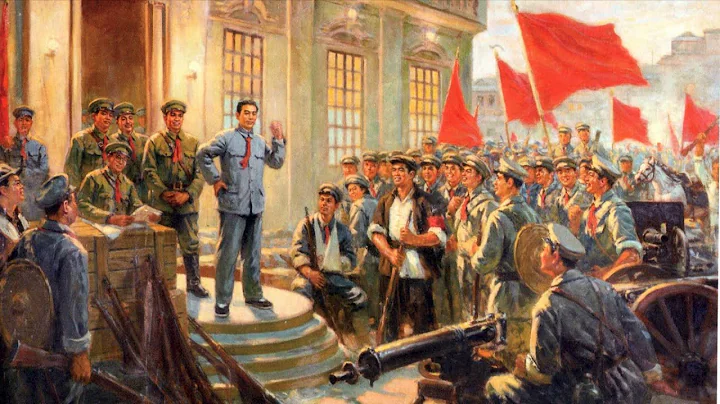
▲Zunyi Conference (oil painting)
The Party History Materials Collection Committee of the Central Committee of the Communist Party of China published "About Zunyi" in September 1984 The "Investigation Report on Several Situations of the Enlarged Meeting of the Politburo" also pointed out: "Because most comrades at that time had not yet realized the political mistakes of the Central Committee, and the war situation was urgent, the meeting did not hold further discussions on the political line." This investigation report was based on interviews with many parties involved, and should be true. This shows that someone raised the issue of "political line" at the meeting, but due to the pressing military situation and ideological issues, no "further" discussion was held.
So, who is most likely to propose it? People's understanding always starts from what they have personally experienced and come into contact with. This is what Mao Zedong pointed out in "On Practice": "Knowledge begins with practice" and "knowledge without practice is impossible." The people who attended the meeting at that time, in addition to members of the Politburo, were the heads of the Red Army headquarters and the various legions. The questions they raised basically focused on military reflection on the reasons for the failure of the fifth counter-"encirclement and suppression" campaign. This was an urgent life-and-death issue that the Red Army needed to solve at that time.
Liu Shaoqi entered the Central Soviet Area from Shanghai at the end of 1932 and engaged in labor movement work. Since the failure of the revolution in 1927, he has been thinking about and summarizing the experiences and lessons of the failure of the revolution. Through the practice of participating in the labor movement in Anyuan and Wuhan, and later through the practice of the Shunzhi Provincial Committee, the Manchuria Provincial Committee, and the Shanghai labor movement, he deeply felt that due to China's economic and cultural backwardness, the Chinese working class and its political parties were relatively vulnerable to the harm of "Left" errors. He believed that the failure of the Great Revolution was not only due to Chen Duxiu's right-leaning opportunist mistakes, but also to the "left" mistakes made, especially in the workers' movement. This point he made many times.
As a result, starting from the spring of 1928, Liu Shaoqi had differences of opinion with the Central Committee on the situation and tasks of the labor movement. He advocated that after the failure of the Great Revolution, the struggle of the working class was in a defensive position. The CCP should try its best to take advantage of legal opportunities to work in cities, temporarily avoid duels with the enemy, and broadly unite all forces that can be united to prepare for future revolutionary attacks and duels. During the "January 28" Anti-Japanese War in 1932, Liu Shaoqi led the Shanghai Huxi Cotton Mill workers to carry out a strike against Japanese imperialism. He practiced his own strategies and ideas and widely won support from all walks of life for the workers' strike. However, these correct propositions were severely criticized as "serious right-wing opportunism" by the Shanghai Provisional Central Committee and representatives of the Communist International in Shanghai. Liu Shaoqi was also dismissed from the post of Workers' Minister of the Central Committee. Although he was forced to make a review, he still repeatedly wrote to the central government, asking the central government to provide systematic explanations on some issues. After entering the Central Soviet Area, although Liu Shaoqi wore the label of "old opportunist", he still insisted on his own ideas and worked with Chen Yun to correct the "left" tendencies in the Soviet area workers' movement. Especially after witnessing the failure of the fifth counter-campaign against "encirclement and suppression", he gained a further understanding of the "Left" errors of the Provisional Central Committee.
Therefore, Liu Shaoqi was most likely to raise the issue of the wrong political line at the Zunyi Conference based on his own practice of working in the White and Soviet areas. This is also reflected to a certain extent in the resolution of the Zunyi Conference, that is, the "Resolution" clearly stated: "There must be a complete change in the leadership style of the mass struggle in the white areas."
▲ Liu Shaoqi in Yan'an in 1937
Judging from the thoughts and practices after the meeting, this conclusion can also be established. The earliest proposal within the party to publicly review the errors of the third "Left" political line was made by Mao Zedong at the Political Bureau meeting of the Central Committee on December 4, 1940. (Zhang Guotao raised the issue of political line at the Shanwo Conference with ulterior motives, which is a different nature.) He pointed out at that meeting: At the end of the Soviet Union, everything was overthrown. This "left" policy cost the army nine-tenths, and the Soviet area lost more than nine-tenths. "The Zunyi Conference resolution only said it was a military error, not a line error. It was actually a line error, so the Zunyi Conference resolution needs to be revised." But even at that time, many people could not accept it, and Mao Zedong had to delete this paragraph when he made this speech publicly (i.e., in the article "On Policy"). It was not until the Politburo meeting in September of the following year that the core leadership of the Central Committee raised the issue again during the initial rectification study.It was at the expanded Seventh Plenary Session of the Sixth Central Committee of the Communist Party of China that was held from May 1944 to April 1945 that the whole party completely resolved and unified its understanding of this issue politically and ideologically.
However, in a series of Politburo meetings after the Long March arrived in northern Shaanxi, Liu Shaoqi continued to reflect on the political mistakes made during the ten-year civil war. Especially after he came to preside over the work of the Northern Bureau in the spring of 1936, in response to the urgent need to actively implement the new policy practice of the Party Central Committee to establish the Chinese Anti-Japanese National United Front, he took the lead in the North China Party organization to vigorously correct the "Left" line errors during the ten-year civil war in terms of theory, policy and ideological work methods. To this end, in just one year, he wrote more than 30 articles and intra-party correspondence, deeply criticizing the errors of closed-doorism and adventurism in the party after the great revolution, demanding that party members and cadres effectively eliminate the empty talk leadership style, and connect the general principles of Marxism-Leninism with specific problems in real life. Especially in early 1937, he wrote four consecutive letters to Zhang Wentian, who was in charge of the Central Committee of the Communist Party of China at that time, requesting that "it is necessary to criticize" the "Left" mistakes made by the Central Committee in the past, and to "pay special attention to and study this issue." "I feel the most about this issue, and I often think about it." He also clearly proposed that we should vigorously correct the mistakes made during the ten-year civil war from the ideological line level. He said: "The root cause of these mistakes is, on the one hand, errors in estimation of the situation. On the other hand, it is also an error in thinking and philosophical methods. We have principles in our actions. Should we be realistic and realistic?" "Yes, it is a question of whether and how to estimate the situation." He believed that "in the past, formal logic played an extremely important role in our party's thinking and had a profound influence on comrades." He used many specific examples to illustrate that many comrades in the party would not concretely apply the basic principles of Marxism-Leninism into practice. He criticized the central government after the Fourth Plenary Session of the Sixth Central Committee for its poor ability to cope with events and poor creativity. "But it is most obedient to the international community, but sometimes it is mechanical obedience." Here he repeatedly emphasized the principle of "seeking truth from facts" and actually put forward the proposition of integrating the basic principles of Marxism with the specific practice of the Chinese revolution. This is consistent with the research direction of Mao Zedong's "On Practice" and "On Contradictions" written in Yan'an in 1937. Their common tenacity was all at the Zunyi Conference, and it was an inevitable reflection of their insistence on exploring a revolutionary path that suited China's national conditions based on reality on different fronts during the ten-year civil war.
The above materials are completely consistent when compared. Liu Shaoqi's speech at the Zunyi Conference should be credible. This shows that at the Zunyi Conference, Liu Shaoqi proposed a review of the political line after the Fourth Plenary Session of the Sixth Central Committee. This was an important historical link in his process of Sinicizing Marxism. It was also an important link in the process of the whole party realizing the first historical leap in the Sinicization of Marxism.
(The author is a researcher at the Central Institute of Party History and Documentation)
From: Theoretical China WeChat public account