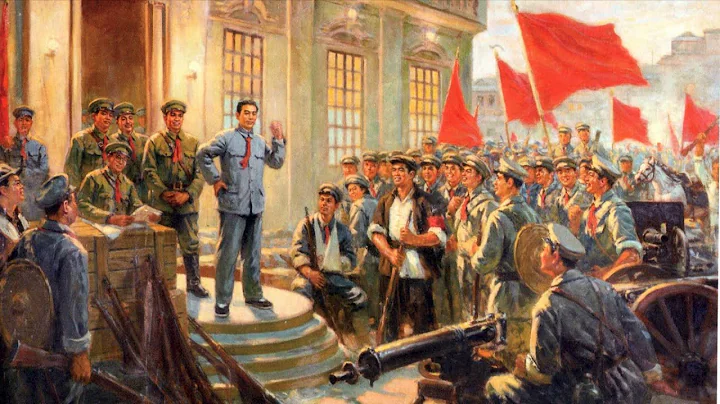
The Revolution of 1911 broke out in 1911. The Revolutionary Party established a provisional government in Nanjing. Sun Yat-sen was elected as the provisional president. In January 1912, the Republic of China was officially established.
The Republic of China was an era of transition between the old and the new. Although new ideas burst out, many old customs, such as three wives and four concubines that had lasted for thousands of years, still existed. It was not until 1950 that monogamy was officially stipulated by law and was banned.

So, after three wives and four concubines were banned, where did those former concubines go?
The " Marriage Law" promulgated in 1950 is considered to be "the most universal fundamental law second only to the Constitution". It stipulates in the law that "men and women are free to marry, monogamous and monogamous, and have equal rights."
After the law was enacted, many people did not take it seriously at all and even opposed the Marriage Law by openly taking concubines. As a result, the concubinage ceremony was stopped midway and was widely reported by newspapers as a warning to others.
As a warlord of the Sichuan Army, Fan Shaozeng had married many wives and concubines. There were even rumors that he had more than 40 concubines. However, the rumors were never credible. He actually had only 7 wives and concubines.
Fan Shaozeng was born in 1894 in Qinghe Town, Dazhu County, Sichuan Province, Suiding Prefecture, Sichuan Province (now Dazhou City). He was a simple and honest man. He was called "Fan Ha'er" since he was a child. He was also mentioned in the TV series "Mr. Silly".
In the 4th year of the Republic of China (1915), Fan Shaozeng led the uprising with the leader of "Brother Pao", and later became a lieutenant general. He successively joined the militia of Yang Sen, Liu Xiang and Chiang Kai-shek.
The reason why Fan Shaozeng can be remembered by future generations is not only because of the legend that he had many wives and concubines, but also because he killed Lieutenant General Naoji Sakai, commander of the 15th Japanese Division, in May 1942. This created the history of the first serving division commander to be killed since the creation of the Japanese Army. Therefore, he was also a veritable anti-Japanese hero.
Regarding marriage, Fan Shaozeng’s first wife was named Chen Wenlan, who was arranged by his parents. Later, according to his own wishes, he married six concubines including Zhang Shaofen, Ye Shaofang, and He Shuxi, giving birth to a total of 4 boys and 8 girls.
After Fan Shaozeng decided to lead his troops in an uprising in 1949, everyone turned their attention to his concubines. How to deal with these women who had followed him for many years became the first problem Fan Shaozeng faced!
He told his wives and concubines at the family meeting that those who wanted to leave could go to Hong Kong. Among all the concubines, only He Shuxi wanted to leave, so Fan Shaozeng gave her some money and sent her out. The remaining concubines were sent back to their hometown in Sichuan for simple placement.
The time came to December 15, 1945, that is, shortly after Fan Shaozeng’s uprising was successful and he fell into the arms of our party. He once again held a family meeting and emphasized that in response to the "monogamy" policy, he would distribute some money to each concubine. After everyone gets the money, they can remarry and find another way to make a living.
Therefore, at Fan Shaozeng's strong request, the four aunts Zhang, Fang, Zhao, and He all left him and found their final destinations and successfully remarried. Only Ye Shaofang insisted on the idea of loyalty and refused to leave no matter what. Fan Shaozeng had no choice but to place her in his hometown in Sichuan first.
According to the memories of his son-in-law Wang Jiguang, among Fan Shaozeng's seven concubines, except for his original wife Chen who died young, the remaining six concubines all left him to fend for themselves under his repeated persuasion. The only one left, Ye Shaofang, took care of him until his death. This can be regarded as the implementation of the "monogamy" system.