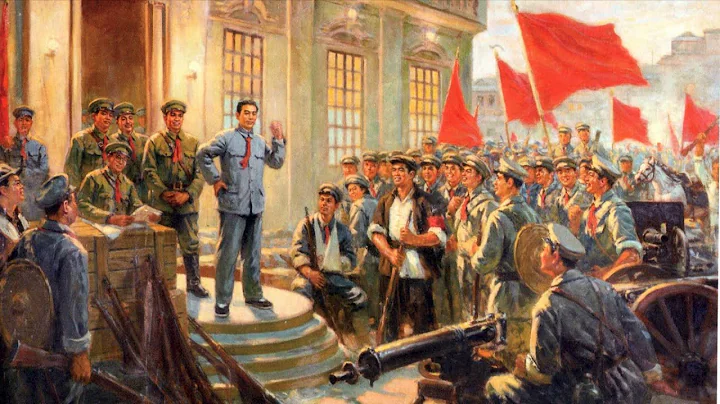
This article is excerpted from Mao Zedong's "Speech at the Enlarged Central Work Conference" (January 30, 1962). There are six points in Mao Zedong's speech. "Selected Readings of Mao Zedong's Works" includes the first, second, fourth and sixth points, while omitting the third and fifth points.
Comrades, let me make some comments now. Let’s talk about six points together, focusing on the issue of democratic centralism and also touching on some other issues.
The first point is the method of holding this meeting.
More than 7,000 people attended this enlarged central work conference. At the beginning of this meeting, Comrade Liu Shaoqi and several other comrades prepared a draft report. This manuscript has not yet been discussed by the Political Bureau of the Central Committee, so I suggested to them that they should not hold a meeting of the Political Bureau of the Central Committee to discuss it first, but immediately send it to the comrades participating in the conference, asking everyone to comment and provide opinions. Comrades, you have people from all walks of life, from all places, from various provincial, prefectural and county committees, from corporate party committees, and from various departments of the central government. Most of you are relatively close to the lower levels. You should understand the situation and problems better than our comrades in the Standing Committee of the Central Committee, the Political Bureau of the Central Committee and the Secretariat of the Central Committee. Also, you are in various positions and can ask questions from various angles. Therefore, I would like to ask for your opinions. The draft of the report has been sent to you, and as expected there has been a lot of discussion. In addition to agreeing with the basic policies proposed by the central government, many opinions have also been put forward. Later, Comrade Shaoqi chaired it and organized a drafting committee of 21 people, which included responsible comrades from various Central Bureaus. After eight days of discussion, the second draft of the written report was written. It should be said that the second draft of the report was the result of discussions involving more than 7,000 people at the central government. This second draft would not have been possible without your input. In the second draft, the first and second parts have been greatly revised, which is your credit. I heard that everyone’s evaluation of the second draft was not bad and they thought it was better. If instead of adopting this method, we adopt the usual method of holding meetings, which is to give a report first, then discuss it, and everyone raises their hands in approval, then it would be impossible to achieve such a good result.
This is a question of how to hold a meeting. Send the draft report first, ask those present at the meeting to comment and make revisions, and then make a report. When giving a report, one does not read from the book, but gives some supplementary opinions and explanations. In this way, democracy can be more fully promoted, wisdom from all aspects can be pooled, different views can be compared, and meetings can be more lively. Our meeting this time is to summarize the work experience of the past 12 years, especially the work experience of the past four years. There are many problems and opinions, so it is appropriate to adopt this method. Can all meetings use this method? That's not it either. With this method, allow plenty of time. Our people's congress session may sometimes use this method. Comrades of the provincial, prefectural and county committees, if you convene meetings in the future, you can also use this method if conditions permit. Of course, you are busy with work and generally cannot spend a long time in meetings, but when you have the conditions, you might as well give it a try. What is the method
? It is a method of democratic centralism and a mass line method. Democracy first, then centralism, come from the masses, go to the masses, and integrate leadership with the masses. This is my first point.
The second point is the issue of democratic centralism.
It seems that some of our comrades still do not understand the democratic centralism mentioned by Marx and Lenin. Some comrades are already veteran revolutionaries, of the "1938 style" or some other style. In short, they have been Communist Party members for decades, but they still don't understand this problem. They are afraid of the masses, afraid of the masses' speeches, and afraid of the masses' criticism. How can there be any reason why Marxist-Leninists should be afraid of the masses? If you make a mistake yourself and don't speak out about it, you are afraid that the masses will tell you about it. The more afraid you are, the more ghosts there are. I don't think you should be afraid. What's so scary? Our attitude is: adhere to the truth and correct mistakes at any time.The issues of right and wrong, right and wrong in our work are issues of internal contradiction among the people. To resolve conflicts among the people, we cannot use curses, fists, or swords and guns. We can only use discussion, reasoning, criticism and self-criticism. In a word, we can only use democratic methods and let the masses speak.
Everyone, whether inside or outside the party, must have a full democratic life, that is to say, they must conscientiously implement democratic centralism. We must really open up the issue and let the masses speak. Even if it is to criticize ourselves, we must let others speak. The result of scolding is nothing more than your own downfall, no longer able to do the work, and being demoted to a lower-level agency to do the work, or transferred to another place to do the work. So what's wrong with that? Why can a person only rise but not fall? Why can I only do the work in this place and not be transferred to another place? I think this kind of descent and transfer, whether correct or not, is beneficial. It can exercise the revolutionary will, investigate and study many new situations, and increase useful knowledge. I myself have experience in this area and have benefited greatly. If you don’t believe it, you might as well give it a try. Sima Qian said: " King Wen was restrained and performed the Book of Changes, and Zhongniee wrote Spring and Autumn . Qu Yuan was exiled, but he was assigned to Li Sao. Zuoqiu Fu was Ming, and he had Mandarin. Sun Tzu established his feet and revised the art of war. Bu Wei moved to Shu, and it was passed down to Lu Lan. Han Fei was imprisoned in Qin Dynasty, and he was so angry that he wrote three hundred poems, which are probably the actions of sages who were angry. "In these few sentences, whether King Wen performed the Book of Changes and Confucius wrote the Spring and Autumn Period has something to do with it. Modern people have doubts. We can ignore it and let the experts solve it. But Sima Qian believes that it did. King Wen's arrest and Zhong Ni'e's death are indeed true. The things Sima Qian talked about, except for the case of Zuoqiu's blindness, all refer to the mishandling of them by the superior leaders at that time. We have wrongly dealt with some cadres in the past. Whether all or part of these people were wrongly dealt with, they should be screened and rehabilitated according to the specific circumstances. However, generally speaking, this kind of mishandling, letting them downgrade or mobilize their work, is always a kind of exercise for their revolutionary will, and a lot of new knowledge can be learned from the masses of the people. I state here that I am not advocating that cadres, comrades, or anyone should be treated indiscriminately and wrongly, as the ancients did when they detained King Wen, evicted Confucius, exiled Qu Yuan, and removed Sun Bin's kneecaps . I am not advocating this, but I am against it. I mean, in every historical stage of human society, there are always mistakes in handling things like this. In the class society , there are many such facts. In socialist society is inevitable. Whether in the period of leadership with the correct line or in the period of leadership with the wrong line, it is inevitable. There is one difference though. During the period of correct line leadership, once it is discovered that there have been mistakes in handling, we can identify and rehabilitate them, apologize to them, and make them feel comfortable and raise their heads again. In the period of leadership with the wrong line, it is impossible to do this. Only people representing the correct line can stand up to correct mistakes at the appropriate time through the method of democratic centralism. As for those who have made mistakes and have been criticized by comrades and judged by their superiors and dealt with them correctly, so they are demoted or transferred. This kind of demotion or transfer will be beneficial to them in correcting their mistakes and acquiring new knowledge. Needless to say.
Some comrades today are very afraid of discussions among the masses and are afraid that they will put forward opinions that are different from those of the leading organs and leaders. As soon as an issue is discussed, the enthusiasm of the masses is suppressed and no one is allowed to speak. This attitude is very bad. Democratic centralism is enshrined in our Party Constitution and Constitution, but they just don't implement it. Comrades, we are engaged in revolution. If we really make a mistake, which is not conducive to the cause of the party and the cause of the people, we should solicit the opinions of the people and comrades and conduct self-examination. This kind of review sometimes takes place several times.If it doesn’t work once and everyone is dissatisfied, do it a second time; if you’re still not satisfied, do it a third time; no more reviews will be made until everyone has no more opinions. Some provincial committees do this. Some provinces are more proactive and let everyone speak. The early one started self-criticism in 1959, and the later one also started self-criticism in 1961. There are also some provinces that were forced to conduct self-criticism, such as Henan, Gansu, and Qinghai. In other provinces, some people reported that they seemed to have just begun to engage in self-criticism. Regardless of whether it is active or passive, whether we review early or review later, as long as we face mistakes, are willing to admit them, correct them, and allow the masses to criticize us, as long as we adopt this attitude, we should welcome it.
Criticism and self-criticism is a method, a method to resolve contradictions among the people, and it is the only method. There is no other way. However, if there is no adequate democratic life and no true implementation of democratic centralism, it is impossible to practice criticism and self-criticism.
Don’t we have many difficulties now? Without relying on the masses and mobilizing the enthusiasm of the masses and cadres, it is impossible to overcome difficulties. However, if you do not explain the situation to the masses and cadres, do not talk to the masses and cadres, do not let them express their opinions, and they are still afraid of you and dare not speak, then it is impossible to mobilize their enthusiasm. I said in 1957 that we must create "a political situation that has both centralism and democracy, both discipline and freedom, a unified will, and personal comfort and liveliness." There should be such a political situation both inside and outside the party. Without such a political situation, it would be impossible to mobilize the enthusiasm of the masses. Overcoming difficulties cannot be achieved without democracy. Of course, it is even more impossible without centralization. However, without democracy, there is no centralization.
Without democracy, it is impossible to have correct centralization. Because everyone has different opinions and does not have a unified understanding, centralized system cannot be established. What is concentration? The first thing is to gather the correct opinions. On the basis of concentrating correct opinions, achieving unified understanding, unified policies, unified plans, unified commands, and unified actions is called centralized unity. If everyone still doesn't understand the issue, has opinions yet to be expressed, and anger hasn't been vented yet, how can you establish centralization and unity? Without democracy, it is impossible to correctly summarize experience. Without democracy, if opinions do not come from the masses, it is impossible to formulate good lines, principles, policies and methods. Our leading organ is just a processing factory in terms of formulating lines, principles, policies and methods. As we all know, it is impossible for a factory to process without raw materials. Without sufficient quantity and quality of raw materials, it is impossible to produce a good finished product. If there is no democracy, no understanding of the situation, no clear understanding of the situation, no adequate collection of opinions from all sides, no communication between the top and bottom, and only the superior leadership organs deciding on issues based on one-sided or untrue materials, then it is inevitable that it will not be subjectivist, and it will be impossible to achieve unified understanding and unified action, and it is impossible to achieve true centralization. Isn't the main topic of our meeting this time to oppose decentralism and strengthen centralization and unity? Without the full development of democracy, is this centralization and unity true or false? Is it real or empty? Is it right or wrong? Of course it can only be false, empty, and wrong.
Our centralism is a centralism based on democracy. The concentration of the proletariat is a concentration on the basis of broad democracy. Party committees at all levels are the organs that implement centralized leadership. However, the leadership of the party committee is collective leadership, not the personal dictatorship of the first secretary. Only democratic centralism should be practiced within the party committee. The relationship between the first secretary and other secretaries and committee members is that the minority obeys the majority. Take the Standing Committee of the Central Committee or the Political Bureau as an example. It often happens that if what I say is right or wrong, as long as people don’t agree with it, I have to obey their opinions because they are the majority. I heard that some provincial, prefectural, and county committees are now in a situation where the first secretary alone has final say in everything. This is very wrong.How can there be any truth that one person's words will count? I am referring to big things, not daily work after making a decision. As long as it is a major matter, we must discuss it collectively, listen carefully to different opinions, and carefully analyze complex situations and different opinions. Think of several possibilities for things and estimate several aspects of the situation, good and bad, smooth and difficult, possible and impossible. Be as careful and considerate as possible. If not, one person will dominate. Such a first secretary should be called the overlord , not the "squad leader" of democratic centralism. Once upon a time, there was a Xiang Yu, called the King of Western Chu. He didn't like to listen to other people's different opinions. There was a named Fan Zeng there who gave him some advice, but Xiang Yu did not listen to Fan Zeng. Another person named Liu Bang is Han Gaozu . He is more able to adopt various opinions. An intellectual named Li Shiqi went to see Liu Bang. On the first day of the new year, I reported that I was a scholar, Confucius . He replied that during the current military period, there are no Confucian scholars. Li Shiqi got angry and said to the porter, "Get out here and report. I am a high-yang drinker, not a Confucian scholar." The porter went in and made the same report. Yes, please. When he was invited in, Liu Bang was washing his feet and he quickly stood up to welcome him. Li Shiqi was still angry because Liu Bang did not see the Confucian scholars, so he criticized Liu Bang. He said, do you want to conquer the world? Why do you despise the elders: At this time, Li Shiqi was already over sixty years old, and Liu Bang was younger than him, so he called himself the elder. When Liu Bang heard this, he apologized to him and immediately adopted Li Shiqi's opinion of seizing Chenliu County . This matter can be found in "Historical Records" Biography of Li Sheng and Lu Jia . Liu Bang was a heroic figure who was described by historians as "open-minded and magnanimous, and easy to follow advice" during the feudal era. Liu Bang fought with Xiang Yu for several years, and it was no accident that Liu Bang won and Xiang Yu lost. Some of our first secretaries are not even as good as Liu Bang in the feudal era, but a bit like Xiang Yu. If these comrades do not change, they will eventually collapse. Isn't there a play called "Farewell My Concubine"? If these comrades never change, they will inevitably have to say "Farewell My Concubine" one day. (Laughter) Why do I have to talk so powerfully? I want to say it in a sarcastic way, to hurt some comrades, and to make these comrades think about it carefully. It is best not to sleep for two days. I wouldn't be happy if they slept because they haven't been poked.
Some of our comrades cannot listen to contrary opinions or criticize. This is very wrong. During our meeting, there was a province where the meeting was originally lively and lively. When the secretary of the provincial party committee came to sit there, there was silence and everyone stopped talking. Comrade Secretary of the Provincial Party Committee, what are you doing sitting there? Why not sit down in your own house and think about the problem and let everyone discuss it? If you have developed a habit of not daring to speak in front of you, then you should avoid it. When you make a mistake, you must criticize yourself and let others speak and criticize you. On June 12 last year, on the last day of the Central Beijing Work Conference, I talked about my shortcomings and mistakes. I asked comrades to spread the word to all provinces and places. Later I learned that many places were not conveyed. It seems that my mistakes can and should be concealed. Comrades, we cannot hide this. I am directly responsible for all mistakes made by the Central Committee, and I am also responsible for indirect mistakes because I am the Chairman of the Central Committee. I am not asking others to shirk their responsibilities. Some other comrades are also responsible, but I should be the first to take responsibility. Our provincial party committee secretaries, prefectural party committee secretaries, county party committee secretaries, district party committee secretaries, enterprise party committee secretaries, and commune party committee secretaries, since they have become first secretaries, they must take responsibility for shortcomings and mistakes in their work. Irresponsible, afraid of responsibility, not allowed to speak, and unable to touch the tiger's butt. Anyone who adopts this attitude will fail ten out of ten.People always say, is your tiger’s butt really untouchable? Want to touch:
In our country, if we do not fully promote people's democracy and intra-party democracy, and do not fully implement proletarian democracy, there will be no real proletarian centralism. Without a high degree of democracy, it is impossible to have a high degree of centralization, and without a high degree of centralization, it is impossible to establish a socialist economy . What would our country be like if we did not establish a socialist economy? It will become a revisionist country, and it will become a country that is actually a bourgeois country. The dictatorship of the proletariat will be transformed into a dictatorship of the bourgeoisie, and it will be a reactionary and fascist dictatorship. This is a very vigilant issue, and I hope comrades will think about it carefully.
Without democratic centralism, it is impossible to consolidate the dictatorship of the proletariat. The implementation of democracy among the people and the implementation of dictatorship over the enemies of the people are inseparable. Combining these two aspects is the dictatorship of the proletariat, or the people's democratic dictatorship. Our slogan is: People's democratic dictatorship led by the proletariat and based on the alliance of workers and peasants. How does the proletariat exercise leadership? Through the leadership of the Communist Party. The Communist Party is the advanced force of the proletariat. The proletariat unites all classes and strata that agree, support and participate in the socialist revolution and socialist construction to exercise dictatorship over the reactionary class, or in other words, the remnants of the reactionary class. In our country, the system of man's exploitation of man has been eliminated, and the economic foundation of the landlord class and the bourgeoisie has been eliminated. The reactionary class is no longer as powerful as it was in the past. For example, it is not as powerful as it was when the People's Republic was established in 1949, nor as powerful as when the bourgeois right wing launched a rampant attack in 1957. So we say they are remnants of the reactionary class. However, we must not underestimate this remnant and must continue to fight against them. The reactionary class that has been overthrown is still trying to restore itself. In a socialist society, new bourgeois elements will also emerge. Throughout the entire socialist stage, there are classes and class struggles. This class struggle is long-term, complex, and sometimes even fierce. Our tools of dictatorship cannot be weakened, but must be strengthened. Our public security system is in the hands of the right comrades. There may also be some local public security departments that are in the hands of bad people. There are also some comrades who work in public security who do not rely on the masses or the party. In their work of eliminating counterrevolutionaries, they do not follow the line of eliminating counterrevolutionaries through the masses under the leadership of the party committee. They only rely on secret work and so-called professional work. Professional work is needed, and investigation and interrogation of counterrevolutionaries are completely necessary. However, the main thing is to implement the mass line under the leadership of the party committee, especially the dictatorship of the entire reactionary class, which must rely on the masses and the party. Implementing dictatorship over the reactionary class does not mean eliminating all reactionary class elements, but rather transforming them and using appropriate methods to transform them into new people. Without extensive people's democracy, the dictatorship of the proletariat cannot be consolidated and the political power will be unstable. Without democracy, the mobilization of the masses, and the supervision of the masses, it is impossible to exercise effective dictatorship over reactionaries and bad elements, and it is impossible to effectively transform them. They will continue to cause trouble, and there is still the possibility of restoration. We should be vigilant about this issue, and I hope comrades will think about it and get angry.
The fourth point is about understanding the objective world.
People's understanding of the objective world, the leap from the kingdom of necessity to the kingdom of freedom, requires a process. For example, regarding the issue of how to carry out democratic revolution in China, from the establishment of the Party in 1921 to the Seventh Party Congress in 1945, it took a total of twenty-four years for our entire party to have a completely unified understanding. There was a party-wide rectification movement in the middle, which lasted for three and a half years from the spring of 1942 to the summer of 1945.It was a detailed rectification movement, and the method used was democratic. That is to say, no matter who made a mistake, as long as he recognized it and corrected it, it would be fine, and everyone helped him understand and correct it. It was called "learning from past mistakes and learning from future mistakes, treating illnesses and saving people." "Starting from the desire for unity, through criticism or struggle, distinguish right from wrong, and achieve new unity on a new basis." It was at that time that the formula "unity dates criticism and unity" came into being. That rectification movement helped all party members unify their understanding. What should be done about the democratic revolution at that time, and how should the party's general line and specific policies be determined? These issues were only completely resolved during that period, especially after the rectification movement.
From the establishment of the Party to the Anti-Japanese War, there were the Northern Expedition and the Ten-Year Agrarian Revolutionary War. We have had two victories and two defeats. The Northern Expedition was successful, but by 1927, the revolution failed. The Agrarian Revolutionary War had achieved great success. The Red Army had grown to 300,000 people, but later suffered setbacks. After the Long March, the 300,000 people shrunk to more than 20,000 people. After arriving in northern Shaanxi, I added that it was still less than 30,000 people, that is, less than one-tenth of the 300,000 people. Which is stronger, the army of 300,000 people or the army of less than 30,000 people? After suffering such a great setback and suffering such great hardships, we were tempered and gained experience. We corrected our wrong line and restored the correct line. Therefore, this army of less than 30,000 people is stronger than the army of 300,000 people in the past. Comrade Liu Shaoqi said in his report that in the past four years, our line is correct and our achievements are the main thing. We have made some mistakes in practical work, suffered hardships and gained experience, so we have become stronger, not weaker. This is exactly what happened. During the democratic revolution, through victory, defeat, victory again, defeat again, and comparisons twice, we came to understand the objective world of China. On the eve of and during the War of Resistance Against Japan, I wrote some papers, such as "Strategic Issues in China's Revolutionary War," "On Protracted War," "On New Democracy," and "The Communist Party's Publications," and drafted some documents on policies and strategies for the central government, all of which were summaries of revolutionary experience. Those papers and documents could only be produced at that time. They were not possible in the past because they had not gone through great storms, had not compared two victories and two defeats, had not yet had sufficient experience, and had not yet fully understood the laws of the Chinese revolution.
The objective world of China, as a whole, is known by the Chinese people, not by the comrades who are responsible for China's issues in the Comintern. These comrades of the Communist International do not understand or do not understand Chinese society, the Chinese nation, and the Chinese revolution very well. We ourselves have not been able to understand the objective world clearly about China for a long time, let alone foreign comrades?
During the Anti-Japanese War, we formulated the party’s general line and a set of specific policies that were in line with the situation. Only then did the inevitable kingdom of the Chinese democratic revolution become known to us, and only then did we gain freedom. By this time, we have been engaged in revolution for more than twenty years. The revolutionary work of the past many years was carried out with great blindness. If someone says that any comrade, such as any comrade in the Central Committee, such as myself, fully understood the laws of the Chinese revolution from the very beginning, that is bragging, and you must not believe it. There is no such thing. In the past, especially in the beginning, we only wanted to revolutionize with all our strength. As for how to reform the law, what to reform, which ones should be reformed first, which ones should be reformed later, and which ones should be carried out in the next stage, we had not figured it out, or not completely, for a long time. My purpose in talking about the historical situation in which we Chinese Communists struggled but succeeded in understanding the laws of the Chinese revolution during the democratic revolution is to guide comrades to understand this: there must be a process for understanding the laws of building socialism.We must proceed from practice, from having no experience to having experience, from having less experience to having more experience, from building socialism, the unrecognized kingdom of necessity, to gradually overcoming blindness, understanding objective laws, and thus gaining freedom, making a leap in understanding and reaching the kingdom of freedom.
We still lack experience in socialist construction. I have discussed this issue with delegations from fraternal parties in several countries. I said that we have no experience in building a socialist economy. I have also talked about this issue of
with journalists from some capitalist countries. Among them is an American named Snow . He always wanted to come to China, so he came in 1960. I talked to him once. I said: "You know, we have a set of experience, principles, policies and methods for politics, military, and class struggle. As for socialist construction, we have never done it in the past and have no experience. You would say, haven't we already done it for eleven years? We have done it for eleven years, but we still lack knowledge and experience. Even if we have a little at the beginning, it is not much." Snow asked me to talk about the long-term plan for China's construction. I said: "I don't know." He said: "You are too cautious in what you say." I said: "It's not about being cautious or not, I just don't know, I just don't have experience." Comrades, I really don't know. We do still lack experience, and we do not have such a long-term plan. In 1960, that was when we hit many snags. In 1961, I talked with Montgomery and mentioned the above opinions. He said: "In fifty years, you will be great." What he means is that in fifty years we will become stronger and "invade" others, but not in fifty years. He expressed this view to me when he came to China in 1960. I said: "We are Marxist-Leninists, and our country is a socialist country , not a capitalist country. Therefore, we will not invade others in a hundred or ten thousand years. As for building a strong socialist economy, in my country, it will not work in fifty years. It will take a hundred years or more. . In your country, the development of capitalism4 took several hundred years. Not counting the sixteenth century, it was still in the Middle Ages. From the seventeenth century to the present, I estimate that it will take more than a hundred years to build a strong socialist economy. That was the late Ming Dynasty and the early Qing Dynasty in China. In another century, to the first half of the eighteenth century, it will be the Qianlong era of the Qing Dynasty. Cao Xueqin, the author of "A Dream of Red Mansions", lived in that era, which was the era when novel characters like Jia Baoyu who were dissatisfied with the feudal system were produced. During the Qianlong era, China already had some germination of capitalist production relations, but it was still a feudal society. This is the social background of the group of novel characters in the Grand View Garden. Before that time, in the seventeenth century, some European countries were already developing capitalism. After more than three hundred years, the productivity of capitalism has become what it is now. Compared with capitalism, socialism has many advantages. Our country's economic development will be much faster than that of capitalist countries. However, China has a large population, a weak economic foundation, and a backward economy. It will take less than a hundred years for China to greatly develop its productive forces and catch up with and surpass the most advanced capitalist countries in the world. I think it is impossible. Perhaps it can be done in just a few decades, such as the fifty years some envision. Sure enough, thank God, wouldn't it be great. But I advise comrades to think more about the difficulties and therefore think longer. It took more than three hundred years to build a strong capitalist economy. In our country, we will build a strong socialist economy within fifty years to one hundred years. So what's wrong with that? Fifty years from now to a hundred years from now, it will be a great era of complete changes in the world's social system. It will be an earth-shaking era, unmatched by any historical era in the past.In such an era, we must be prepared to engage in a great struggle that has many different characteristics from the forms of struggle in past eras. For this cause, we must combine the universal truth of Marxism-Leninism with the concrete reality of China's socialist construction and the concrete reality of the future world revolution as best as possible, and understand the objective laws of struggle step by step from practice. Be prepared to suffer many failures and setbacks due to blindness, so as to gain experience and achieve final victory. From this point of view, there are many benefits to imagining a longer time, but it is harmful to imagine a shorter time.
In terms of socialist construction, we still have a lot of blindness. Socialist economy, for us, still has many unrecognized realms of necessity. For my part, I still don’t understand many issues in economic construction work. I don't know much about industry and commerce. I know a little bit about agriculture. But I only understand it relatively well, but I still don’t understand much. To understand more about agriculture, you also need to understand soil science , botany, crop cultivation, agricultural chemistry, agricultural machinery, etc.; you also need to understand the various branches within agriculture, such as grain, cotton, oil, hemp, silk, tea, sugar, vegetables, tobacco, fruit, medicine, miscellaneous, etc.; as well as animal husbandry and forestry. I believe in the soil science of the Soviet Union's Williams. In Williams' soil science works, he advocated the integration of agriculture, forestry and animal husbandry. I think this three-way combination is necessary, otherwise it will be detrimental to agriculture. I advise comrades to study all these agricultural production issues seriously in their spare time from work. I also want to study some more. But up to now, I have very little knowledge in these areas. What I pay more attention to are institutional issues, production relations and issues. As for productivity, I have very little knowledge. In terms of socialist construction, our entire party has very insufficient knowledge. We should accumulate experience, study hard, and gradually deepen our understanding of it in practice and clarify its laws in the next period of time. We must work hard and investigate it and study it in earnest. You have to go down and stay, go to the production brigade , the production team, go to the factory, go to the store, go and stay. According to the investigation and research, we used to do relatively well, but after entering the city, we stopped doing it seriously. We advocated it again in 1961, and now the situation has changed. However, among leading cadres, especially among senior leading cadres, in some places, departments and enterprises, the trend has not yet formed. There are some provincial party committee secretaries who have not yet crossed over. If the secretary of the provincial party committee does not go, how can we ask the secretary of the prefectural party committee and the secretary of the county party committee to stay there. This phenomenon is not good and must be changed. It has been twelve years since
was established in the People's Republic of China. These twelve years are divided into the first eight years and the last four years. The period from 1950 to the end of 1957 was the first eight years. From 1958 to now, it is the last four years. At this meeting, we have preliminarily summarized our past work experience, mainly the experience in the last four years. This summary is reflected in Comrade Liu Shaoqi's report. We have formulated, are formulating, or will formulate specific policies in various aspects. Those that have been enacted, such as 60 articles on rural communes, 70 articles on industrial enterprises, 60 articles on higher education, and 14 articles on scientific research, are already being implemented or tried out, and will need to be revised in the future, and some may even be significantly revised. are being developed, such as commercial work regulations. To be formulated, such as primary and secondary education regulations. We should also formulate some regulations for the work of our party and government organs and mass organizations. The military has established some regulations. In short, in the seven fields of work: industry, agriculture, commerce, academia, military, government and the party, we should sum up experience and formulate a complete set of principles, policies and methods to keep them on the right track.
It is not enough to have a general line. We must also have a set of specific principles, policies and methods suitable for the situation in all aspects of industry, agriculture, commerce, academia, military, politics and the party under the guidance of the general line. Only then can it be possible to convince the masses and cadres, and use these as teaching materials to educate them so that they have a unified understanding and unified action. Only then can it be possible to win the cause of revolution and construction. Otherwise, it is impossible. We had a profound understanding of this during the Anti-Japanese War. At that time, we did this, which enabled the cadres and the masses to have a unified understanding of a set of specific principles, policies and methods during the democratic revolution period, and thus took unified actions, which made the democratic revolution cause at that time a victory. This is known to everyone. During the period of socialist revolution and socialist construction, in the first eight years, our revolutionary tasks were to complete the reform of the feudal land system and then realize agricultural co-operation in the countryside; and to realize the socialist transformation of capitalist industry and commerce in the cities. In terms of economic construction, the task at that time was to restore the economy and implement the first five-year plan. No matter in terms of revolution or construction, at that time there was a fully convincing general line that was suitable for the objective conditions, as well as a set of principles, policies and methods under the guidance of the general line. Therefore, cadres and the masses were educated and their understandings were unified, and the work was done relatively well. This is also known to everyone. However, there was a situation at that time. Because we had no experience, we had to copy the Soviet Union in terms of economic construction, especially in heavy industry. Almost everything was copied from the Soviet Union, and we had very little creativity of our own. This was completely necessary at the time, but at the same time it was a shortcoming, lacking creativity and independence. This certainly shouldn't be a long-term solution. Since 1958, we have established the policy of relying primarily on self-reliance and supplementing it with foreign aid. At the Second Session of the Eighth National Congress of the Communist Party of China in 1958, the general line of "working hard, striving to reach the top, and building socialism with greater speed, efficiency and economy" was adopted. In that year, people's communes were established and the slogan of the Great Leap Forward was put forward. Within a considerable period of time when we proposed the general line for socialist construction, we have not yet had time and it is not possible to formulate a set of specific principles, policies and methods suitable for the situation because we still have insufficient experience. Under such circumstances, cadres and the masses still do not have access to a complete set of teaching materials and systematic policy education, so it is impossible to truly have a unified understanding and unified action. Only after a period of time, encountering some difficulties, and gaining both positive and negative experiences can this be possible. Well now, these things are available, or are being developed. In this way, we can carry out socialist revolution and socialist construction more properly. Under the guidance of the general line, to formulate a set of specific principles, policies and methods, we must draw from the masses, conduct systematic and thorough investigation and research, and conduct historical inspections of successful and failed experiences at work. Only by doing so can we find out the laws that are inherent in objective things and not subjectively invented by people, and can we formulate various regulations that suit the situation. This matter is very important, comrades please pay attention to this.
In the seven areas of industry, agriculture, commerce, academia, military, politics, and the party, the party leads everything. The party must lead industry, agriculture, commerce, culture and education, the military and the government. Generally speaking, our party is very good. The main components of our party members are workers and poor farmers. The vast majority of our cadres are good and they are working hard. However, we must also realize that there are still some problems within our party, and we should not imagine that everything is going well in our party. We now have more than 17 million party members, and almost 80% of them joined the party after the founding of the People's Republic of China and joined the party in the 1950s. Before the founding of the People's Republic of China, only 20% of people joined the party. Among the 20 percent of the people, those who joined the Party before 1930 and those who joined the Party in the 1920s, according to calculations in previous years, there are more than 800 people. Some have died in the past two years, so I am afraid there are only more than 700 people.Whether among the old or new party members, especially among the new party members, there are some who have impure character and impure style. They are individualists, bureaucrats, subjectivists, and even degenerated elements. There are also people who wear the banner of being Communists, but they do not represent the working class, but the bourgeoisie. The party is not pure, and we must see this, otherwise we will suffer.
The above is my fourth point. That is to say, our understanding of the objective world must go through a process. First there is no understanding or incomplete understanding. After repeated practice, achievements are achieved in practice, there are victories, overcoming struggles, bumping into nails, and comparison of success and failure. Then it is possible to gradually develop into a complete understanding or a relatively complete understanding. By that time, we will be more proactive, freer, and become smarter people. Freedom is the understanding of necessity and the transformation of the objective world. Only on the basis of understanding necessity can people have free activities. This is the dialectical law of freedom and necessity. The so-called necessity is the regularity of objective existence. Before we understand it, our actions are always unconscious and blind. We are stupid people at this point. Haven't we done a lot of stupid things in recent years?
The last point, the sixth point, is to unite the whole party and all the people.
We must unite the advanced elements and activists within the party and outside the party, unite the intermediate elements, and lead the backward elements, so that the whole party and the whole people can be united. Only by relying on this unity can we do a good job, overcome difficulties, and build China well. We must unite the whole party and the whole people. This does not mean that we have no tendency. Some people say that the Communist Party is the "people's party", but we don't see it that way. Our party is a proletarian party, an advanced force of the proletariat, and a fighting force armed with Marxism-Leninism. We stand on the side of the people, who make up more than 95 percent of the total population, and we will never stand on the side of the landlords, rich, reactionary, bad, and rightists who make up 4 or 5 percent of the total population. This is also true on the international scale. We are united with all Marxist-Leninists, all revolutionary people, and the entire people. We absolutely do not talk about unity with the anti-communist and anti-people imperialists and reactionaries of various countries. Whenever possible, we will also establish diplomatic relations with these people and strive for peaceful coexistence on the basis of the Five Principles. But these things are in a different category from our unity with the people of other countries.
To unite the whole party and the people, we must promote democracy and let people speak. This is true both within the party and outside the party. Comrades from the provincial party committee, comrades from the prefectural party committee, and comrades from the county party committee, when you go back, you must let people speak. Comrades here must do this, and comrades not here must do the same. All party leaders must promote intra-party democracy and let people speak. What are the boundaries? One is to abide by party discipline, the minority obeys the majority, and the whole party obeys the central committee. Another is that secret groups are not allowed to be organized. We are not afraid of open opposition, but of secret opposition. Such people do not tell the truth in person. What they say in person is all lies and lies, and their true purpose is not revealed. As long as he is not violating discipline or engaging in secret group activities, we will allow him to speak, and we will not punish him if he makes a mistake. You can criticize if you say something wrong, but you have to convince others with reason. What to do if you are not convinced? Let him reserve his opinion. As long as they obey the resolution and what the majority decides, the minority can retain different opinions. It is beneficial to allow a few people to retain their opinions, both within and outside the party. Let him keep his wrong opinions temporarily and he will change them in the future. Many times, the opinions of a few people are correct. There is often a fact in history that in the beginning, the truth was not in the hands of the majority, but in the hands of the minority. Marx and Engels had truth in their hands, but they were in the minority at the beginning. Lenin was also in the minority for a long time.We also have this experience within our party. When Chen Duxiu ruled and when the "Left" line ruled, the truth was not in the hands of the majority in the leadership, but in the hands of the minority. Natural scientists in history, such as Copernicus, Galileo, and Darwin, had their theories not recognized by the majority for a long time. Instead, they were regarded as wrong. At that time, they were in the minority. When our party was founded in 1921, there were only a few dozen members, a minority. However, these dozens of people represented the truth and the destiny of China.
There is a problem of arresting people and killing people, which I would like to talk about. At this time, when the victory of the revolution has only been more than ten years, when the defeated reactionary class elements have not yet been reformed, and when some people are trying to conspire for restoration, people will always arrest and kill some, otherwise the people will not be able to be angry and the people's dictatorship will not be consolidated. However, do not take it lightly than arresting people, especially do not take it lightly than killing people. There are some bad people, bad elements and degenerate elements who have infiltrated our ranks. These people sit on the heads of the people and shit and piss. They are extremely vicious and seriously violate laws and disciplines. These are little Chiang Kai-sheks. There must be a way to deal with such people. Some of the most heinous ones must be arrested and a few killed. Because if we do not arrest or kill such people at all, it will not be enough for the people to get angry. This is the so-called "you must arrest, you must kill". But we must not catch more or kill more. Whatever may or may not be caught, and whatever may or may not be killed, must be determined not to catch or kill. There is Pan Hannian [1], who was once the deputy mayor of Shanghai. He secretly surrendered to the Kuomintang in the past. He is a CC faction figure. He is now locked up in a prison cell. We did not kill him. If you only need to kill one person like Pan Hannian, once the killing ban is started, all similar people will have to be killed. There is also Wang Shiwei [2], a hidden Kuomintang spy. When he was in Yan'an, he wrote an article titled "Wild Lilies", attacking the revolution and slandering the Communist Party. Later he was captured and killed. Those were killed by the security agencies themselves in the middle of the march, not the decision of the central government. Regarding this matter, we always criticize and think that he should not be killed. He works as a spy, writes articles and scolds us, and refuses to change. Just leave him there and let him work. Killing him is not a good idea. People need to catch less and kill less. Arresting and killing people at every turn will make everyone feel insecure and afraid to speak. Under this kind of atmosphere, there will not be much democracy.
Don’t throw hats on others. Some of our comrades are accustomed to using their hats to suppress people. When they open their mouths, hats fly all over the place, scaring people so much that they dare not speak. Of course, there are always hats. Didn’t Comrade Liu Shaoqi’s report contain many hats? Isn’t “decentralism” a hat? However, don’t just put it on people’s heads, causing people to be decentralized. It is best for the person to wear the hat himself, and to wear it appropriately. It is best not to let others wear it. If he wears it a few times and everyone disagrees with him, then it will be cancelled. In this way, there will be a good democratic atmosphere. We advocate not grabbing pigtails, not wearing hats, and not using sticks. The purpose is to make people feel fearless and dare to speak out.
For those who have made mistakes and those who do not let others speak, we must adopt a kind and helpful attitude. Don't have such an atmosphere: it seems that you can't make mistakes, once you make a mistake, it's a disaster, and once you make a mistake, you can't turn around from now on. When a person makes a mistake, as long as he is sincerely willing to correct it and as long as he does self-criticism, we should welcome him. In the first or second self-criticism, we should not be too demanding. The review is not thorough yet. It is okay if it is not thorough. Let him think again and help him in good faith. People need help. Comrades who have made mistakes should be helped to understand their mistakes. If someone sincerely criticizes himself and is willing to correct his mistakes, we must forgive him and adopt a lenient policy towards him. As long as his work performance is still important and his ability is acceptable, he can continue to work there.
In this speech, I criticized some phenomena and some comrades, but I did not mention Zhang San or Li Silai by name. You know it yourself.(Laughter) Regarding the shortcomings and mistakes in our work over the past year, the first account is the responsibility of the Central Committee, and I am the first responsible for the Central Committee; the second account is the responsibility of the provincial party committee, the municipal party committee, and the autonomous region party committee; the third account is the prefectural party committee level; the fourth account is the county party committee level; and the fifth account is the enterprise party committee and the commune party committee. In short, everyone has his own account.
Comrades, when you go back, you must improve democratic centralism. Comrades of the county committee must guide the commune party committee to improve democratic centralism. This starts with establishing and strengthening collective leadership. Stop implementing the long-term fixed leadership method of "fragmentation and responsibility". In that method, the party committee secretary and committee members each do their own thing, and there can be no real collective discussion and no real collective leadership. To promote democracy, we must inspire criticism from others and listen to criticism from others. You have to be able to withstand criticism. We should take the initiative and make self-criticism first. I will review whatever I have, and in one hour, or at most two hours, I will pour out everything, it’s just that much. If someone thinks it is not enough, ask him to put it forward. If it is right, I will accept it. When people talk, is it better to be proactive or passive? Of course it's better to take the initiative. What should I do if I am already in a passive position? It was undemocratic in the past and now it is passive. That doesn't matter. Let's just criticize. I vent my anger during the day and don't watch the show at night. I ask you to criticize me day and night. (Laughter) At this time, I sat down and thought about it calmly. I couldn't sleep for two or three days. Think about it, think it through, and then make a sincere review. Wouldn't that be great? In short, if you let others speak, the sky will not fall, and you will not collapse. What if no one is allowed to speak? Then it is inevitable that it will collapse one day.
This is what I will talk about today. The focus is on the issue of implementing democratic centralism and promoting democracy within and outside the party. I suggest to our comrades that we consider this issue carefully. Some comrades do not yet have the idea of democratic centralism. We must start to establish this idea and begin to understand this problem now. If we fully develop democracy, we can mobilize the enthusiasm of the broad masses within and outside the party, and we can unite the people who account for more than 95% of the total population. If we do this, our work will get better and better, the difficulties we encounter will be overcome faster, and the development of our career will be much smoother.
Comments
[1] Pan Hannian (1906-1977) was born in Yixing, Jiangsu. Joined the Communist Party of China in 1925. In 1936 and 1937, he served as a representative in negotiations between the Communist Party of China and the Kuomintang. During the Anti-Japanese War and the War of Liberation, he led covert struggles against the enemy and carried out united front work in Shanghai and other places. From the summer of 1949 to the spring of 1955, he successively served as Minister of Social Affairs and United Front Work of the East China Bureau of the Central Committee of the Communist Party of China and the Shanghai Municipal Party Committee, third secretary of the Shanghai Municipal Party Committee, and deputy mayor. In 1955, he was imprisoned and examined for the so-called "traitor" issue. In 1963, he was wrongly identified as a "traitor" and sentenced. In August 1982, after legal procedures and a notice issued by the Central Committee of the Communist Party of China, Pan Hannian was vindicated for being wrongly accused of being a traitor.
〔2〕Wang Shiwei (1906--1947) was from Qianchuan, Henan. A translator, he has also written some literary reviews and essays. He once served as a special researcher at the Literature and Art Research Office of the Yan'an Academia Sinica. As for the fact that he was a hidden Kuomintang spy or agent, according to the investigation, it cannot be established.
(Source: Xinhuanet)
Follow @ chasing moon and stars for more exciting content