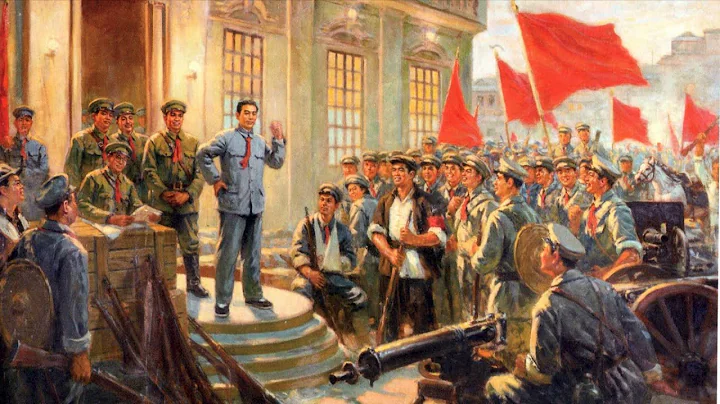
Faith - Chapter 50: The east is red, the sun rises, China has Mao Zedong

Northern Shaanxi folk song "The East is Red" Li Youyuan words
#Look at China - Hiking and cycling 50,000 miles# Six hundred million years ago, The Taihang Mountains area is a vast ocean. After frequent crustal activities, the ground rose and fell, and the seawater advanced and retreated. When the sea retreated, there were widespread swamps and dense forests. Later, the Himalayan movement that occurred in the Cenozoic era caused the Taihang Mountains to strongly uplift, while the North China Ping principle in front of the mountains relatively sank. After millions of years of hard work, the Taihang Mountains were finally created.
Yangquan City, Shanxi Province is located on the west side of the middle section of the Taihang Mountains. It is surrounded by mountains and rivers and is known as the "Hometown of Coal and Iron". In the summer and autumn of 1940, the "Monument to the Hundred Regiments War" launched by the Eighth Route Army stood on Mount Shinao Mountain.
Memorial Hall of the Hundred Regiments War - Mount Shinao, Yangquan City, Shanxi Province (1,100 meters above sea level)
Memorial Hall of the Hundred Regiments War
" Hundred Regiments War " is 194 In the summer and autumn of 2000, Japanese imperialism took advantage of the German fascist army to advance rapidly in Western Europe and Northern Europe. The strategic deployment of the United States had not yet been completed, and Britain was unable to look eastward. It actively prepared to implement the "southern advance" policy and seize the colonies of Britain, the United States, France, the Netherlands and other countries in Southeast Asia and the Western Pacific. Therefore, in China The battlefield intensified political inducement activities to induce the Kuomintang to surrender, and at the same time continued to attack the anti-Japanese base areas with the main force, especially in North China, they stepped up the implementation of the 1940 "Supreme Construction Plan" and the " cage policy" with "railways as pillars, highways as chains, and bunkers as locks" in an attempt to destroy the anti-Japanese base areas in North China. land, consolidate its occupied areas, and make China the rear base for its "southern advance"; in order to smash the "cage policy" of the Japanese imperialists, strive for a more favorable development of the war situation in North China, influence the situation of the war of resistance across the country, and overcome the danger of the Kuomintang's compromise and surrender, the Eighth Route Army headquarters is determined to launch a large-scale offensive campaign against the communication lines and strongholds occupied by the Japanese in North China.
World Anti-Fascist Propaganda Poster
On July 22, 1940, the Eighth Route Army Commander-in-Chief Zhu De, Deputy Commander-in-Chief Peng Dehuai, and Deputy Chief of Staff Zuo Quan issued the "Campaign Preparatory Order", stipulating that no less than 22 regiments of troops should be used to massively attack the Zhengtai Railway. At the same time, it is required to deploy appropriate forces to carry out extensive attacks on the Tongpu, Pinghan, Jinpu, Bac Ninh, Deshi Railways and some major highway lines in North China to cooperate with the attack on the Zhengtai Railway. On August 8, Zhu De, Peng Dehuai, and Zuo Quan issued the "Campaign Operation Order", which stipulated that the Shanxi-Chahar-Hebei Military Region should attack the Shijiazhuang to Yangquan (exclusive) section of the Zhengtai Railway; the 129th Division should attack the Zhengtai Railway. From Yangquan (inclusive) to Yuci section; the 120th Division attacked the Tongpu Railway and Fen (Yang) Li (Shi) Highway north of Xinxian County, and placed heavy troops in the north and south areas of Yangqu to block the Japanese reinforcements from the Zhengtai Railway. The Eighth Route Army headquarters required all departments to take the opportunity to regain some strongholds occupied by the Japanese while breaking the communication lines.
The Hundred Regiments Campaign launched by the Eighth Route Army
In these areas and communication lines, there were stationed all 3 Japanese divisions, 2 regiments of 2 divisions, 5 independent mixed brigades all, 2 brigades each of 4 independent mixed brigades, and 2 brigades of 1 cavalry brigade, totaling more than 200,000 people, 150 aircraft and 150,000 puppet troops. According to the original regulations of the Eighth Route Army Headquarters, the number of participating troops in the war was no less than 22 regiments. However, after the campaign was launched, because the majority of commanders and fighters of the Eighth Route Army and the people in the anti-Japanese base areas hated the Japanese army's "cage policy", they were very enthusiastic about participating in the offensive. Therefore, various ministries invested a large amount of troops. The Shanxi-Chahar-Hebei Military Region invested 39 regiments; The 129th Division (including the 1st and 3rd Columns of the Death Squadron , etc.) has 46 regiments; the 120th Division (including the 2nd and 4th Column of the Death Squadron, etc.) has 20 regiments, with a total of 105 regiments of more than 200,000 people, and many local guerrillas and militiamen participating in the battle. When Peng Dehuai and Zuo Quan listened to the situation report in the war room of the Eighth Route Army headquarters and learned that the actual number of troops participating in the battle had reached 105 regiments, Zuo Quan said excitedly: "Okay! This is a hundred-regiment battle.Peng Dehuai continued: "No matter how many regiments there are, let's just call this battle the Hundred Regiments Battle!" "
Statistics of the results of the Hundred Regiment War
The Hundred Regiment War lasted for three and a half months from August 20 to December 5, 1940. The Eighth Route Army and the anti-Japanese soldiers and civilians behind enemy lines conducted more than 1,800 large and small battles. More than 20,000 Japanese troops and more than 5,000 puppet troops were killed and injured; more than 280 Japanese troops and more than 18,000 puppet troops were captured; more than 900 miles of railways and 3,000 miles of highways were destroyed; 258 bridges and stations were destroyed; and a large number of weapons, equipment and military supplies were seized. Judging from the number of enemy (Japanese troops) destroyed, the Eighth Route Army initiated the campaign alone. The results of the Hundred Regiments War were no less than the 1939 winter offensive against Japan launched by Chiang Kai-shek's 71 divisions in ten theaters approved by the country. If the number of annihilations of puppet troops is included, the Eighth Route Army's results were even higher than the number of enemies annihilated by the entire National Army during the winter offensive. The Hundred Regiment War enhanced the reputation and political status of the Eighth Route Army in resisting Japan behind enemy lines, boosted the confidence of the people across the country in striving for victory in the War of Resistance, and strategically provided strong support to the Kuomintang army in blocking the Japanese attack on the frontal battlefield.
【Diary on the road】019-2-20 20:21Tomorrow, I will cross the Taihang Mountains from Shecheng Town along the Handan (Dan) Chang (Zhi) Highway. On the way, I will pass the famous Shentouling Ambush and Xiangtangpu Ambush Battle sites during the Anti-Japanese War.
Monument of Changhan Avenue Battle Battle
Xiangtangpu Ambush Battle took place in In late March 1938, the 129th Division of the Eighth Route Army found out that the Japanese troops were transporting frequently on the Handan (Dan) Chang (Zhi) Highway. The security along the route was strengthened, and an additional stronghold was set up in Dongyangguan, with more than 150 people stationed there. In order to further destroy the Japanese army's transportation lines and attack the enemies attacking southeast Shanxi, the 129th Division of the Eighth Route Army decided to use three main regiments to An ambush was set up in the Xiangtangpu area to annihilate the Japanese transport convoy and cut off the enemy's transportation lines. The specific battle was directed by Xu Xiangqian (Xu Xiangqian commanded hundreds of such ambush battles in just over a year during the Anti-Japanese War).
Xiangtangpu is a small village on the Handan-Changchun Highway. The mountains on the south side of the town are steep; the north side of the town is also high, but the mountains are gentler. There is a long canyon between the two mountains. The Japanese army built the canyon along the mountain and along the valley. A simple road was built. Xiangtangpu is just the throat from Hebei to Shanxi and over the Taihang Mountains. Choosing to ambush the Japanese army here will not only help the Eighth Route Army launch a battle; it can also seize the enemy's vital points and deal a heavy blow to them.
Xiangtangpu
Pre-war preparations for the Xiangtangpu ambush battle: Since most of the Eighth Route Army commanders and fighters have never seen a car, they are not familiar with cars. The performance and characteristics of the car were not understood, so each unit took the time to conduct pre-war mobilization and education for the participating officers and soldiers, explaining the car's characteristics and destruction methods. At midnight on the 30th, each unit secretly entered the ambush area and prepared for battle.
At 8 a.m., the observation station reported: Two companies of automobile squadrons belonging to the Yamada Baggage Troops drove from Dongyangguan to our ambush area, with a total of 180 vehicles and more than 170 people's cover. Guard troops. At about 9 o'clock, the Japanese convoy completely entered the ambush area. Under the unified command, the ambush troops opened fire together, and our soldiers rushed down the road and started hand-to-hand combat with the enemy. After two hours of fierce fighting, all the Japanese troops were wiped out, except for more than 30 Japanese troops who managed to escape due to the small number and large gaps in our Nanshan troops.
When the battle for Xiangtangpu was raging, the enemies of Licheng and Dongyangguan dispatched There were more than 3,400 infantry and cavalrymen, and the enemy from Shexian County dispatched more than 400 men and six vehicles in an attempt to relieve the enemy in Xiangtangpu, but they were all defeated by our troops responsible for security duties. At 16:00, the Japanese army dispatched 12 aircraft and bombed the sky over Xiangtangpu continuously for 2 hours. By this time, the troops of the 129th Division of the Eighth Route Army had quickly cleared the battlefield and withdrew five kilometers away from the battlefield to rest in hiding. The enemy aircraft returned without success. Xiangtangpu ambush battle, the Eighth Route Army The 129th Division annihilated more than 400 Japanese troops, destroyed more than 180 vehicles, and seized more than 130 firearms, 34 mortars, and a large amount of military supplies. —— Handan · Shecheng Town
Shentou Ridge
Arrive at the battlefield site of the Shentou Ridge ambush battle of the 129th Division of the Eighth Route Army.The Shentouling ambush was an ambush conducted by the 129th Division of the Eighth Route Army on March 16, 1938, on the Hand (Dan) and Chang (Zhi) highways between Lucheng County and She County, Shanxi Province. This battle annihilated one unit each of the 16th Division, 108th Division, and 14th Division of the Japanese invaders, totaling more than 1,500 people (the Japanese army reported losses of 407 people missing). It dealt a heavy blow to the arrogance of the Japanese army invading the southeastern Shanxi region, destroyed the enemy's transportation lines, effectively coordinated the combat operations of our 115th Division in the western Shanxi area, and restrained the Japanese army's attacks on the south and west banks of the Yellow River. ——Handan · Shentou Township
#Looking at China—50,000 miles of hiking and cycling# is located in the hilly mountainous area 70 miles east of in Wuxiang County. During the Anti-Japanese War, this was the location of the Eighth Route Army Headquarters. The older generation of revolutionaries such as Zhu De, Peng Dehuai, Zuo Quan, Deng Xiaoping, Liu Bocheng, Yang Shangkun, Lu Dingyi, and Yang Lisan once fought against the Japanese invaders here... Changle Village in Wuxiang County is where the Eighth Route Army smashed the Japanese Nine Route "Encirclement and Suppression" and won the Changle victory; Panlong Town is the seat of the Eighth Route Army headquarters, Wangjiayu Village is the office of Zhu De, Peng Dehuai and others. The anti-Japanese war was burning across the Taihang Mountains, and the story of the Eighth Route Army's resistance was widely circulated. ——Changzhi·Shibei Township
#Looking at China—50,000 miles of hiking and biking# I rode to Niangziguan today on International Women’s Day, so I happened to take a photo of women’s day coming to Niangziguan to celebrate the festival.
Women's Day in front of Niangziguan
The tourist guide said that Niangziguan experienced two histories of fighting against imperialist aggression: During the Eight-Nation Allied Forces' invasion of China, the German commander Waldersee organized forty-six "punitive parties" (33 of which were German troops). According to the records of the believers at the time, "as far south as Zhengding , Zhangjiakou in the north, and Shanhaiguan in the east are all within the circle of influence of the coalition forces, and have been patrolled and traveled all over. Every boxer's nest, whether it was a government office or a residential building, was burned down, and often the whole village was robbed. "During the battle to defend Zhangjiakou, Da Awu, the leader of the Boxer Rebellion, led his troops to set up an ambush at Yantong Mountain in the north of the city and killed the German commander Colonel York, which led to the bankruptcy of the German army's plan to rob Minling Tomb. But the fiercest battle took place on the front line of Niangziguan, Shanxi. Generals Liu Guangcai and Li Yongqin of the Qing army commanded the Zhongyi Army and the Wugong and Jinwei battalions. From October 26, Guangxu to February 27, they continuously defeated tens of thousands of German troops and multiple attacks by the French army, and annihilated part of them.
During the Anti-Japanese War, Niangziguan once again played a defensive role. In October 1937, the Japanese army was eager to invade Shanxi from Pingxingguan and occupy Taiyuan, but was blocked by the Eighth Route Army and failed. Later, the Japanese army invaded westward along the Zhengtai Railway and made Niangziguan a temporary target. At that time, the Chinese army used tens of thousands of troops, including the Eighth Route Army, to set up defenses at Niangziguan to prevent the enemy from advancing westward.
Pingxingguan and Yanmenguan battles
The Eighth Route Army night attack on Yangmingbao
The Eighth Route Army killed Japanese Lieutenant General Norihide Abe
In August 1940, Niangziguan became a battlefield during the Hundred Regiments Battle of the Eighth Route Army. At that time, the Shanxi-Chahar-Hebei Military Region sent 10 regiments to break through the Zhengtai Line occupied by the Japanese army. The focus of the destruction was the section from Niangziguan to Pingding. On the night of August 20, the main force of the Eighth Route Army once invaded Niangzi Pass.
Go all the way down from Niangziguan, leaving Shanxi Province and entering Jingxing County, Hebei Province. Jingxing, this is where Commander Nie Rongzhen of the Eighth Route Army launched the Hundred Regiment Campaign and rescued a Japanese girl. During the Hundred Regiments War in 1940, our soldiers rescued two Japanese little girls from the flames of war in the Wangshe Coal Mine in the east of Jingxing. The child is innocent. Nie Rongzhen saved the Japanese girl and met 40 years later, which makes the Japanese ashamed to this day...
Nie Rongzhen saved the Japanese girl
☆The Seventh National Congress of the Communist Party of China was held in Yan'an
The Communist Party of China held its Seventh National Congress in Yan'an from April 23 to June 11, 1945. A total of 755 delegates attended the Seventh National Congress, including 547 official delegates and 208 alternate delegates, representing the party's 1.21 million party members. They were divided into eight delegations: Central (including the military-directed system), Northwest, Shanxi-Suiyuan, Shanxi-Chahar-Hebei, Shanxi-Hebei-Luyu, Shandong, Central China and the Rear Area.The congress called on the entire party to carry forward the three major styles of work and lead the people across the country in striving to achieve the party's tasks. It is determined that Mao Zedong Thought, which is the unity of Marxism-Leninism and the practice of the Chinese revolution, will serve as the guideline for all work of the whole party.
The Seventh National Congress of the Communist Party of China in Yan'an - Photographed by Zou Yulin at the Yan'an Revolutionary Memorial Hall
Unite on Comrade Mao Zedong's military ideology to strive for the victory of the liberation of the Chinese people.
On July 26, 1945, the United States, Britain and China jointly issued the Potsdam Declaration, urging Japan to surrender unconditionally, otherwise it would give Japan a "final blow". Since the United States had successfully tested the atomic bomb at this time and the former President Roosevelt passed away on April 12, the new President Truman was not very interested in the Soviet Union's participation in the war, so he did not invite the Soviet Union for consultation or signature, which caused the Soviet Union to be quite dissatisfied. On August 6, 1945, in order to avoid a landing battle with heavy casualties and to take over the Japanese mainland before the Soviet Union, the US military dropped the first atomic bomb on Hiroshima, Japan, and dropped the second atomic bomb on Nagasaki three days later. The Soviet Red Army also declared war on Japan on August 8, 1945 in accordance with the Yalta Agreement, launched Operation August Storm, and dispatched troops to Northeast China on August 9, 1945.
The Soviet Red Army sent troops to the Northeast
At this time, the Japanese Kwantung Army had only 700,000 troops deployed in Northeast China and the Korean Peninsula. The Soviet Red Army deployed as many as 1.5 million troops on the battlefield in the Far East. The equipment of the two sides was also very different. The Soviet Red Army swept the Japanese Kwantung Army. At noon on August 15, 1945, Emperor Hirohito of Japan issued the "End of War Edict" via radio, announcing unconditional surrender. On September 2, 1945, Japanese Foreign Minister Aoi Shigemitsu officially signed the instrument of surrender on the USS Missouri.
Just before Japan announced its unconditional surrender, some people on the Chinese battlefield had already predicted that the end of the Anti-Japanese War was coming. On August 9, 1945, Mao Zedong published "The Last Battle against the Japanese Invaders": "On August 8, the Soviet government announced war against Japan, and the Chinese people warmly welcomed it. Due to this action of the Soviet Union, the war against Japan will be greatly shortened. The war against Japan is in its final stage, and the time for the final victory over the Japanese aggressors and all their lackeys has arrived. Under this situation, all the anti-Japanese forces of the Chinese people should launch a nationwide counterattack and cooperate closely and effectively with the Soviet Union and other parties. The Confederates fought.
The Eighth Route Army, the New Fourth Army and other people's armies should, under all possible conditions, carry out extensive attacks against all invaders and their lackeys who are unwilling to surrender, annihilate the power of these enemies, seize their weapons and assets, violently expand the liberated areas and reduce the occupied areas. We must freely organize armed work teams, with hundreds and thousands of teams going deep behind enemy lines, organizing the people, breaking the enemy's lines of communication, and cooperating with the regular army in operations. We must let go and launch the occupied area The millions of people immediately organized an underground army to prepare for an armed uprising, cooperating with the army attacking from the outside and destroying the enemy. Attention should still be paid to the consolidation work in the liberated areas.
This winter and next spring, we should universally implement rent and interest reduction among the existing 10 million people and the people in all newly liberated areas, develop production, organize the people's political power and the people's armed forces, strengthen the militia work, strengthen the discipline of the army, adhere to the united front of the people from all walks of life, and prevent the waste of people. Strength and material resources. All of this is to strengthen our army's offensive against the enemy. People across the country must pay attention to preventing the danger of civil war and and strive to promote the establishment of a democratic coalition government. A new stage of China's national liberation war has arrived, and the people across the country should strengthen unity and fight for final victory. "
China's War of Resistance Against Japan has entered the stage of a comprehensive counterattack, and both the Kuomintang and the Communist Party are bound to devote themselves to the responsibility of regaining the country's territory. With the help of U.S. military air and sea transportation, the Kuomintang quickly occupied major cities and accepted Japan's surrender . The Communist army took over long-established small and medium-sized cities and rural areas, and regained Zhangjiakou. The Eighth Route Army and the New Fourth Army controlled a large number of railway trunk lines due to the long-term resistance behind enemy lines.
Passing by the former site of the Eighth Route Army Headquarters Kitamura
From August 15, 1945, when Emperor Hirohito announced his unconditional surrender to the outbreak of the all-out civil war between the Kuomintang and the Communist Party in June 1946, the leader of the Chinese Kuomintang, Chiang Kai-shek, and the leader of the Communist Party of China, Mao Zedong, had a historic handshake and signed the " Double Ten Agreement". However, faced with the fact that only one sun can appear in the sky in China, a poor farmer named Li Youyuan in northern Shaanxi sang the voice of the people: "The east is red, the sun is rising, and China has a Mao Zedong. He seeks happiness for the people, (hello) He is the great savior of the people."
People's Leader Mao Zedong
The interests of the masses are above all else - Mao Zedong
However, on the evening of March 18, 1947, Mao Zedong, the great savior of the people, reluctantly bid farewell to Yan'an, where he had lived for ten years, and began his journey to northern Shaanxi amid the clearly audible sound of gunfire as the Kuomintang troops attacked Yan'an. Before leaving, Mao Zedong said to the leading cadres of the Northwest Field Corps who came to see him off: "Our army's war is not about gains and losses in a city or a place, but in annihilating the enemy's effective strength. If people are saved and land is lost, both people and land will be saved; if land is lost and people are lost, both people and land will be lost." "We must trade one Yan'an for the whole of China." On the morning of March 19, the Northwest Field Corps took the initiative to abandon Yan'an. In the afternoon of the same day, the Kuomintang army Hu Zongnan entered Yan'an and occupied the empty city of Yan'an.
evacuated Yan'an and moved to northern Shaanxi