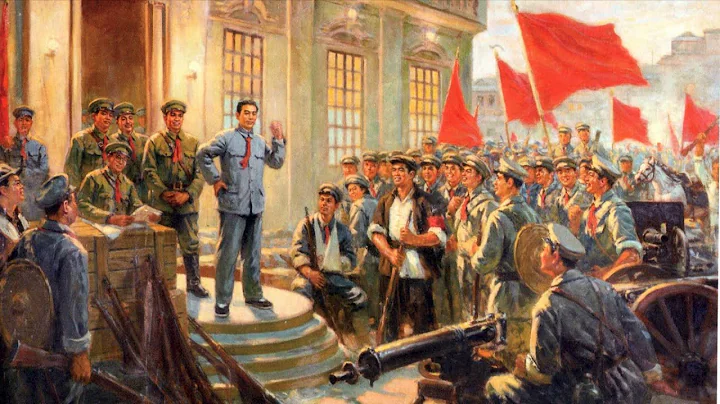
In the historical knowledge we have accepted, the uprising led by Chen Sheng and Wu Guang is called "the first large-scale peasant uprising in Chinese history." They rose up and ignited the people's anger against Qin. They immediately gathered in response and finally toppled the "edifice" of the Qin Dynasty.
They were the first heroes to carry out the anti-Qin banner. As for their identities, they were naturally poor farmers at the bottom of the Qin Dynasty. The reason lies in the two sentences written by Sima Qian in "Historical Records": Chen She tried to farm with servants when he was young, and also expressed his self-comfort and sadness of "I am rich and noble, and I will never forget each other." The second is "In July of the first year of the second year, he was relegated to Yuyang from the left, and 900 people settled in Daze Township. Chen Sheng and Wu Guang all took over. "

In the Qin Dynasty, poor people lived in on the left and on the right of Lu. In ancient times, there was a saying that "the rich are on the right and the poor and weak are on the left." According to " "Historical Records" records that Chen Sheng and Wu Guang were appointed as "tun chief". This term representing Chen Sheng and Wu Guang's status is very important for us to infer whether they were poor farmers.
"Zhengyun" said: "The troops were sent to guard the village. ""Chen Sheng's Biography" Note: "A place where people gather is called a village, and it is long and handsome. "That is to say, the chief or commander-in-chief of a village branch is a junior officer in the Qin Dynasty army. He is a fifth-level nobleman among the twenty-level knighthoods of the Qin Dynasty. His salary is 200 dan, and he is the second-largest military leader after the county captain. From this point of view, this village chief is by no means an ordinary poor peasant. The people can serve. In the Qin Dynasty, officials and officials must have titles. Grassroots officials were appointed by powerful commanders and were not randomly selected from the poor people in Luzuo. Ordinary poor people were not qualified to hold any official positions. The commander of the village means that they are either local powerful people or people with noble titles.
Some subtleties in "Historical Records" also reveal the huge identity difference between Chen Sheng, Wu Guang and ordinary farmers. Before the uprising, Chen Sheng's first sentence was: "When it rains, I am waiting..." The word "公" is a humble word for himself in ancient Chinese, expressing respect for others, while the word "waiting" indicates that there are more people. At the same time, it also expresses It is clear that the identities of Chen Sheng and his interlocutor are fundamentally different. Next, the meaning of the word " Ji " in " Ji Di Ling Wu Zhan..." should be similar to the commonly used " Ji Ji " and " Ji Ling" today, which means to give in; and the word "Di" is a humble address to oneself in front of everyone, which shows that Chen Sheng's identity is different from that of the farmers guarding the border. The complete meaning of this passage should be: "Everyone encounters heavy rain and has missed the deadline to guard the border. According to the law, all of you must be beheaded. Even if I, brother, "Ling Wu Zhan, your future is also very miserable, because sixty-seven out of ten people who died guarding the border..." The word "Ling" in "Ji Di Ling Wu Zhan" cannot be said without a certain degree of power, let alone "Ling Wu Zhan".
From this, we can sort out their life trajectories: they were born as common people in the city, had a title and a name, and had a special background. They controlled the fate of nine hundred farmers guarding the border. They were by no means as simple as poor farmers with no land, no house, and no status.
.