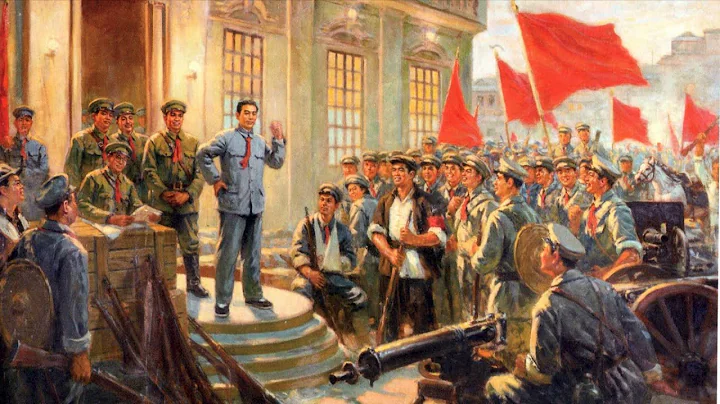
On July 2, 1959, our party held an enlarged meeting of the Political Bureau in Lushan. During the break, General Huang Kecheng talked with Chairman Mao about the tragic Siping Defense War in Northeast China 13 years ago.

Huang Kecheng
"I decided to fight the Siping Defense War." Before Huang Kecheng could finish speaking, Chairman Mao interrupted him.
When Chairman Mao said this, Huang Kecheng not only did not stop there, but also said: "It's your decision, and it is wrong." , which caused the conversation between the Chairman and the general to end unhappily.
So, why did Huang Kecheng think that the Siping Defense War was wrong? Why did Chairman Mao fight and flatten ? What impact will the defeat of Siping have on our army?
After Japan surrendered in 1945, our country ushered in a rare period of peace. There was no more war, and all parts of the country were in a happy atmosphere. However, when most people were still in While they were enjoying themselves, more than 24,000 people from the Eighth Route Army's Hebei Reliao Military Region were quietly leaving the customs through the nine gates west of Shanhaiguan. At the same time, a large number of Kuomintang troops, with the assistance of US warships, rushed from Qinhuangdao to Shanhaiguan.
It is not accidental that many forces flocked to the same place at the same time, because Chairman Mao and Chiang Kai-shek both realized that occupying this strategically important piece of territory in the Northeast would bring many unexpected gains to future revolutionary work.
Chiang Kai-shek and Zhang Xueliang
Chinese people all know that as early as the Republic of China, Northeast China was already the most developed heavy industrial city in the country. It is rich in mineral resources, and the black soil is even more prosperous. Producing grain, so after Zhang Zuolin occupied the Northeast, the industrial system of the three northeastern provinces ranked first in the country, and his Northeastern Army became the most complete warlord force with land, sea and air weapons at that time.
It is precisely because the Northeast has many unique advantages that Chairman Mao and Chiang Kai-shek both set their sights here after the Soviet troops withdrew from the Northeast. The competition between the two forces eventually caused the air in this land to suddenly become tense.
Chiang Kai-shek sent troops into the Northeast
In fact, as early as the end of the Anti-Japanese War, Chairman Mao proposed the strategic concept of conquering the Northeast. At that time, Chairman Mao sent 100,000 troops and 20,000 cadres to the Northeast. Compared with the Kuomintang army in the southwest, it was easier for our army to rush to the Northeast to accept the Japanese surrender. Finally, under Chairman Mao's deployment, within just a few months, the People's Liberation Army was spread throughout the three northeastern provinces, and the number once reached 270,000.
However, just as our army was intensively establishing effective control over the Northeast, Chiang Kai-shek also began to mobilize troops and generals. In order to compete for the Northeast, Chiang Kai-shek first dispatched the 13th Army with full U.S. equipment and the 52nd Army with semi-U.S. equipment, and then added Sun Liren's New First Army, Chen Mingren's 71st Army, Zeng Zesheng's 60th Army, and Lu Junquan's 93rd Army sent troops to the Northeast. The dispatch of so many regular troops in a row shows that Chiang Kai-shek is bound to win the Northeast.
In March 1946, when the Soviet army had just withdrawn from the Northeast, the Kuomintang troops quickly dispatched, preparing to occupy strategic points along the railway while the Soviet army was withdrawing. Among these strategic points, Siping was a vital transportation hub city. Occupying Siping meant that it would be easier to enter southern Manchuria, western Manchuria and northern Manchuria..
However, Chiang Kai-shek did not expect that Huang Kecheng's four brigades and Deng Hua's Liaoxi Baoyi Brigade had captured Siping first. At this time, the Kuomintang army wanted to pass through Siping and go north to Changchun, Harbin and other places. Big cities are no longer so easy. For Chiang Kai-shek, this is intolerable. After learning that Siping was occupied by our army, Chiang Kai-shek roared frequently. He realized that if he wanted to monopolize the Northeast, Siping must be captured first. A battle in Siping was inevitable.
Chiang Kai-shek
In fact, Chairman Mao had already expected that Chiang Kai-shek would not give up easily. Therefore, after occupying Siping, Chairman Mao immediately telegraphed the Northeast Bureau to "be prepared to transfer the main force of South Manchuria to Siping Street and Changchun in time, and work with Huang, Li and Zhou Baozhong to fight for the defense of Northern Manchuria."
Chairman Mao was very determined to defend Siping. In addition to letting Lin Biao personally command this battle, Chairman Mao also gathered three brigades of Huang Kecheng's 3rd Division, Liang Xingchu's Shandong 1st Division, and Yang Guofu's 7th Division's two brigades. At that time, the number of troops deployed in Siping reached more than 80,000.
Schematic diagram of the Siping Defense War
The reason why Siping was so valued was because at the negotiation table in Chongqing at that time, Chairman Mao and Chiang Kai-shek were engaged in a war without gunpowder. Chairman Mao hoped that the north of Changchun would belong to our army and the south of Changchun would belong to Chiang Kai-shek. However, Chiang Kai-shek always demanded exclusive control of the Northeast and would not give in.
Therefore, Chairman Mao's purpose of clinging to Siping was very clear, which was to use fighting to promote talks. If he wanted to win at the negotiating table, he must first win on the battlefield. In the end, Siping, a small city with an area of 10,300 square kilometers, became Chairman Mao's important bargaining chip for the future of our army.
On April 18, 1946, the Siping Defense War officially kicked off. As soon as the battle started, the Kuomintang army relied on its firepower advantage to launch a wave of strong attacks. Its aircraft, artillery and tanks rushed towards Siping non-stop. However, although the enemy's firepower was powerful, our army was also a veteran who had been tempered by many years of war. In the face of the enemy's fierce impact, our army always stood firm. No soldier retreated, firmly blocking the enemy outside Siping City.
On the ninth day after the Siping Defense Battle started, an urgent telegram from Chairman Mao was sent to Siping. In the telegram, Chairman Mao told Lin Biao:
The Siping defenders are very brave. I hope to be commended by an order. Please consider adding some defenders, such as one or two regiments, to transform Siping Street into Madrid.
"Turn Siping Street into Madrid", a few simple words can show Chairman Mao's attitude towards Siping at that time, which is to stick to the end. Lin Biao understood this and immediately Organize troops to strengthen defense. However, because our army was engaged in guerrilla warfare all year round at that time, it lacked experience in conventional urban assault battles. In addition, it was at a disadvantage in terms of weapons and equipment, and its logistics supplies could not keep up. The longer the fight lasted, the more difficult it would be for our army.
At the same time, Du Yuming, the top military commander in the Northeast of the Kuomintang army, was also dispatching troops. In just a few days, Du Yuming assembled ten more divisions to launch a strong attack on Siping. At the same time, he asked Liao Yaoxiang the New Sixth Army to launch an attack on Benxi to solve his worries.
At that time, the three main regiments of the Fourth Column of South Manchuria led by Xiao Hua were stationed in Benxi. Facing the New Sixth Army, which had an advantage in strength and weapons and equipment, the soldiers of the three main regiments fought bloody battles, but were eventually defeated because they were outnumbered. In less than two days, Benxi fell, and Xiao Hua could only lead the remaining troops to evacuate.
Lin Biao deployed the battle
html On May 14, Liao Yaoxiang’s New Sixth Army, which had ended the Benxi battle, marched to Siping and began to assist Du Yuming in attacking Siping. For Lin Biao, He said that the war situation was very unfavorable, and just a few days ago, the Kuomintang air force blew up the weapons and ammunition transported by our army to the Meihekou headquarters. At this time, there was a strong enemy siege in front and no supply support in the rear. What was left to Lin Biao was an insurmountable chasm.The situation was critical. Lin Biao immediately sent a telegram to Chairman Mao in Chongqing, explaining the difficulties of the current situation and stating that if we continue to fight, our army will be in an extremely passive situation. However, after carefully weighing the difficulties facing Siping, Chairman Mao finally replied:
The Northeast War has attracted attention at home and abroad. Chiang Kai-shek has rejected the armistice plan agreed by Marshall, the Democratic League and our party, and insisted on fighting to Changchun.Therefore, we must persist in fighting in Siping and Benxi, beating the stubborn troops in the two places to exhaustion, consuming their strength, frustration and vigor, so that the troops, weapons and ammunition mobilized in 6 months will be exhausted to the maximum, and there will be no time to replenish them. And because I have obtained Chang and Kazakhstan's troops and supplies, I can replenish them continuously, and then I can seek peace that is beneficial to me.
Obviously, even if this battle is full of difficulties, for the sake of the overall future, Chairman Mao still believes that Siping should be adhered to. Only in this way can our army gain sufficient initiative under unfavorable circumstances.
After the fall of Benxi, the Kuomintang army's offensive became more fierce. Liao Yaoxiang's New Sixth Army and Chen Mingren's 71st Army began to move north after ending their respective wars. For a time, Siping was almost completely surrounded, and Siping itself was a plain with no danger to defend. If you want to defend Siping, there is no other way except relying on the bravery of the soldiers.
It was precisely because this style of fighting was too costly that many key combatants who had survived the Anti-Japanese War died heroically in this battle. Huang Kecheng was so worried that he kept sending telegrams to Lin Biao, saying that the enemy's firepower was too strong and it was not suitable to fight again at this time. Changchun should be given up to consolidate the rear area in order to fight again in the future.
However, Huang Kecheng's suggestion never received a reply from Lin Biao, because Lin Biao was also worried at that time. As a battlefield commander, he knew very well that the war could not be fought like this, but Siping was related to the overall situation. If the Siping Defense War could last until the day of negotiation, then half of the Northeast would belong to our party. The longer the Siping Defense War lasts, the more beneficial it is to our party.
Since May, Du Yuming has stepped up his attack on Siping. The casualties of the Northeastern Democratic Coalition have also continued to expand. As the fighting became more and more intense, the defensive positions of the Northeastern Democratic Coalition in other directions were successively broken through, and even Tazishan, the commanding height of the Siping defense line, was surrounded. Although the Northeastern Democratic Coalition resisted tenaciously and fought bloody battles with the enemy on Tazishan, news of the fall of Tazishan finally came.
Du Yuming
The fall of Tazishan meant that Siping could no longer hold on. Faced with such a critical situation, Lin Biao immediately telegraphed Chairman Mao and reported to Chairman Mao that "the Siping front line has been breached and requested to retreat."
Due to the emergency of the war, Lin Biao ordered the troops to withdraw from Siping that night without waiting for Chairman Mao's call. With Lin Biao's withdrawal, the Siping Defense War also came to an end. Although the battle only lasted for more than a month, both sides suffered huge losses. Our army had annihilated a total of more than 10,000 enemy troops, but its own losses amounted to more than 8,000. When the troops withdrew from Siping, they were seriously injured and had run out of ammunition and food.
It was precisely because the battle was so brutal and the battle failed to defend Siping after paying such a price that Huang Kecheng, who had always loved soldiers, felt that Chairman Mao was ill-advised in launching the Siping Defense War, because from the perspective of a soldier, the Siping Defense War was indeed unwise and too many fighting backbones were sacrificed, which was irreversible.
But from an overall perspective, Chairman Mao's decision is undoubtedly correct. Although our army lost troops and generals in this battle, it secured extremely favorable development conditions for our party at the negotiation table. When Chiang Kai-shek placed the main force in Siping, our army successfully liberated Changchun, Harbin, Qiqihar, and created favorable conditions for our army's future base construction in the Northeast.
At the same time, after the Siping Defense Battle, Chiang Kai-shek's troops were severely weakened. Although they finally occupied Siping, they were unable to advance northward and found it difficult to cross the Songhua River. Therefore, although the Siping Defense Battle was not tactically brilliant, it was strategically a must-fight.