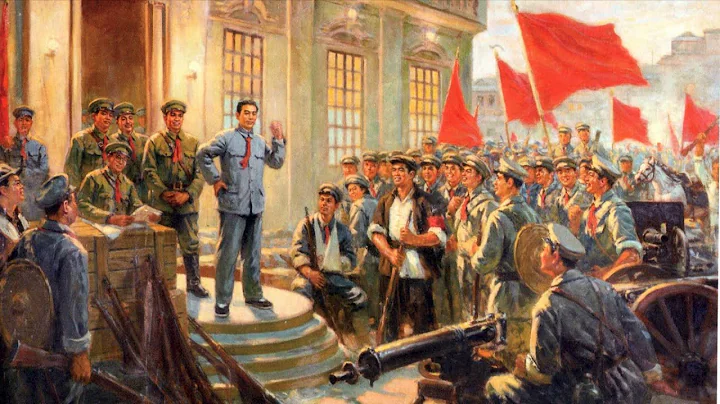
Marshal He Long is from Sangzhi, Hunan. He was born in 1896. Due to his poor family, he was forced to drop out of school after only five years of studying in a private school. Later, he made a revolution with two kitchen knives, and formed a team, and participated in the National Protection War, the Law War and the Northern Expedition War, and was promoted to the commander of the 20th Army of the National Revolutionary Army. In 1927, He Long led his troops to participate in the Nanchang Uprising and served as the commander-in-chief of the uprising. On the way to the south, he joined the Communist Party under the introduction of Zhou Yiqun and Tan Pingshan.

1928, He Long returned from Shanghai to western Hunan and Hubei to create a base. Under his leadership, the Red Army defeated the strong with weak and successively established the revolutionary base in western Hunan and Hubei and the revolutionary base in border areas of Hunan, Hubei, Sichuan and Guizhou. The enemy had no choice but to take He Long, so he raised a butcher knife to his family. His father, younger brother, eldest sister, second sister and fourth sister were killed by the enemy one after another. In order to carry out the revolution, He Long lost five close relatives. In the winter of 1935, Chiang Kai-shek mobilized heavy troops to launch a siege on the Red 26th Army. Due to the huge difference in the strength of the enemy and us, He Long, Ren Bishi and others led their troops to start the Long March 2.
In July 1936, He Long led his troops to meet with Red Fourth Front Army in Ganzi. Faced with Zhang Guotao's win over, he was unmoved. At the meeting, when Zhang Guotao was preparing to speak, He Long whispered to him: "Old Zhang, today we only talk about unity, don't talk about division, otherwise be careful of me shooting you with a black gun!" Due to the resolute struggle of He Long and others, Zhang Guotao's conspiracy to win over the Second Front Army failed. Shortly after the Long March arrived in northern Shaanxi, the Anti-Japanese War broke out in full swing. He Long served as the commander of the 120th Division of the Eighth Route Army and led his troops to the front line to fight against the Japanese and puppet troops.
Not long after, due to various reasons, his wife Jian Xianren went to the Soviet Union to study, and the relationship between the couple came to an end, which made He Long very painful. Before he met Jian Xianren, he had three marriages. The first wife was a child bride and died of illness after marrying He Long for 8 years. The second wife was a marriage arranged by her parents. After He Long joined the revolution, she also died of illness. In 1929, He Long met his third wife Jian Xianren, and the couple broke up after 11 years of ups and downs.
After breaking up with Jian Xianren, He Long felt very depressed. In addition, the war was tense at that time, so he had no time to consider personal issues. In late April 1939, He Long led his troops to fight fiercely with the Japanese invaders at the Qihui of Hejian. In order to stop the Eighth Route Army's offensive, the Japanese released poison gas. He Long, who was commanding from the front, was infected with poisonous gas, was dizzy and had difficulty breathing, but he still insisted on command, and eventually wiped out more than 700 Japanese invaders and seized a lot of military supplies. Shortly after the war, He Long returned to Yan'an for a meeting. After someone introduced him, he met his later wife Xue Ming.
Xue Ming is from Wen'an County, Hebei Province. He was born in 1916. Her father was a businessman and had a wealthy family. Therefore, Xue Ming received a relatively good education since he was a child. While studying in Tianjin, Xue Ming began to accept progressive ideas and thus embarked on the revolutionary path. In 1936, 20-year-old Xue Ming joined our party and served as an underground traffic officer, mainly responsible for the contact work of the Tianjin Student Union and the Women's Rescue Association. After the outbreak of the Anti-Japanese War, under the organization's appointment, Xue Ming led a propaganda team to the south to promote the anti-Japanese war, and worked in Shandong, Jiangsu and Jiangxi successively.
A year later, Xue Ming came to Yan'an, first studying at the Central Party School, and then working in the Organization Department of Yan'an County Party Committee. When He Long expressed his feelings to Xue Ming, Xue Ming refused on the grounds that he was busy with work and had no time to consider personal issues. He Long was not discouraged, but asked, "Then when are you going to consider personal issues?" Xue Ming thought for a while and said, "It will take at least three to five years!" She thought that He Long would give up when she said this, but He Long said without thinking, "I can wait for three to five years!"
At that time, He Long had a very famous reputation in Yan'an, and there were many young women who loved him. Therefore, when he told Xue Ming that he was willing to wait for her for three to five years, Xue Ming was very moved. She knew that He Long had true feelings for her and agreed to date. In August 1942, He Long and Xue Ming held a simple wedding, and there were endless people coming to congratulate him.After marriage, Xue Ming, as He Long's secretary, followed him in battle. In addition to taking care of his diet and daily life, he was also responsible for telegram transactions and drafting documents.
After the founding of New China, Xue Ming served as a member of the Standing Committee of the Women's Federation of Southwest Bureau and Director of the Propaganda Department of Beijing Municipal Party Committee. During the Cultural Revolution, Mr. He was persecuted, and Xue Ming stood firmly on his husband's side and gave him great spiritual support. In 1969, President He passed away, and Xue Ming was in great pain after receiving the bad news. It took her a long time to get out of her grief, and then she and her children depended on each other and went through difficult years. After the end of the Cultural Revolution, Xue Ming returned to work and served as the Procurator General of the General Staff Military Procuratorate. In 2011, Xue Ming died of illness at the age of 95. She and He Long had one son and two daughters. The son later became lieutenant general and the eldest daughter later became a major general.