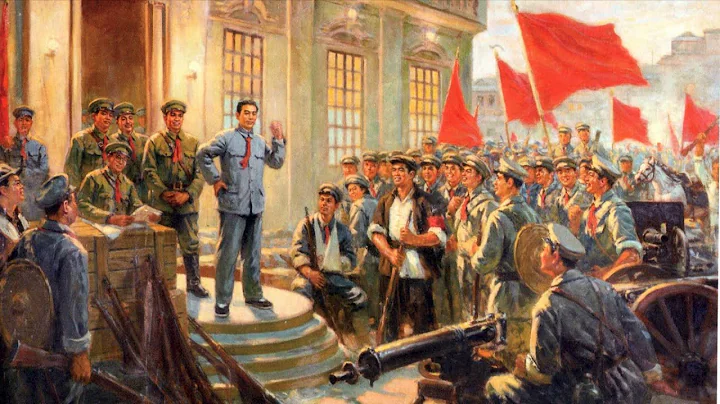
On April 23, 1945, the Central Committee of the Communist Party of China held the Seventh National Congress of the Party in the Yangjialing Grand Auditorium in Yan'an.
Seventh National Congress was held on the eve of the victory of the Anti-Japanese War. There were 755 representatives attending the Seventh National Congress, including 547 formal representatives and 208 alternate representatives, representing 1.21 million members of the entire Party. Among the seven representatives, the oldest is nearly 70 years old, and the youngest is only about 20 years old. When the seventh National Congress of
was held, it has been 18 years since the six Congresses held in Moscow . This 50-day conference was praised by Mao Zedong as "a victorious conference and a united conference". The conference determined the party's political line and wrote Mao Zedong Thought into the party constitution. At the same time, a new Central Committee and central leadership body were elected, laying a deep political, ideological and organizational foundation for the party to lead the people to win the victory of the War of Resistance Against Japan and the victory of the new democratic revolution in the country.

1,
There is an important agenda for the seventh National Congress, that is, to elect the Seventh Central Committee of the Party.
Before the election, the central government issued a list of candidates to each delegation.
is fully discussed by delegations: who should choose and who should not, and what standards and principles are used to conduct the election. The representatives discussed it very enthusiastically, especially on whether to choose comrades who have made mistakes, and there were relatively large differences.
In order to unify thinking and do a good job in the election of the Seventh National Congress, the Central Committee of the Communist Party of China held a special meeting on May 24, 1945.
At this special meeting, Mao Zedong made a report on the election policy and elaborated on many important principled issues of the election, allowing the representatives to unify their thoughts and ensure the normative, rational, fair and just nature of the elections of the seventh National Congress.
China Communist Party News Network once published a memorial article by former Minister of the Ministry of Coal Industry Gao Yangwen "The Mystery Behind the Scenes of the Communist Party of China".
As a representative who participated in the Seventh National Congress, Gao Yangwen listened to Mao Zedong’s report on the election policy with his own ears, and then participated in the vote counting work of the Central Committee of the Seventh National Congress as a vote counter. Therefore, he has an unforgettable memory of the process and progress of this election.
Gao Yangwen said in this reminiscence article that Mao Zedong emphasized to all representatives in his speech: comrades who make mistakes should not "push away with one palm", but should unite them.
He said: "What kind of people should we elect to enter the new Central Committee? We must elect those comrades who insisted on the correct line during the Agrarian Revolutionary War to enter the new Central Committee, and those who made mistakes at that time, and now those who have admitted their mistakes and corrected them will enter the new Central Committee. It is not good to elect none of the comrades who made mistakes, which is not conducive to unity, and it is not good to elect all of them."
After Mao Zedong finished this report, the central government did not immediately hold a formal election for caution, but instead set up a preliminary election before the formal election. The central government means to pass the pre-election to see what aspects need to be done to lay a solid foundation for the formal election. The pre-selected result of
is indeed not as expected by Mao Zedong. Among those comrades who made mistakes at different times, only Zhang Wentian received more than half of the votes, while Wang Ming, , Bogu, Wang Jiaxiang and others had less than half of the votes. After the pre-selected results came out, Mao Zedong felt that in order for Wang Ming and others to pass the formal election, he had to do persuasion to the representatives.
Why did Mao Zedong care so much about whether Wang Ming, Bo Gu and others could be elected?
Mao Zedong always believed that the mistakes of comrades who made mistakes in the past were made under certain historical conditions. After rectification and the problem has been clarified, we should not pay too much attention to personal responsibility. Communists should learn to work with people who have different opinions, which is also Mao Zedong's consistent thought.
It is precisely because of this that Mao Zedong is very concerned about whether a person like Wang Ming can be elected. This also shows Mao Zedong's noble character of putting the interests of the Party first and unity first.
2.
Many of the seven representatives were victims of the "left" opportunistic line represented by Wang Ming, and they were also very clear about the huge losses caused to the revolution by Wang Ming's "left" line, so many representatives were extremely disgusted with Wang Ming, and they could even be said to be hated to the core, and no one wanted to vote for him.
In fact, Mao Zedong himself is also a victim of the "left" opportunistic line represented by Wang Ming.
Wang Ming is also known as Chen Shaoyu, from Jinzhai, Anhui. In the autumn of 1925, 21-year-old Wang Ming was sent to study at Sun Yat-sen University in Moscow by the organization, and was favored by the president Miff , and since then he began to rise to the top.
In January 1931, with the strong support of Miff, Wang Ming became a member of the Political Bureau of the Central Committee at the Fourth Plenary Session of the Sixth Central Committee of the Communist Party of China and grasped the real power of the Party.
Wang Ming believes that the only driving force of the Chinese revolution is the workers and peasants and lower classes petty bourgeoisie , and insists on the urban-centered theory, believing that the national revolutionary climax has arrived and an offensive line must be implemented nationwide.
1 In June 11931, Wang Ming went to the Soviet Union to serve as the head of the Communist Party of China's delegation to the Communist International. Before going to Suzhou, Wang Ming handed over the work of the central government to Bo Gu.
After Wang Ming went to the Soviet Union, Bo Gu and others continued to implement Wang Ming's "left" adventurous policy, which eventually led to the forced Central Red Army to Long March .
At the Zunyi Conference held in January 1935, Mao Zedong's correct line finally received the support of the vast majority of comrades in the party. Mao Zedong was also elected as a member of the Standing Committee of the Political Bureau of the Central Committee, becoming one of the members of the central leadership body, and gradually becoming the core of the central leadership.
3.
After the outbreak of the Anti-Japanese War, the Anti-Japanese National United Front was formed. Wang Ming was commissioned by Communist International to return to Yan'an in November 1937.
After Wang Ming returned to Yan'an, he regarded himself as an imperial envoy of the Communist International and demanded that the central government must obey his command.
In December 1937, Wang Ming made a report on "How to Continue the National War of Resistance and Fight for Victory of the War of Resistance" at the meeting of the Political Bureau of the Central Committee, and put forward many criticisms on the Party's policies and policies since the War of Resistance, many of which were targeted at Mao Zedong.
Due to long-term living abroad, Wang Ming did not have an in-depth understanding of the actual situation of the Chinese revolution. He disdained Mao Zedong's advocated guerrilla warfare , emphasized that the main form of struggle against the enemy was "mobile war", and even proposed the wrong idea of "fighting big wars and tough battles" with the Japanese army.
Fortunately, the comrades who attended the meeting consciously resisted his propositions, so they did not make his propositions come into a resolution.
According to Peng Dehuai's recollection, Wang Ming played the sign of the Communist International at the meeting, but the content of his speech completely ignored the fundamental issue of how the proletariat fights for leadership in the anti-Japanese national war.
So the line he proposed is a line that abandons the leadership of the Communist Party’s national united front against Japan and loses the proletarian stance and surrenderism. As one of the leaders attending this meeting, Peng Dehuai naturally would not agree with Wang Ming's proposal.
However, after this meeting, the central government decided that Wang Ming would serve as secretary of the Secretariat and also serve as secretary of the preparatory committee of the seven major universities. This also means that although Wang Ming made serious mistakes during the Agrarian Revolution, the Party Central Committee and Mao Zedong still ignored the past and arranged very high positions for him.
However, Wang Ming overestimated his position within the party, wanted to act arbitrarily, and overbear the central government and Mao Zedong. It was just that Mao Zedong did not immediately criticize Wang Ming for the sake of unity within the party.
In February 1938, at the Politburo meeting where the Central Political Bureau discussed the situation of the War of Resistance and its relations with the Kuomintang, Wang Ming denied the role of the guerrilla warfare led by the Communist Party of China and the anti-Japanese base area behind the enemy in the War of Resistance, and placed the hope of victory in the War of Resistance on the Kuomintang, and proposed that our party obey the unified leadership of the Kuomintang militarily, and would be unified in command, organized, unified in combat plans, and unified in combat actions.
Mao Zedong refuted Wang Ming's wrong view and pointed out the necessity of fighting for leadership of the united front: Chiang Kai-shek is afraid that we will grow and grow. We must be wary while cooperating with the Kuomintang and should maintain strategic independence and autonomy. But in order to maintain unity within the party, Mao Zedong still made some concessions at this meeting.
Seeing that Mao Zedong gave in to him everywhere, Wang Ming couldn't help but feel a little fluttered, thinking that at the upcoming Seventh National Congress, he would definitely be elected as the leader of the Party, and now he can exercise the power of the leader of the Party in advance.
On March 21, 1938, Wang Ming drafted and submitted the "Proposal of the Central Committee of the Communist Party of China to the Provisional National Congress of the Kuomintang" to the Central Committee of the Communist Party of China without the consent of the Central Committee. His unorganized and undisciplined behavior was of course severely criticized by the central government.
Wang Ming's words, deeds and style aroused Mao Zedong's deep worries. Mao Zedong knew in his heart that the reason why Wang Ming did not take the central government seriously was because Wang Ming thought he had returned with the instructions of Stalin and the Communist International. He was the imperial envoy who held the " Shangfang Sword " in his hand, and was supported by the Communist International behind it.
In order to avoid Wang Ming causing any further losses to the whole party, Mao Zedong tried his best to win comrades, and sent Ren Bishi to Moscow to report to the Communist International, so that the Communist International could accurately understand the reality of the Chinese revolution and support the correct policies and policies of the central government.
In April 1938, Ren Bishi submitted a written report on behalf of the Central Committee to the Communist International on behalf of the Central Committee on the Situation of the War of Resistance Against Japanese Aggression and the Work and Tasks of the Communist Party of China, and gave a detailed explanation of the domestic situation in China and the characteristics of the cooperation between the Kuomintang and the Communist Party of China. After listening to Ren Bishi's report, the Communist International believed that the CCP's political line was correct.
Before Ren Bishi returned to China, General Secretary of the Executive Committee of the Communist International General Secretary of the Communist International Dimitrov specifically told Ren Bishi: "The Communist International recognizes Comrade Mao Zedong as the leader produced in the actual struggle of the Chinese revolution. Please tell Wang Ming, don't fight!"
Dimitrov's statement represents that the Communist International officially recognized Mao Zedong's leadership position in the Communist Party of China. From then on, Wang Ming could no longer hold the "Shangfang Sword" of the Communist International.
4.
From September 29 to November 6, 1938, the expanded Sixth Plenary Session of the Sixth Central Committee of the Communist Party of China was held in Yan'an. The meeting firstly conveyed the important instructions of Dimitrov, General Secretary of the Communist International and the Communist International Executive Committee. This was undoubtedly a fatal blow to Wang Ming, who was trying to seize the main leadership of the central government.
At the Sixth Plenary Session of the 19th Central Committee, he affirmed Mao Zedong's leadership position in the whole party, criticized Wang Ming's wrong proposition of "everything is obedient to the united front", and decided to abolish the Yangtze River Bureau where Wang Ming served as secretary, and Wang Ming stayed in Yan'an and was appointed Minister of the Central United Front Work Department and Director of the Central Women's Movement Committee.
After failing to challenge Mao Zedong's status, Wang Ming turned to Mao Zedong's slanderous attitude.
On the surface, he admitted that Mao Zedong was the leader of the party, saying that Mao Zedong "better than any comrade in our party, Marxism-Leninism , is a great theorist, good at applying Marxism-Leninism flexibly to the practice of the Chinese revolution", but he still insists on his wrong views in his heart.
Mao Zedong has given Wang Ming many times the opportunity to recognize and correct his mistakes. In December 1940, Mao Zedong said at the Politburo meeting: "Summarizing past experiences is an education for those who make mistakes and those who have not made mistakes. Understanding past mistakes can prevent repeated mistakes from happening in the future."
But Wang Ming turned a blind eye and still wanted to launch new challenges to Mao Zedong.
1 In June 1941, in order to prevent Japan from cooperating with Germany to attack the Soviet Union, the Soviet Union asked the Eighth Route Army to launch an attack on the Japanese troops in the areas of Pei , Zhangjiakou , and Baotou .
Mao Zedong believed that the strength of the enemy and us was very different. If we attacked the Japanese army desperately, it would be unfavorable to the CCP or the Soviet Union." But the Soviet Union was dissatisfied with Mao Zedong's correct decision and sent a telegram to accuse the CCP.
Wang Ming thought the opportunity had come, so he attacked and criticized Mao Zedong. He didn't expect that the central government was full of comrades who supported Mao Zedong, and his challenge ended in failure.
5.
Mao Zedong once said: "The key crux of Wang Ming is that he thinks too little about his own affairs, but he is worried too much about other people's affairs." This evaluation can be said to be incisive and incisive.
Mao Zedong is 11 years older than Wang Ming. Although both came from peasant families, Mao Zedong's father was a hardworking and frugal farmer. Mao Zedong went to the fields to work since childhood and had the closest emotional connection with farmers. He knew the sufferings of farmers and was unfair about the farmers' experiences.
This is exactly this kind of experience that Wang Ming lacks. His father is a private school teacher. After Wang Ming officially entered the private school at the age of 7, he basically spent his youth in a private school far away from reality.
When Mao Zedong launched the Autumn Harvest Uprising and carried out an armed struggle, Wang Ming wrote an article at Sun Yat-sen University in Moscow to promote urban riots, believing that "the climax of the Chinese revolution is coming soon, and the total victory of the Soviet revolution in the whole of China" is about to be realized.
Wang Ming's "left-leaning adventure" caused huge losses to the Red Army, Wang Ming went from one extreme to another, proposing that the Communist Party should fully obey the leadership of the Kuomintang and change from "left-leaning" to "right-leaning".
, Mao Zedong had long seen Chiang Kai-shek's intentions, requiring the Communist Party to adhere to the principle of independence and autonomy and maintain a high level of class alertness towards the Kuomintang.
Facts have proved that Mao Zedong is a leader with a leader who should have far-sighted and visionary vision, while Wang Ming wears tinted glasses, sticks to his unchanging thinking, and follows the "vocal insect" that is led by the Communist International.
Before the seventh National Congress was held, Mao Zedong sent people to talk to Wang Ming and persuaded Wang Ming to reflect on his mistakes.
Wang Ming saw that Mao Zedong had determined his status in the whole party, he had to agree with Mao Zedong Thought and reviewed the "left" adventure-oriented mistakes he made during the Agrarian Revolution War. (But later, Wang Ming said in his book "Fifty Years of the Communist Party of China", that this review was forced and not what he really wanted.) When the Seventh National Congress of
was held, although Wang Ming was ill, he was still carried into the venue on a stretcher and attended the opening ceremony of the Seventh National Congress. In line with the principle of "punishing the past and preventing the future, and treating diseases and saving people ", Mao Zedong still ignored past grudges and hoped that the representatives could elect Wang Ming into the Central Committee.
After the official vote, Mao Zedong stood in the venue waiting for the vote counting results. He only left happily after knowing that Wang Ming and Bo Gu had more than half of the votes.
Wang Ming ranks second last among the 44 Central Committee members, , and ranks before Bo Gu. Mao Zedong ignored past grudges and was lenient to others, showing the broad mind of a proletarian politician.
In order to understand everyone's thoughts, Mao Zedong also asked Zhu De to speak to the representatives and mobilized the representatives to choose Wang Ming. But many delegates believe that if a person like Wang Ming is elected to the Central Committee, it will make the central government impure, so they are reluctant to vote for Wang Ming.
Seeing this situation, Mao Zedong decided to do the work of the representatives himself. He personally went to various delegations and told the delegates: "Not everything is wrong for comrades who have made mistakes in the route. They are still the same as us on issues such as anti-imperialism, anti-feudalism, and anti-Chiang struggles.
It is inevitable that comrades make mistakes. It is like a beginner who overturns the car and receives the lesson of overturns, and will avoid overturning the car again. Choosing them is better than not choosing them, which is better for the revolution. Therefore, comrades who have made mistakes should not be pushed away with one palm. My opinion is better to choose them. Choosing them is better than not choosing them than not choosing them..."
After Mao Zedong patiently and repeatedly did his work, many representatives were convinced and their thoughts began to change. (Even so, some representatives still expressed their unwillingness to vote for Wang Ming).
VI,
On June 9, the election of the Seventh Central Committee officially began.As a vote counter, after the representatives voted, Gao Yangwen and several other vote counters were counting the votes received by the candidates in the background, a tall man suddenly appeared in front of the vote counters. Everyone looked up and found that it was Mao Zedong who came to the vote counting site.
Mao Zedong said to the vote counters with a smile, "Thank you all for your hard work!" Then he found a stool to sit down, asked about the votes received by Zhang Wentian and Bo Gu, and asked Wang Ming how many votes he received and whether he could be elected as a member of the Central Committee?
Because the vote count has not been counted yet, Gao Yangwen replied: "Zhang Wentian is okay to get the vote, but Bo Gu and Wang Ming don't get too many votes, so it's hard to say whether they can choose it."
Mao Zedong said "Oh" and said: "It's better to choose it, they will change it!" After
finished counting the vote collection, Gao Yang Wen reported to Mao Zedong: "Bo Gu and Wang Ming are both over half, but among the elected Central Committee members, one is the last and the other is the second to last!"
After listening to the report, Mao Zedong finally breathed a sigh of relief and said to Gao Yangwen happily: "That's good, the Seventh National Congress has really become a united conference! Thank you for your hard work, come and smoke a cigarette?" Obviously, Mao Zedong was in a very comfortable mood after knowing the election results!
Mao Zedong handed Gao Yangwen a cigarette and started chatting with him again. He asked Gao Yangwen what his name was, and Gao Yangwen replied that his name was Yang Wen (Gao Yangwen was a name that was later changed).
Mao Zedong smiled and said, "Your name is very good, there are willows and articles. Willow branches will take root and survive when they are inserted into the ground.
The Anti-Japanese War was won, and our cadres in Yan'an will go out to work in large numbers. You must be like willow trees. No matter where you go, you must take root there. Together with the local cadres and people, do a good job in the revolution!"
That night, Mao Zedong and the vote counters had a working meal and ordered a bowl of braised pork in the kitchen. Gao Yangwen said that the taste of this bowl of braised pork would never be forgotten in his life!
At the Seventh National Congress of the Communist Party of China, a total of 44 Central Committee members were elected. Wang Ming ranked 43 among the Central Committee members, ranking only before Bo Gu, and was the second-to-last vote. Everyone knows that in this election, if Mao Zedong had not kept his past grudges and had the broad mind of a proletarian politician, Wang Ming would have basically never been elected.
It is regrettable that on January 30, 1956, Wang Ming left Beijing with his family to Moscow for treatment, but he never returned. After Sino-Soviet relations deteriorated, Wang Ming also had a pseudonym Mamavich and wrote many articles to attack Mao Zedong, distort the history of the Communist Party of China, and gradually embarked on the path of opposition to the party.
On March 27, 1974, Wang Ming died in Moscow at the age of 70. After his death, he was buried in the New Saint Cemetery in Moscow.
Reference materials:
China Communist Party News Network: "Mao Zedong and the Seven Democratic Elections", "The Story Behind the Seventh Elections: Uniteness is the priority and not "exclude" Wang Ming and others make mistakes"
China News Network: " Party representatives recall the past of the Seventh Elections: Chairman Mao once "canceled" for Wang Ming"