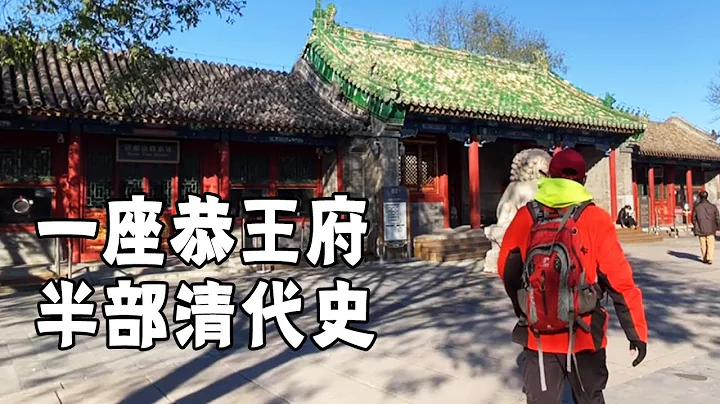
Gongwang Mansion is located in the northwest corner of Shichahai, Beijing. It is a typical palace garden with both a central axis and a symmetrical technique. Built at the end of the 18th century, it is the most complete Qing Dynasty palace in Beijing, and it can be called the "Pearl of Shichahai".

The tourists who come here are not entirely for the architectural landscape, but for the historical figures here, one is the Qing Dynasty giant greed and Shen , The other is Prince Gong Yixin. One is Qianlong's favorite minister, and the other is a modern man. These two historical figures were born in different eras, but they played a legendary story in this mansion.
The predecessor of Prince Gong's Mansion was the Mansion of Juxiang Heshen in the Qing Dynasty. Around the 40th year of Qianlong (1775), the power of Heshen, who was in power for a while, caught this piece of surrounding water, connected to the West Mountain, and not far from the "Emperor's Home", and bought it at a high price. Multiple properties. In the forty-first year of Qianlong, 1776, Heshen demolished the old houses since the Ming Dynasty and built a new house. He began to build his luxurious mansion on the east side of Qianhai and back to Houhai. It was called "Hedi".
It is said that during the Hongzhi period of the Ming Dynasty, the eunuch Li Guang, the officials of the early Qing Dynasty Song Quan, and Song Nao were also placed here.
In the forty-five year of Qianlong (1780), He Shen was already a senior official with several highest official positions. At the same time, Qianlong pointed to marriage and will be married to Princess Xiao His son, Fengshen, was of great virtue, and Yu Cong began to build a new mansion after forty-five years after Qianlong. In the fifty-fourth year of Qianlong (1789), Emperor Qianlong's beloved daughter and Princess Xiao married here and became Heshen's daughter-in-law. This royal mansion has been basically completed. At this time, Heshen Mansion became a princess mansion of the same level as the princess mansion in the sense of ritual system, and the princess lived on the east road after entering the mansion. Heshen lived on West Road and built seven halls here, which later became Xijinzhai. In short, the predecessor of Prince Gong's Mansion, He Shen Mansion, was newly built in accordance with the dual specifications of the Princess Mansion and the First Grade Official Mansion.
In the Qianlong era, Heshen had the wealth that no one could match. In modern terms, he was the richest man in the world at that time. Since he has so much money, where are all the belongings hidden in his home? The answer is the Yanlou in Fuzhong, here is Heshen Treasure House, which is 160 meters long from east to west and has more than 40 houses. The back wall is particularly tall, and the wall one person above the ground is double-layered. It is where He Shen used to hide stolen silver and treasures.
In order to be able to distinguish what is hidden in the wall, He Shen also designed windows of different shapes on the back wall. Just look at the shape of the window to know the inside. What is hidden. He Shen really worked hard to hide his belongings. When building the wall, double-layer masonry is used, that is, a cracked wall. How many gold and silver treasures are hidden in the cracked wall? According to historical records, there are more than 32,000 taels of gold in the Jiaqiang private library. The word "jacketed wall" only appeared in historical data, until the first large-scale renovation of Prince Gong's Mansion in 2008, the "jacketed wall" used by Heshen for treasures was discovered for the first time. However, the treasure cellar recorded in historical data has not been found yet.
It is well known that Heshen was the number one corrupt official in the Qing Dynasty. The Emperor Jiaqing had long regarded Heshen as a thorn in his eyes. He was stabbed in the flesh, and he was killed quickly. The fifth day after Qianlong's death, that is, the fourth year of Jiaqing (1799) On the eighth day of the first lunar month, Emperor Jiaqing deprived the two positions of Heshen Military Machinery Minister and Jiumen Admiral, and was "given to commit suicide" and copied his home. How many properties are seized?
Let’s take a look at the unofficial record of Xue Fu, a diplomat from the late Qing Dynasty, but the number is quite scary. It has been valued at 264 million taels of silver. , Plus those without valuation, totaled about 1.1 billion taels of silver. At that time, the Qing Dynasty’s annual treasury income was only 70 million taels of silver.
Let’s look at the official statistics again. According to the records of Qing Dynasty’s archives, there are 2000 houses, 1266 hectares of fields, more than 30,000 taels of gold, more than 3 million taels of silver, 1001.5 rented houses everywhere, and the loan of the principal. There are 12 pawn shops opened, and 8 pawn shops have been opened by their family members Liu Quan, Liu Yin, Liu Ke, and Hu Liu; pawn shops, houses, and land are worth more than 230,300 silverTwo; money-lending silver taels totaling 26,315 taels; eighty large lathes converted a total of 9,600 taels of silver; tens of millions of valuables such as jewelry, antiques and clothing are immeasurable.
Actually, the property checked is not all of Heshen’s property, and there are also omissions, like Heshen’s daughter-in-law Gulun and Princess Xiao, where the property of Emperor Jiaqing is exempt checked. How much does Heshen's estate have? Since none of the existing historical data on Heshen's family properties is complete, and there are countless treasures in his family properties, it is impossible to accurately analyze and estimate the exact amount of his family properties.
After He Shen was executed, Emperor Jiaqing gave the western half of this mansion to his seventeenth brother Yong King Lin Qing. The reason why he was only given half of it was because at that time, the ten princesses of Emperor Qianlong and their foreheads were still living there. Princess Hexiao is one of the most legendary princesses, whose birth mother Wang is the favorite concubine of Emperor Qianlong in his later years. In the first month of the 40th year of Qianlong (1775), when the tenth daughter of Emperor Qianlong came to the world, Emperor Qianlong was naturally happy when she came to her son, and the ten princesses looked so cool as their father and loved her. Although the ten princess was a woman, she was born with supernatural power, able to open ten strong bows, and often accompanied her father to horse and hunt. One time when he was hunting, Emperor Qianlong said to ten princesses, “If you are an elder brother, this throne will be yours in the future!”
Later, he married Heshen’s son Fengshen Yinde, and met Ma Ma Relying on her father's power and behavior, the princess seriously reprimanded her husband, saying that Fengshen Yinde only knew that paying bribes would eventually destroy the family. The words of the ten princesses are unfortunately true. When copying Heshen’s house, Emperor Jiaqing still took care of his brother and sister and did not kill the little brother-in-law, and the princess and his wife still lived in the original home. As a result, the mansion was divided into two, the west is the Palace of Qing Dynasty, and the east is the Palace of Princess. It was not until the death of the ten princesses in September of the Daoguang 3rd year (1823) that the entire mansion came under the name of King Qing. Speaking of Yonglin, many people are not familiar with it, but if you mention his grandson, the Qing prince Yiyu who signed the "Xin Chou Treaty" with Li Hongzhang and the Eight-Power Allied Forces, I am afraid that no one knows again. Before Xianfeng changed his residence to Prince Gong, he lived here as a general of the auxiliary country.
From Qingwang’s Mansion to Gongwang’s Mansion
From Qingwang’s Mansion to Gongwang’s Mansion
As for Prince Gong Yixin, that is the most in modern Chinese history. One of the important political figures, he participated in the Second Opium War and almost all major political activities afterwards (between 1853 and 1898). During the "Xinyou Coup", it was he who helped Cixi to "close the curtain to listen to politics." "The throne. It is no exaggeration to say that without Yi Xin, the entire modern history of China and even later Chinese history would be rewritten.
In the first year of Xianfeng, that is, in 1851, Prince Gong Yixin, an important political figure in the late Qing Dynasty, became the third-generation owner of this house and changed its name to Prince Gong’s Mansion. The name of Prince Gong’s Mansion is still in use today.
花園
"A mansion of Prince Gong, half of Qing Dynasty history" is the historical geographer Hou Renzhi's evaluation of the mansion of Prince Gong. In the early years of the Republic of China, this palace was sold to the church by Prince Gong’s grandson Pu Wei for 400,000 yuan. It was later redeemed by Fu Jen Catholic University with 108 gold bars and used as a school for girls. After the founding of the People's Republic of China, the palace was used by many units such as the dormitory of the Ministry of Public Security, the fan factory, and the conservatory.
Prince Gong’s Mansion is divided into three parallel roads: East, Middle, and West. It is the largest courtyard house in the world. The three buildings on the middle road are the main body of the mansion, one is the main hall, the second is the apse, and the third is the extension building. There are three courtyards on East Road and West Road, which echo the buildings of Middle Road. The last part of the palace is the garden, and more than ten scenic spots are different.
花園
It is called "Langrun Garden or Cuijin Garden", commonly known as the Garden of Prince Gong's Mansion. Walking in the garden is like walking among the mountains and rivers. Echoes the road with the mansion.
is located in the Miyun Cave under the Dicuiyan, Huayuanzhong Road, it is the Emperor Kangxi of the Qing DynastyThe royal brush. Kangxi had a deep knowledge of calligraphy, but few inscriptions, so the word "Fu" is extremely precious. Its words are vigorous and powerful, which can be broken down into many fields, many children, many talents and longevity. It is cleverly conceived and can be called the world's number one "blessing".
花園
Typical Chinese traditional theater. The building area is 685 square meters, and the building form is a fully enclosed structure with three-volume hooks. The decoration of the big theater is fresh and beautiful, with purple flowers in full bloom, making people feel like watching a play under a vine frame.
大戏楼
The last building on Yuanzhong Road. Because it is shaped like a flying bat, it is named "Bat Hall", which is also for blessing. Because this building constitutes a bat-shaped plane, some people say that "this hall has sunshine from morning to dusk", and it is hailed as "the only example of Beijing's ancient architecture."
Bathall
Shuhu Yinluan Temple, the main building of Prince Gong’s Mansion. As the main hall of the palace, it can only be opened during major events and important festivals to play a ceremonial role. In the early years of the Republic of China, due to accidental fire, the main hall and the east and west side halls were burned down, and the Yin'an Temple courtyard is now rebuilt.
银安殿
(End)