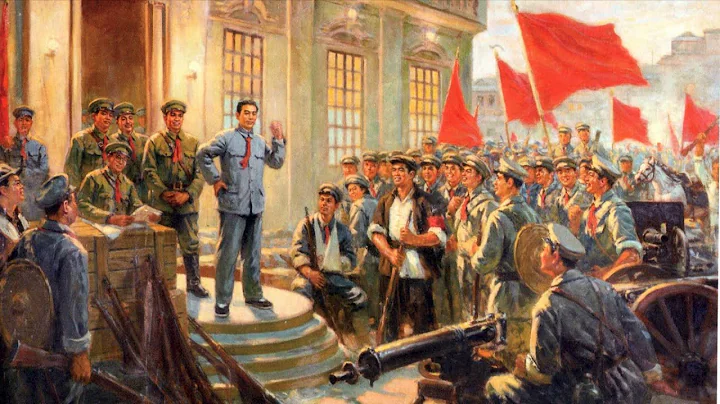
In the long course of history, there has been a group of people who stepped in when the nation was in crisis, and did their best to benefit the people without taking any needle or thread. Now, they have disappeared from the vast world, but their spirits will remain immortal and have become unforgettable heroes in the hearts of Chinese people.

Prime Minister Zhou Enlai is an iconic figure . When he was young, he determined to study for the rise of China and went abroad to study and learn advanced ideological and cultural knowledge;
Such a respectable Premier Zhou, the people always think of him. There is no need to call for help, neighbors rush to tell each other, and spontaneously go to pay tribute to the Premier. The ten-mile long street sends the Premier off, leaving a strong mark.
Leave no ashes and carry the revolution to the end
January 8, 1976, is a day worth remembering by all Chinese people. On this day, the beloved Premier Zhou Enlai closed his eyes forever.
Premier Zhou Enlai was still bravely fighting cancer in his last moments. On the sickbed, he was still worrying about the fate of his motherland, hoping to do as many things as possible. However, when the time came to part ways, the desperate racing of doctors and nurses was of no avail. 's advanced cancer was irreversible and took the life of Premier Zhou Enlai.
When the news of Zhou Enlai's death came, Chairman Mao Zedong, who was also suffering from illness, burst into tears. He closed his eyes and raised his head to calm down. Upon seeing this, correspondent also stopped reading the newspaper and waited for the chairman to calm down. During that time, Chairman Mao Zedong seemed to have lost his smile. While fighting the disease, he recalled his old comrades.
How should the funeral of Premier Zhou Enlai be held? This was a major event at that time. The Party Central Committee had carefully considered it for a long time and was prepared to take it seriously. Comrade Deng Yingchao put forward Zhou Enlai's last request before his death, but it made the Party Central Committee difficult.
"What! Cremation without leaving ashes!" Relevant personnel from the Party Central Committee raised their voices, unable to believe this. After all, this is the prime minister of a country. If his ashes are not left, how will future generations of Chinese people pay their respects to him? This situation has never been encountered in previous funerals. The Party Central Committee refused on the spot and insisted on the practice of funerals for leading figures.
However, considering Deng Yingchao's special status, as the Prime Minister's wife, she is the person who knows the Prime Minister best , the Party Central Committee will reflect this appeal upwards.
Comrade Deng Yingchao knew the difficulty of this matter, but still persisted in persuading, "This is Enlai's last wish, just follow what he said." It turned out that as early as 1956, Zhou Enlai and his wife signed an initiative advocating for cremation after death, and agreed not to leave ashes after death and that the soul would return to China.
You must know that under the infiltration of traditional culture, the concept of "the dead are the greatest" is deeply rooted. After a person dies, he must rest in the earth and be with the loess for future generations to mourn. With the influx of new trends of thought, funeral reform has ushered in new reforms, advocating abandoning burials and leaving graves, choosing to level the graves and return to farming, leaving high-quality land to future generations for farming..
The emergence of new things is always full of twists and turns and difficulties. At this time, cremation before burial was still being advocated. Leaders of the Party Central Committee set an example and took the lead in signing the initiative. However, it is not popular among the people and more time is still needed.
However, Premier Zhou Enlai had to do more than just cremate him. He also had to scatter the ashes after the cremation. This was another revolutionary progress at the time.
As the first person in the history of our country who proposed not to leave ashes after death, Premier Zhou Enlai got his wish. With the hard persuasion of his wife Deng Yingchao, he finally got the consent of the Party Central Committee. Deng Yingchao, who was immersed in sadness at this time, finally saw a glimmer of light and felt a little comfort in his heart.
htmlOn the afternoon of November 15, the memorial service for Premier Zhou Enlai had just ended. Deng Yingchao called the family members together and revealed that the Prime Minister had made an agreement with him more than ten years ago not to leave ashes after death, so as to better protect the land of China.
If you want to accomplish this important thing in public, it is impossible to rely on Deng Yingchao alone. As the wife of Premier Zhou Enlai, Deng Yingchao's "goals" were too big, and her every move was watched by the people. If the location where the ashes are scattered is made public, the people will inevitably hold public memorials, which is completely contrary to Premier Zhou's wishes.
That night, Deng Yingchao found two comrades, Zhang Shuying and Gao Zhenpu, members of Premier Zhou Enlai’s party group, to discuss the location for scattering the ashes.
The two of them have been with Premier Zhou Enlai for many years and respect the leader's request very much. They said on the spot that they would fulfill their mission and complete the last task assigned by the Prime Minister.
"This matter must be kept secret", Deng Yingchao repeatedly warned her. Seeing that this important matter was finally completed, she felt excited and sad at the same time. After the Prime Minister left, she was alone and rarely showed her grief. In public, she always maintains an elegant and refined look, restrains her emotions as much as possible, and arranges her work well.
Live up to the people Ten Miles of Long Street to send off the Prime Minister
Premier Zhou Enlai's funeral affairs are proceeding in an orderly manner. Deng Yingchao is responsible for the process arrangements and funeral matters, keeping everything simple according to the Prime Minister's requirements; while Zhang Shuying, Gao Zhenpu and other four people went to various places to inspect, and finally selected four suitable locations and carried out according to the plan.
Until this time, except for Deng Yingchao and five others, almost no one in the country knew the place where Premier Zhou Enlai’s ashes were scattered.
The selected date of condolences finally arrived, and everything was in order. On that day, Deng Yingchao accompanied Premier Zhou Enlai on his final journey. The moment she got the urn, she suddenly realized, "Comrade Enlai, I did it." She knew in her heart that she could not and could not participate in the final step of scattering the ashes.
In order to fulfill Premier Zhou Enlai's wish, Deng Yingchao got into the car with the empty urn and drove eastward in the night. On both sides of the road, the inner and outer three floors were crowded with people. They wore white flowers and with tears in their eyes, looked firmly in the direction of the Great Hall of the People and spontaneously expressed their condolences to Premier Zhou Enlai.
Deng Yingchao looked at the crowd on Ten Mile Long Street, her eyes were red again. She stroked the urn and whispered, "Comrade Enlai, the masses are here to see you." While the car was still driving forward, cries came from the crowd. Deng Yingchao could no longer control her emotions, lowered her head and started crying.
At this moment, Gao Zhenpu and others also started to take action. They picked up the heavy ashes and began the task of spreading the ashes.
In order to avoid the attention of the media, they chose a more low-key way. They used the underground passage of the Great Hall of the People to avoid the mourning crowd and took a jeep that Premier Zhou Enlai rarely used. This jeep is of great significance. It was once given to him by Stalin . However, Premier Zhou Enlai rarely uses it and prefers to travel with the big red flag, and it has become his iconic vehicle. This gray jeep is less familiar to many people and is more convenient for travel.
The night was getting darker and darker, and the people who came to express their condolences were reluctant to disperse. Even after repeated persuasion, they still insisted on waiting. "Let us send one more to Premier Zhou " the crowd said while crying, and then there were crying sounds one after another, and the whole Beijing was immersed in sadness.
When the people heard about Premier Zhou’s wish to leave no ashes after his death, although they were very shocked and regretful, they still respected the Premier’s decision. Premier Zhou Enlai served the country and the people during his lifetime, and he will live with the land after his death and will accompany the world forever.
Although there is no monument or tomb, for the people who love Premier Zhou, As long as they express condolences, Premier Zhou's shadow is everywhere.
Of course, the people at the time were also curious about where Premier Zhou's ashes were scattered, but they never got the slightest information. It was not until more than thirty years later that this secret was officially revealed. Premier Zhou's ambition and affection are entrusted in every part.
Four handfuls of ashes with the whole of China in mind
When the era of turbulent undercurrents finally came to an end, and the names of the framed revolutionaries were cleared one by one, the relevant people who participated in the matter of scattering the ashes of Premier Zhou Enlai started talking, made the place of ashes public to the public, and told the reasons behind the site selection.
After many inquiries, we learned that Premier Zhou Enlai’s ashes were divided into four parts and took a small plane that spread pesticides to complete the final journey. Under the night, the small plane flew over Beijing, Miyun Reservoir , Tianjin Haihe River and Shandong Binzhou Yellow River estuary . It floated down at four familiar locations and finally landed firmly in the soil.
Half of his ashes fell in Beijing, which is the place where he struggled. One was the place he built for New China, and the other was a water conservancy highlight project; a quarter fell in Tianjin, where the revolution started, and where love grew; a quarter fell in the Yellow River , paying tribute to the mother of the motherland and calling the wanderers from afar to return home.
The ashes are flying over Beijing. This is the place where Premier Zhou Enlai struggled all his life, and it is also the hometown of his dream.
lived with his father in Beijing when he was a boy. The comfortable and harmonious life in old Beijing left a deep impression on him. Subsequently, the revolutionary situation intensified. As one of the main battlegrounds of the May 4th Movement, Beijing became a place where Zhou Enlai kept going back and forth. Here he met a number of aspiring young people and worked together for the rise of China.
After the founding of New China, Beijing became the capital. Premier Zhou Enlai made suggestions to open up new horizons. He witnessed the founding ceremony of the country and the state banquet. He advocated the construction of Beijing Railway Station, Beijing Hotel, the Great Hall of the People, etc., and witnessed New China's transformation from poverty to economic self-sufficiency. Here, Premier Zhou takes care of everything during the day, and bows his head in front of the lamp at night, worrying about the development of New China day and night.
The ashes are scattered in Beijing, and Premier Zhou Enlai can guard this place, connect with the people of Beijing, and witness the development of the motherland.
The second ashes are also in Beijing. The location is in the Miyun Reservoir. This is a major water conservancy issue that Premier Zhou Enlai has always had in mind.
Premier Zhou Enlai has said many times that he has two major things in his mind. One is God, who wants to promote two bombs, one satellite and space flight, and the other is water conservancy, which needs to go from "fighting" with water to "symbiosis" with water. The Miyun Reservoir is a major water conservancy project and was personally directed and supervised by Premier Zhou Enlai.
Beijing used to be short of water resources. It only relied on Yuquan Mountain for water supply, which was far from being able to meet the needs of urban life and production. In order to promote water conservancy, Premier Zhou Enlai invited water conservancy experts to conduct site selection and exploration, and finally selected several major reservoirs for pilot projects and personally presided over the promotion.
Among them, Miyun Reservoir is the largest one and has attracted the attention of Premier Zhou Enlai. Miyun Reservoir is the largest reservoir in the Beijing-Tianjin-Tangshan region and the second largest reservoir in the and regions of North China. Once completed, it can continuously supply water to urban Beijing and solve the problem of regional water shortage.
In order to build the Miyun Reservoir, countless time and energy were poured into it. The entire cycle lasted nearly two years. More than 50,000 residents were persuaded to relocate, more than 30 million cubic meters of earth and stone were excavated, and various difficulties were overcome to complete an impossible task. Fortunately, all these efforts eventually resulted in the completion of the Miyun Reservoir, which led to the great development of my country's water conservancy industry.
The third ashes were scattered in Tianjin. For Premier Zhou, Tianjin is his second hometown.Here he studied at Nankai University, organized many anti-imperialist and anti-feudal struggles, and also established the revolutionary group "awakening society".
Tianjin is where he officially started the revolution. He was filled with the blood of youth and was imprisoned many times, fighting hard against the enemy. Of course, there is also a selfish intention behind this. Tianjin is also the place where Premier Zhou Enlai and his revolutionary partner Deng Yingchao met and fell in love. The two like-minded young people became friends here and stayed together for a lifetime. In Tianjin, Premier Zhou Enlai implemented revolutionary theory into practice and fought against the enemy despite risks.
For the fourth time, he scattered his ashes to his mother, the Yellow River, and embraced his mother at the mouth of the Yellow River in Binhai, Shandong. In China, the Yellow River has the meaning of "mother". Zhou Enlai has expressed his love for the Yellow River in his articles many times and thanked the Yellow River for nurturing the children of China. Zhou Enlai often reminded those around him that a person should not forget his roots and should be selfless and dedicated like the mother of the Yellow River, silently providing the source of life for the people on both sides of the strait without taking a penny.
The Yellow River is known as the "Ninety-Nine Bays". As the second longest river in China, it has a very vast drainage basin, covering the great rivers and mountains of the motherland. So, why was the last pile of ashes chosen at the mouth of the Yellow River in Binhai, Shandong? In addition to embracing the motherland, he also expressed his feelings - hoped that he would be brought into the Taiwan Strait through the sea water, so that he could be a family by sea and land, and realize the reunification of the motherland at an early date.
Several years later, when they learned about the location where Premier Zhou Enlai’s ashes were scattered, the people once again gave it a thumbs up. Such a pioneering figure still did not forget New China until his deathbed. What kind of magnanimity and magnanimity this shows.
People who are beneficial to the people will never forget them. To this day, if you ask any Chinese about Zhou Enlai's deeds, you will always receive the affectionate title "Premier Zhou". This is not only his position, but also his lofty status in the hearts of the people.
Conclusion
Premier Zhou Enlai has no grave or monument in his life, and his ashes will always remain on the land he cares about. The loyalty and courage of a great man of this generation is worthy of being remembered by every son and daughter of China.
Everyone of the leaders who experienced that era paid a heavy price for the development of the motherland.They worked hard but never cared about gains and losses, which is worth learning by every young person.
Premier Zhou Enlai is more like a thorough revolutionary, always working hard for the development of New China, trying to break the limitations of the masses' thinking, and looking forward to seeing a better China.