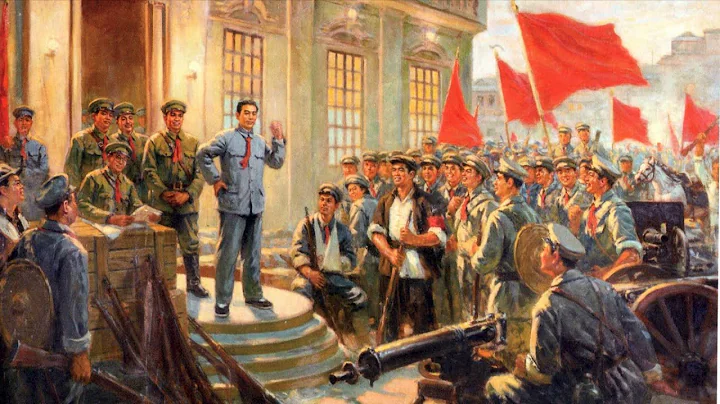
There are many heroic men in China, but there are also many idiot generals and hip-pulling generals in history. Let's take a look at the top ten most famous generals in history and see how they turned cruel wars into a joke.
1. Li Jinglong
Li Jinglong is the son of Li Wenzhong, who ranked third among the founding heroes of the Ming Dynasty. It stands to reason that with such a father who is both civil and military, Li Jinglong should not be much worse, no matter how bad he is. However, his performance in the Jingnan Campaign was shocking, and he successfully made himself an "undercover" of Zhu Di.

Let’s first look at the defense of Beijing.
In the first year of Jianwen, Li Jinglong used 500,000 troops to storm Zhu Di's home base of Peiping, which had only tens of thousands of defenders. At that time, two officers had led people to attack the city wall, and a breakthrough was about to be achieved. The surprising result was that Li Jinglong actually ordered the withdrawal of troops. As a result, the next day, when Li Jinglong ordered to attack the city again, Beiping City had turned into an ice city. It turned out that the prince Zhu Gaochi of King Yan who was guarding the city came up with a desperate plan, which was to pour water on the city wall. It was the time of Jiulong. In winter, it is conceivable that as soon as the water is poured on it, it turns into ice. With this strategy, Zhu Gaochi successfully held on until Zhu Di led his army to return for reinforcements. As a result, Li Jinglong's army, which had worked hard on the expedition, collapsed at the foot of Peiping City and returned in defeat.
Let’s talk about the battle of Baigou River where Li Jinglong’s 600,000 troops faced off against Zhu Di’s 100,000 troops .
In the second year of Jianwen, Zhu Di led 100,000 Yan troops to advance along the river from Sujiaqiao. They were ambushed by more than 10,000 people from the Ministry of Security. Pioneer officer Ping An and the chief governor Zhai Neng and his son, the governors, fought hard and were invincible. The Yan army could only be forced to retreat. Guo Yingbu had already laid mines on the Yan army's retreat route, causing the Yan army to suffer heavy losses during the retreat.
The next day, Zhu Di asked for battle again, and the Ministry of Ping An defeated the Yanhou army general Fang Kuanbu. Fang Kuan was wounded and fled. Zhu Di led thousands of elite soldiers into the formation, killing countless enemy troops. However, Li Jinglong suddenly led the main force of 500,000 Ming troops to bypass Yan Division's back and launched a pincer attack from both front and rear. According to historical records, King Yan changed his horse three times and fought with his sword, but was almost injured by Ping An and Zhai Neng. In desperation, Zhu Di came to the river embankment, raised his riding whip, and pretended to call for reinforcements. Li Jinglong became suspicious and slowed down the offensive; Zhu Gaoxu also came to the rescue at this time, and the war temporarily eased.
Soon, Zhai Neng once again led the army to kill, shouting "Destroy Yan", and the situation was once again unfavorable to the Yan army. But at this critical moment, Li Jinglong's handsome flag was suddenly blown off by the wind. Zhu Di took the opportunity to fight back, and the situation was instantly reversed. Li Jinglong once again staged an escape drama, and only less than 30,000 of the 600,000 troops returned to Nanjing.
What material is Shuaiqi’s flagpole made of? No matter how strong the wind is, it can't be blown away. To say the least, even if there is no commander's flag, doesn't Li Jinglong have any other way to prove that the coach was not killed? This can no longer be simply described as a straw bag.
After Zhu Di proclaimed himself emperor, Li Jinglong was admitted to have "silent influence". I don't know if this was considered as a rectification of Li Jinglong's name or a satire on him?
2. Fan Wenhu
Fan Wenhu, the son-in-law of a powerful official in the Southern Song Dynasty Jia Sidao , was the famous "escape general" in history.
1259, Fan Wenhu, who had no military exploits due to his tough background, was promoted to the commander of the military capital of Wuding, Huangzhou, and became the sole and responsible senior general of the Song Army.
1269, Fan Wenhu was ordered to lead 50,000 naval troops to rescue Xiangfan, which had been besieged by the Yuan army for two years. However, Fan Wenhu and his men were attacked at Guanzitan before they arrived in Xiangyang. The Song army suffered a slight defeat in the Mongolian interception. Fan Wenhu saw that the situation was not good and drove away in a light boat. " Wenhu escaped with the light boat." The Song army's small defeat turned into a "big rout", and tens of thousands of prisoners were killed and captured. This is Fan Wenhu's first escape.
However, only four months after the defeat of Guanzitan, Fan Wenhu rose instead of falling, and was appointed by Jia Sidao as the deputy capital commander in front of the palace, with a total ban on troops.
1271, the competition for Xiangfan entered the decisive stage. Originally, the Southern Song Dynasty appointed Li Tingzhi as the ambassador of Beijing and Hu to unified command the armies to rescue Xiangyang. However, under Fan Wenhu's slander, he was appointed as the Fuzhou observation envoy to contain Li Tingzhi during the reinforcements.
There are many heroic men in China, but there are also many idiot generals and hip-pulling generals in history. Let's take a look at the top ten most famous generals in history and see how they turned cruel wars into a joke.
1. Li Jinglong
Li Jinglong is the son of Li Wenzhong, who ranked third among the founding heroes of the Ming Dynasty. It stands to reason that with such a father who is both civil and military, Li Jinglong should not be much worse, no matter how bad he is. However, his performance in the Jingnan Campaign was shocking, and he successfully made himself an "undercover" of Zhu Di.
Let’s first look at the defense of Beijing.
In the first year of Jianwen, Li Jinglong used 500,000 troops to storm Zhu Di's home base of Peiping, which had only tens of thousands of defenders. At that time, two officers had led people to attack the city wall, and a breakthrough was about to be achieved. The surprising result was that Li Jinglong actually ordered the withdrawal of troops. As a result, the next day, when Li Jinglong ordered to attack the city again, Beiping City had turned into an ice city. It turned out that the prince Zhu Gaochi of King Yan who was guarding the city came up with a desperate plan, which was to pour water on the city wall. It was the time of Jiulong. In winter, it is conceivable that as soon as the water is poured on it, it turns into ice. With this strategy, Zhu Gaochi successfully held on until Zhu Di led his army to return for reinforcements. As a result, Li Jinglong's army, which had worked hard on the expedition, collapsed at the foot of Peiping City and returned in defeat.
Let’s talk about the battle of Baigou River where Li Jinglong’s 600,000 troops faced off against Zhu Di’s 100,000 troops .
In the second year of Jianwen, Zhu Di led 100,000 Yan troops to advance along the river from Sujiaqiao. They were ambushed by more than 10,000 people from the Ministry of Security. Pioneer officer Ping An and the chief governor Zhai Neng and his son, the governors, fought hard and were invincible. The Yan army could only be forced to retreat. Guo Yingbu had already laid mines on the Yan army's retreat route, causing the Yan army to suffer heavy losses during the retreat.
The next day, Zhu Di asked for battle again, and the Ministry of Ping An defeated the Yanhou army general Fang Kuanbu. Fang Kuan was wounded and fled. Zhu Di led thousands of elite soldiers into the formation, killing countless enemy troops. However, Li Jinglong suddenly led the main force of 500,000 Ming troops to bypass Yan Division's back and launched a pincer attack from both front and rear. According to historical records, King Yan changed his horse three times and fought with his sword, but was almost injured by Ping An and Zhai Neng. In desperation, Zhu Di came to the river embankment, raised his riding whip, and pretended to call for reinforcements. Li Jinglong became suspicious and slowed down the offensive; Zhu Gaoxu also came to the rescue at this time, and the war temporarily eased.
Soon, Zhai Neng once again led the army to kill, shouting "Destroy Yan", and the situation was once again unfavorable to the Yan army. But at this critical moment, Li Jinglong's handsome flag was suddenly blown off by the wind. Zhu Di took the opportunity to fight back, and the situation was instantly reversed. Li Jinglong once again staged an escape drama, and only less than 30,000 of the 600,000 troops returned to Nanjing.
What material is Shuaiqi’s flagpole made of? No matter how strong the wind is, it can't be blown away. To say the least, even if there is no commander's flag, doesn't Li Jinglong have any other way to prove that the coach was not killed? This can no longer be simply described as a straw bag.
After Zhu Di proclaimed himself emperor, Li Jinglong was admitted to have "silent influence". I don't know if this was considered as a rectification of Li Jinglong's name or a satire on him?
2. Fan Wenhu
Fan Wenhu, the son-in-law of a powerful official in the Southern Song Dynasty Jia Sidao , was the famous "escape general" in history.
1259, Fan Wenhu, who had no military exploits due to his tough background, was promoted to the commander of the military capital of Wuding, Huangzhou, and became the sole and responsible senior general of the Song Army.
1269, Fan Wenhu was ordered to lead 50,000 naval troops to rescue Xiangfan, which had been besieged by the Yuan army for two years. However, Fan Wenhu and his men were attacked at Guanzitan before they arrived in Xiangyang. The Song army suffered a slight defeat in the Mongolian interception. Fan Wenhu saw that the situation was not good and drove away in a light boat. " Wenhu escaped with the light boat." The Song army's small defeat turned into a "big rout", and tens of thousands of prisoners were killed and captured. This is Fan Wenhu's first escape.
However, only four months after the defeat of Guanzitan, Fan Wenhu rose instead of falling, and was appointed by Jia Sidao as the deputy capital commander in front of the palace, with a total ban on troops.
1271, the competition for Xiangfan entered the decisive stage. Originally, the Southern Song Dynasty appointed Li Tingzhi as the ambassador of Beijing and Hu to unified command the armies to rescue Xiangyang. However, under Fan Wenhu's slander, he was appointed as the Fuzhou observation envoy to contain Li Tingzhi during the reinforcements.
As a result, the Battle of Xiangfan fell into crisis. Li Tingzhi wanted to go to war several times, but Fan Wenhu refused to let him go. He drank and had fun with his wives and concubines all day long, which made Li Tingzhi hate him. Later, the war finally broke out. Fan Wenhu was first defeated in Turbulent Beach, resulting in more than 100 generals of the Song Army being captured by Mongolia. Immediately afterwards, Fan Wenhu once again staged an escape drama in Lumen. "The first battle was unfavorable, so he abandoned his flags and drums and fled at night." Most of the Song army, which lost its command, was captured by the Mongols, and countless warships and armored battleships were captured. You must know that Fan Wenhu brought an army of 100,000 this time, almost all the troops to assist Xiangfan, but it did not bring him even a little bit of courage. This was the second time that Fan Wenhu abandoned the army and fled.
After Fan Wenhu's defeat, Li Tingzhi did not give up his efforts to aid Xiangyang. He first recruited dead soldiers, and then sent generals Zhang Shun and Zhang Gui to lead the 3,000 people he recruited to aid Xiangyang. Zhang Shun and Zhang Gui fought fiercely for 120 miles, and finally broke through the Yuan army's blockade and advanced to Xiangyang. Zhang Shun was killed in the fierce battle. When his body was found, "he had four shots and six arrows in his body, and he was as angry as life." However, the heroic fighting of the Song Army did not bring about Fan Wenhu's "repentance."
Zhang Gui made an appointment with Fan Wenhu before entering the city and asked him to lead his army to meet him at Longweizhou. But when Zhang Gui once again broke out of the city and fought his way to Longweizhou to meet Fan's army, Fan Wenhu was nowhere to be seen. He was finally defeated and died of exhaustion. Fan Wenhu had mistakenly thought that the Yuan army was attacking because he heard the wind and birds singing nearby half a day ago and disappeared. This was his third escape.
Fan Wenhu's escape story is not over yet. This time he tricked Yuan Dynasty .
After the demise of the Southern Song Dynasty, Fan Wenhu surrendered to the Yuan Dynasty and was reused by Kublai Khan (it seems that Fan Wenhu was not useless).
In 1280 AD, Kublai Khan ordered the Eastern Expedition to Japan, and Fan Wenhu was ordered to attack Japan's Dazaifu. Who knew that he was reluctant to send troops to Eagle Island because of fear, and instead encountered a typhoon. Fan Wenhu relied on his firm will to survive and survived holding a wooden board, but more than half of the soldiers "drowned to death."
Until this time, the Yuan army was still strong. General Zhang Xi suggested that the soldiers should take advantage of the damaged ships and fight to the death without hesitation. Fan Wenhu not only refused, but once again "escaped on a dangerous ship" and quietly returned to China via Korea. The fate of the tens of thousands of soldiers who were abandoned on Eagle Island can be imagined. According to historical records, "The Japanese army attacked Eagle Island, and the Yuan army suffered a disastrous defeat because their generals escaped. Most of them were killed, and the remaining 20,000 to 30,000 were captured."
However, Fan Wenhu's ending was good. Although he was dismissed from his post and investigated after escaping from Japan, he was activated again in just one year. Since then, Fan Wenhu has been promoted many times, and when he died, he was promoted to Shangshu Youcheng at the age of 80. It is true that good people do not live long and harm the legacy of thousands of years.
3. Xiao Hong
Xiao Hong, a general of the Liang clan in the Southern Dynasty, and the younger brother of Xiao Yan, Emperor Wu of Liang Dynasty. In the late years of the Southern Qi Dynasty, he was awarded the title of "Zhonghujun" to guard the capital. After Xiao Yan succeeded to the throne, he was granted the title of Governor of Yangzhou and Prince of Linchuan County.
There are two things about Xiao Hong's deeds, one is greed for money and avoid disaster; the other is running away from night terrors.
Historical records indicate that Xiao Hong loved money as much as his life and had nearly a hundred warehouses where money was stored. At that time, someone tipped Xiao Yan that there were weapons and armor hidden in Xiao Hong's warehouse, and there was a conspiracy to rebel. Xiao Yan then went to check it out in person. When he opened the warehouse, he found that more than thirty warehouses were filled with gold and silver, and the remaining warehouses were filled with precious objects such as jewelry and coral. Xiao Yan's doubts were immediately eliminated. Instead of blaming Xiao Hong for being greedy, he praised him as an expert in financial management. After that, Xiao Yan believed that Xiao Hong had no political ambitions and placed more emphasis on him.
Although Xiao Hong was a military commander, he had fought one battle in his life. However, it was this battle that firmly placed him on the pillar of shame in history.
When the Liang Kingdom was first established, the Northern Wei Dynasty often took advantage of fire to plunder and invaded repeatedly, so Xiao Yan decided to launch a large-scale Northern Expedition. In 505, Xiao Liang, with Xiao Hong as commander, attacked the Northern Wei Dynasty in three groups. Xiao Hong led an army of 150,000 to attack Luokou, Wei Rui led an army of 50,000 to attack Hefei, and Huan He led an army of 50,000 to attack Qingyan.
However, the large-scale Northern Expedition launched by Nanliang was ruined by Xiao Hong's stupidity.At that time, Wei Rui's troops had captured Xiaoxian City, flooded Pingyang, destroyed Feicheng, and stationed in Dongling. According to the Northern Wei Dynasty, Zongcheng was only twenty miles away. Just when the two sides were about to fight, they suddenly received news of Xiao Hong's defeat. Xiao Yan had to issue an edict to mobilize all the troops.
At that time, Xiao Hong, the commander-in-chief of the Liang Army, was afraid of the Northern Wei Army and did not dare to fight. The entire army huddled in Luokou. One night, there was a night terror in Liang Jun's camp. Xiao Hong thought it was a sneak attack by the Northern Wei army, so he took only a few close associates with him and fled in a hurry, ignoring hundreds of thousands of troops.
The commander fled and was leaderless. When the news spread, the army collapsed instantly. The soldiers fled first, abandoning their helmets and armor. The news reached the Northern Wei general Yuan Ying, who immediately ordered a hunt. Xiao Hong's escape caused Liang Jun to lose more than 50,000 people and countless weapons and baggage.
Emperor Yuan Ke of the Northern Wei Dynasty saw that the Nanliang army was defeated and fled, so he ordered Yuanying to take advantage of the victory and go south to pacify Nanliang. After receiving the order, Yuanying quickly led his army southward, first capturing the horse head, and then forcing his troops to force Zhongli.
Although Nan Liang finally forced the Northern Wei Dynasty back through the Battle of Zhongli, Xiao Hong's stupidity could not be washed away.
4. Su Jun
Su Jun, the son of Su Mo, a general in the Eastern Jin Dynasty and Prime Minister of Anle, the protagonist of the "Su Jun Rebellion", and the funniest rebel general to die in history.
During the Yongjia Rebellion , Su Jun defended himself in his hometown and became the commander-in-chief of the refugee army. After Sima Rui ascended the throne, he was awarded the title of General Yingyang and the Internal History of Huailing. Later, during the Wangdun Rebellion , he was worshiped as the Champion General and Shaoling County Duke for his meritorious service in suppressing the rebellion.
After the death of Sima Shao, Emperor Ming of Jin Dynasty, his relative Yu Liang came to power. In order to eliminate dissidents, he got rid of Sima Zong. Sima Zong's subordinate Bian Chan fled to Su Jun, but Su Jun hid him and refused to hand him over. Yu Liang therefore determined that Su Jun would be a disaster later, and decided to strike first to gain strength. In the second year of Xianhe's reign, Yu Liang granted Su Jun the title of Grand Secretary of Agriculture, and made him a regular attendant on the cavalry. He then ordered his younger brother Su Yi to command the army on his behalf.
This is obviously the method of "rising up and falling down secretly". Don't Su Jun understand that he had ambitions in the first place, but now that Yu Liang can't tolerate him, he joins forces with the famous general Zu Di's younger brother Zu Yue to rebel against Yu Liang.
The allied forces of Su and Zu were unstoppable, occupying Jiankang, the capital of the Eastern Jin Dynasty, and drove away Yu Liang. But in order to vent his anger, Su Jun allowed the soldiers to plunder the harem and behaved extremely cruelly. In 238, Tao Kan, the governor of Jingzhou, led his army to attack the king, and the war changed.
Su Jun and Tao Kan fought, and both sides won or lost. At the same time, Jin general Mao Bao defeated Zu Yue's nephew Zu Huan and captured Hefei. Soon after, Shouchun, Zuyue's base, was captured by Hou Zhao's army, which greatly damaged the Soviet and Zu coalition forces. Although the combined forces of Su and Zu were weak, what really determined Su Jun's success or failure was the latter thing.
Su Jun hijacked Emperor Cheng of Jin Sima Yan and retreated to Stone City. Jin general Wen Qiao and Su Jun fought in Stone City. Su Jun's son Su Shuo led the army into battle and led dozens of cavalry to kill the Jin army in chaos. Su Jun, who was drunk, saw his son so brave on the tower, and thought that he, the father, could not lag behind. So he mounted his horse and charged into the enemy's camp. It didn't matter what he did, he rushed into the enemy's camp in no time. Naturally, the Jin army would not give up such a good opportunity, so they attacked in groups. Su Jun was immediately turned into a hedgehog. The Jin generals caught up and chopped off the head with a knife. The morale of the Jin army was greatly boosted, but the rebels were unable to recover. Stone City was quickly lost and the rebellion subsided.
As the commander-in-chief of an army, Su Jun died in battle after drinking, and was rumored to be a laughing stock.
, Zhao KuoSome friends may take Zhao Kuo's ability to "talk on paper" as an issue, saying that he is familiar with military books and even his father Zhao She is not his opponent. The battle of Changping is the first time to lead troops, lack of experience, etc., so he will not be reduced to the "most famous general", but "a wise son is better than a father". Let's take a look at Zhao Kuo's parents' evaluation of him.
Zhao She said: "Soldiers are dead, and encirclement is easy to say. It is enough to prevent Zhao from encircling him. If he must encircle him, he who defeats Zhao must encircle him.""Zhao She believed that Zhao Kuo was arrogant and complacent, thinking that he was unmatched in the world, and he only knew how to keep books. This was a taboo among military strategists. If Zhao Kuo becomes a general in the future, Zhao Kuo must be the one who defeats him.
Zhao's mother said: "When his father is a general, the number of people he feeds and eats is counted in the tens, and the friends he has are counted in the hundreds. All the rewards given by the king and the clan are given to the military officials, and on the day he is ordered, he does not care about family affairs. Once Jin Kuo becomes a general and heads eastward, no military officer dares to look up to him. The gold and silk given by the king are kept at home, and those who see convenient land and houses can buy them. "This means that when Zhao She was a general, he loved his soldiers as much as his own son and distributed all his property to the soldiers. However, Zhao Kuo was completely opposite to Zhao She. Not only did he not get close to the soldiers, he also hid his property and bought land. How could such a person lead an army?
The final battle of Changping also proved that as Zhao She said, "Those who defeat Zhao must conquer it."
Six, Zhuge Ke
Zhuge Ke. , a powerful official in the Eastern Wu Dynasty, the son of Zhuge Jin, and the nephew of Zhuge Liang. After Sun Quan's death, he became Sun Liang's chief Tuogu minister, and was granted the title of Taifu, taking control of the military and political power of the state of Wu.
In 253 AD, in order to consolidate his position in Soochow, Zhuge Ke ignored the dissuasion of his ministers and led 200,000 troops to the north in March. According to the Records of the Three Kingdoms: Zhuge Ke’s Biography, this expedition was extremely unpopular. “So we went against the general public and sent out troops. We sent out 200,000 people in prefectures and counties, and then we lost the support of the people. "
But no matter what, Zhuge Ke successfully launched the Battle of Hefei. In April, the Soochow army besieged the new city of Hefei. Zhuge Ke built a mountain to attack. Cao Wei general Zhang Te defended the new city with 7,000 people for more than three months. More than half of the soldiers died in the battle, and the outer city collapsed in many places. Wei and Wu entered into street fighting, and Hefei could be attacked overnight.
However, in this case, Zhuge Ke foolishly fell into Zhang Te's delaying strategy. According to historical records, in order to delay time, Zhang Te said to the Wu people: "I have no intention of fighting anymore, but according to the laws of Wei, if you are attacked for more than a hundred days and rescue cannot come, even if you surrender, your family will be exempted from punishment; it has been ninety days since you defended the city. If someone does not want to surrender in another ten days, I will talk to him and explain the good and evil. You can take my seal and ribbon as a token first." "
According to Zhang Te's wishes, if we are given 10 days to get 100 days of immunity from punishment, we will definitely leave the city and surrender after 10 days. If he is a scheming general, he will naturally not believe Zhang Te's statement. But Zhuge Ke, who is smart and wise, easily believed Zhang Te's words. Zhang Te threw the seal ribbon to the Wu people, and Zhuge Ke showed his sincerity. Not only did he not Instead of taking the seal, Zhang Te ordered the Wu troops who had invaded the outer city to rest outside the city. That night, Zhang Te ordered his men to remove the wood and fences of the houses, not only to repair the collapsed areas of the city wall, but also to "repair it."
The next day, when Wu Jun discovered something unusual, Zhang Te refused to surrender again. He said to the Wu people: "I can only die in battle!" "Zhuge Ke was furious, but at this time, the Wu army no longer had the high morale that it had at the beginning. Moreover, the weather was hot and the Wu soldiers were tired. Zhuge Ke could not attack the city, and he vented his anger on his generals. The soldiers continued to complain, and the morale of the Wu army had reached a freezing point. Therefore, timely withdrawal should be the best choice.
But for the arrogant Zhuge Ke, how could he swallow this sigh of relief, so he still insisted on attacking the city. At the same time, Wei Guotai Sima Fu had rushed to the new city with 200,000 reinforcements. Sima Fu took the opportunity to advance and defeat the Wu army. ml1htmlIn August 255, Zhuge Ke had no choice but to lead his army back. Sima Shi also ordered Wen Qin to lead the elite to cut off Zhuge Ke's retreat. Zhuge Ke fled in fear, but Wen Qin stepped forward and defeated the enemy army, beheading more than 10,000 people.
After the Battle of Hefei, Zhuge Ke's reputation in Soochow fell to the bottom. Sun Jun took advantage of the fact that Zhuge Ke was resented by all the people and was disliked by everyone to spread rumors that he wanted to rebel. In October of the same year, Sun Jun and Sun Liang, the Lord of Wu, made a plan and invited Zhuge Ke to a banquet with wine. In the end, Sun Jun and Sun Liang succeeded in getting rid of Zhuge Ke. Soon after, Zhuge Ke's three clans were wiped out.
In the Battle of Hefei, the fundamental reason for Zhuge Ke's failure was that he was angry at being a scholar. He did not understand the cruelty of war, and was tricked by the enemy. He died of his own stupidity.
7. Wang Xuanmo
Wang Xuanmo, after the generals, was the staunch main combatant in the Southern Dynasty. He took refuge with Liu Yu in his early years and served successively as Zhishi, Wuning Prefect, and Pengcheng Prefect. However, he never realized his dream of "fighting on the battlefield". After the death of Emperor Wu, Emperor Wen succeeded to the throne. He wrote a letter to the Northern Expedition, and his passionate words successfully aroused Emperor Wen of the Song Dynasty's desire to "enclose the wolf and live in Xu". "Hearing Wang Xuanmo's statement makes people want to seal the wolf and live in Xu." (from "The Biography of Southern History·Wang Xuanmo")
However, dreams are beautiful, and reality is very skinny. Wang Xuanmo, who went to the battlefield for the first time, deeply understood this sentence.
html In 0450, during the Northern Expedition of the Liu Song Dynasty, Wang Xuanmo served as the vanguard of the Northern Expedition. At that time, due to the oppression of the Han people in the north by Xianbei of the Northern Wei Dynasty, the people of the Central Plains formed volunteers to support the Northern Expedition of the Southern Dynasties. As a vanguard general, Wang Xuanmo had great distrust of the surrendered rebels. He not only refused to cooperate, but also treated them as rogue bandits and suppressed them. In addition, the military discipline of his troops was lax and they burned, killed, humiliated and looted at will, thus losing the support of the people. According to historical records, Wang Xuanmo banned the use of siege equipment because he was greedy for the property in Huatai City, resulting in a small Huatai City that could not be conquered for more than 90 days.The Northern Wei Dynasty took this opportunity to gather forces to counterattack. Wang Xuanmo was frightened by the counterattack by the Northern Wei army. He left tens of thousands of soldiers on the front line and fled directly. The Song army, which had lost its leader, was in chaos and was eventually wiped out.
Xiao Bin, the commander-in-chief of the Northern Expedition, heard about it and wanted to kill Wang Xuanmo, but was dissuaded by the cavalry general Shen Qingzhi. Xiao Bin was also worried that killing the general would cause chaos in the army, so he ordered Wang Xuanmo to garrison Suinsui (today's Chiping, Shandong).
However, Liu Yigong, the king of Jiangxia who accompanied the army and monitored the army, believed that Wang Xuanmo was not strong enough to defend the city, so he ordered Wang Xuanmo to withdraw to Licheng. As a result, Wang Xuanmo was pursued by the Northern Wei army during his retreat, and was defeated again and fled.
Wang Xuanmo fled without a fight twice, leaving Shen Qingzhi speechless. In the end, Wang Xuanmo was removed from all official positions and demoted to a civilian. However, later Wang Xuanmo was repeatedly demoted and promoted, and was even appointed as Minister Gu Ming for a time, and he was promoted to General of Chariots and Cavalry, and Marquis of Qujiang County. Such a person can occupy a high position, which shows that the rapid demise of in the Southern Dynasties and Song Dynasty was not without reason.
8. Ma Di
Zhuge Liang's five Northern Expeditions, the best one was when Ma Di lost Jieting. At that time, Tianshui , Nan'an, and Anding counties all rebelled against Wei and returned to Shu, and the Shu army gained another general Jiang Wei was at his peak because Ma Su did not listen to the dissuasion of General Pi Wang Ping and abandoned the city to defend the mountain. The water channel was cut off by Zhang He, causing the Shu army to lose the important street pavilion, and the first Northern Expedition returned without success.
Although Ma Di has always performed well in front of the street guarding pavilion, not only being able to talk to Zhuge Liang about military strategies, but also making very accurate judgments on strategic directions, no matter how optimistic Zhuge Liang is about Ma Di and "deeply improving his skills", the battlefield is the only touchstone. The battle at the street pavilion is enough to make Ma Di one of the "most famous generals".
9. Cao Shuang
Cao Shuang is ranked among the top ten most famous generals. He has not been wronged at all. As a military general, he has no military exploits. As a politician, he is hesitant in doing things. As the last person in power of the Cao family, he passively completed the handover of the Cao family's regime to the Sima family's regime.
Cao Shuang is the son of Cao Zhen, the second-generation core general of the Cao Wei regime and the great Sima. He had a good relationship with Wei Ming Emperor Cao Rui since he was a child. After Cao Zhen's death, Cao Shuang inherited the title of Marquis of Shaoling. Cao Rui was seriously ill, so he appointed Cao Shuang as the general, with the title of Jiajie Yue, to oversee all Chinese and foreign military affairs, and entrusted the crown prince Cao Fang to him and Sima Yi.
After Cao Fang succeeded to the throne, he added Cao Shuang to serve in the middle, and was granted the title of Marquis of Wu'an. He was given swords and shoes to go to the palace. At first, Cao Shuang discussed everything with Sima Yi and did not dare to act independently. Later, he followed Ding Mi's plan and worshiped Sima Yi as his Taifu, thus bypassing Sima Yi. Later, Empress Dowager Guo was moved to Yongning Palace, where she had her own discretion in all political affairs.
In the fifth year of the first , counselors Deng Yang and Li Sheng suggested that Cao Shuang conquer Shu in order to establish his military exploits. Cao Shuang did not listen to Sima Yi's dissuasion and appointed Xiahou Xuan as the general for the expedition to the west. Instead, he led an army of 70,000 to march from Luo Valley to conquer Shu. As a result, the march had to be suspended due to lack of supplies and food halfway. At that time, both Yang Wei and Xia Houxuan, who were in the army, persuaded him to withdraw, but Deng Yang insisted on continuing to attack Shu. The two sides argued endlessly, and Cao Shuang had no idea. It took him nearly a month to decide to withdraw. However, by this time, Shu Han's Fei Yi had already moved in to defend the Wei army's rear, and Cao Shuang was able to evacuate after a hard battle.
Cao Shuang's efforts were not only ineffective, but also cost tens of thousands of soldiers and exhausted the cattle and horses he brought. The Qiang, Hu and other places also complained about him, and Guanzhong was greatly wasted.
In the first month of the tenth year of the first lunar month, the three brothers Cao Fang and Cao Shuang went to Gaoping Tomb to worship Emperor Ming. Sima Yi launched the Gaoping Ling coup in Luoyang, and went to the palace to report to the Empress Dowager Guo, who had always been at odds with Cao Shuang. He said that Cao Shuang's brothers had corrupted the country's laws and abused power for personal gain.
After receiving the impeachment form, Cao Shuang was panicked and did not dare to tell Cao Fang. At the same time, Great Sinong Huan Fan and General Sima Luzhi escaped from Luoyang and ran to Gaopingling to join Cao Shuang. Huan Fan urged Cao Shuang to take Cao Fang to Xuchang, and in the name of the emperor called on all the troops to attack Sima Yi. Cao Shuang was hesitant again and had no accurate idea, so Huan Fan persuaded Cao Shuang to use the troops of Quenan Camp and Diannong Xiaowei to temporarily resist, and then occupy Xuchang, and said that he could use his identity as Da Sinong to transport grain and grass for the army. But Cao Shuang was still hesitant.
Sima Yi was also afraid that Cao Shuang would fight to the death, so he sent his attendants Xu Yun, Shangshu Chen Tai and others to induce Cao Shuang to give up his rights, and promised to Luoshui that as long as he gave up his rights, he could keep his title. Cao Shuang thought about it all night, and finally gave up resistance and surrendered to Sima Yi.
Cao Shuang's stupidity ultimately cost him a heavy price - the destruction of the three tribes.
10. Xianyu Zhongtong
During the Tianbao period, after Yang Guozhong became prosperous, he recommended him as the military governor of Jiannan.
In the tenth year of Tianbao, King Geluofeng of the Nanzhao Kingdom of the Tang Dynasty rebelled against the Tang Dynasty, captured Yunnan County, killed the county governor Zhang Qiantuo, and captured a large amount of territory in the Tang Dynasty, "Yaozhou and Xiaoyizhou Fan Thirty-Two". Li Longji was furious when he heard this, and immediately ordered Xianyu Zhongtong to speed up his army to conquer Nanzhao. Xianyu Zhongtong received the edict and did not dare to neglect it. He led 80,000 elite troops to Yunnan County.
Ge Luofeng was originally forced by Zhang Qiantuo to rebel against the Tang Dynasty. After learning about the Tang army's crusade, he wanted to seek peace. He sent envoys to Xianyu Zhongtong's army twice to explain the reasons for rebelling against the Tang Dynasty, and expressed his willingness to release the prisoners, return the occupied land, and restore old friendship with the Tang Dynasty.
Unfortunately, no matter how well Ge Luofeng's envoy informed him of the interests, he could not impress Xianyu Zhongtong, who was arrogant and eager to make meritorious deeds.
Faced with the Tang army's pressing step by step, Ge Luofeng knew that he was unable to resist, so he sent people to Tubo for help. A large number of Tubo troops entered Nanzhao to cooperate with Nanzhao in fighting.
However, Xianyu Zhongtong had no idea about all this. At this moment, he was dreaming about pacifying Nanzhao and getting promoted to a noble position.
The Nanzhao army and Tubo used the tactic of luring the enemy deep into the territory, attracting the Tang army to go deep into the hinterland of Nanzhao. Xianyu Zhongtong did not pay attention to the small country of Nanzhao at all. When he saw the enemy retreating, he immediately sent his troops to pursue him.
After the Tang army entered the miasmatic hinterland of Nanzhao, they were attacked by the Nanzhao and Tubo armies. 80,000 elite soldiers died in the battle, with more than 60,000 people killed, and another 10,000. Many people were captured. Xianyu Zhongtong abandoned his son who was accompanying the army and fled in panic. "Sixty thousand soldiers died, and Zhongtong only escaped with his own life." Xianyu Zhongtong ran back to Chengdu in a hurry, but his son was not so lucky and died in the rebellion.
The entire army was wiped out Xian Yu Zhongtong was not held accountable by the court because his friend Yang Guozhong, a popular figure in front of Emperor Xuanzong of the Tang Dynasty, not only concealed the fact of his defeat for him, but also recommended him as Jing Zhaoyin.
Xianyu Zhongtong, the defeated general, transformed into a "Beijing official". But the good times did not last long. Xianyu Zhongtong's defeat was exposed, and Xuanzong was furious. Yang Guozhong did not dare to continue to defend him and allowed him to be dismissed from office.
After being dismissed from office, Xianyu Zhongtong closed his doors to thank guests, read and drank, and entertained himself. Later, he served as the prefect of Hanyang until his death.
At that time, Wei Rui's troops had captured Xiaoxian City, flooded Pingyang, destroyed Feicheng, and stationed in Dongling. According to the Northern Wei Dynasty, Zongcheng was only twenty miles away. Just when the two sides were about to fight, they suddenly received news of Xiao Hong's defeat. Xiao Yan had to issue an edict to mobilize all the troops.
At that time, Xiao Hong, the commander-in-chief of the Liang Army, was afraid of the Northern Wei Army and did not dare to fight. The entire army huddled in Luokou. One night, there was a night terror in Liang Jun's camp. Xiao Hong thought it was a sneak attack by the Northern Wei army, so he took only a few close associates with him and fled in a hurry, ignoring hundreds of thousands of troops.
The commander fled and was leaderless. When the news spread, the army collapsed instantly. The soldiers fled first, abandoning their helmets and armor. The news reached the Northern Wei general Yuan Ying, who immediately ordered a hunt. Xiao Hong's escape caused Liang Jun to lose more than 50,000 people and countless weapons and baggage.
Emperor Yuan Ke of the Northern Wei Dynasty saw that the Nanliang army was defeated and fled, so he ordered Yuanying to take advantage of the victory and go south to pacify Nanliang. After receiving the order, Yuanying quickly led his army southward, first capturing the horse head, and then forcing his troops to force Zhongli.
Although Nan Liang finally forced the Northern Wei Dynasty back through the Battle of Zhongli, Xiao Hong's stupidity could not be washed away.
4. Su Jun
Su Jun, the son of Su Mo, a general in the Eastern Jin Dynasty and Prime Minister of Anle, the protagonist of the "Su Jun Rebellion", and the funniest rebel general to die in history.
During the Yongjia Rebellion , Su Jun defended himself in his hometown and became the commander-in-chief of the refugee army. After Sima Rui ascended the throne, he was awarded the title of General Yingyang and the Internal History of Huailing. Later, during the Wangdun Rebellion , he was worshiped as the Champion General and Shaoling County Duke for his meritorious service in suppressing the rebellion.
After the death of Sima Shao, Emperor Ming of Jin Dynasty, his relative Yu Liang came to power. In order to eliminate dissidents, he got rid of Sima Zong. Sima Zong's subordinate Bian Chan fled to Su Jun, but Su Jun hid him and refused to hand him over. Yu Liang therefore determined that Su Jun would be a disaster later, and decided to strike first to gain strength. In the second year of Xianhe's reign, Yu Liang granted Su Jun the title of Grand Secretary of Agriculture, and made him a regular attendant on the cavalry. He then ordered his younger brother Su Yi to command the army on his behalf.
This is obviously the method of "rising up and falling down secretly". Don't Su Jun understand that he had ambitions in the first place, but now that Yu Liang can't tolerate him, he joins forces with the famous general Zu Di's younger brother Zu Yue to rebel against Yu Liang.
The allied forces of Su and Zu were unstoppable, occupying Jiankang, the capital of the Eastern Jin Dynasty, and drove away Yu Liang. But in order to vent his anger, Su Jun allowed the soldiers to plunder the harem and behaved extremely cruelly. In 238, Tao Kan, the governor of Jingzhou, led his army to attack the king, and the war changed.
Su Jun and Tao Kan fought, and both sides won or lost. At the same time, Jin general Mao Bao defeated Zu Yue's nephew Zu Huan and captured Hefei. Soon after, Shouchun, Zuyue's base, was captured by Hou Zhao's army, which greatly damaged the Soviet and Zu coalition forces. Although the combined forces of Su and Zu were weak, what really determined Su Jun's success or failure was the latter thing.
Su Jun hijacked Emperor Cheng of Jin Sima Yan and retreated to Stone City. Jin general Wen Qiao and Su Jun fought in Stone City. Su Jun's son Su Shuo led the army into battle and led dozens of cavalry to kill the Jin army in chaos. Su Jun, who was drunk, saw his son so brave on the tower, and thought that he, the father, could not lag behind. So he mounted his horse and charged into the enemy's camp. It didn't matter what he did, he rushed into the enemy's camp in no time. Naturally, the Jin army would not give up such a good opportunity, so they attacked in groups. Su Jun was immediately turned into a hedgehog. The Jin generals caught up and chopped off the head with a knife. The morale of the Jin army was greatly boosted, but the rebels were unable to recover. Stone City was quickly lost and the rebellion subsided.
As the commander-in-chief of an army, Su Jun died in battle after drinking, and was rumored to be a laughing stock.
, Zhao KuoSome friends may take Zhao Kuo's ability to "talk on paper" as an issue, saying that he is familiar with military books and even his father Zhao She is not his opponent. The battle of Changping is the first time to lead troops, lack of experience, etc., so he will not be reduced to the "most famous general", but "a wise son is better than a father". Let's take a look at Zhao Kuo's parents' evaluation of him.
Zhao She said: "Soldiers are dead, and encirclement is easy to say. It is enough to prevent Zhao from encircling him. If he must encircle him, he who defeats Zhao must encircle him.""Zhao She believed that Zhao Kuo was arrogant and complacent, thinking that he was unmatched in the world, and he only knew how to keep books. This was a taboo among military strategists. If Zhao Kuo becomes a general in the future, Zhao Kuo must be the one who defeats him.
Zhao's mother said: "When his father is a general, the number of people he feeds and eats is counted in the tens, and the friends he has are counted in the hundreds. All the rewards given by the king and the clan are given to the military officials, and on the day he is ordered, he does not care about family affairs. Once Jin Kuo becomes a general and heads eastward, no military officer dares to look up to him. The gold and silk given by the king are kept at home, and those who see convenient land and houses can buy them. "This means that when Zhao She was a general, he loved his soldiers as much as his own son and distributed all his property to the soldiers. However, Zhao Kuo was completely opposite to Zhao She. Not only did he not get close to the soldiers, he also hid his property and bought land. How could such a person lead an army?
The final battle of Changping also proved that as Zhao She said, "Those who defeat Zhao must conquer it."
Six, Zhuge Ke
Zhuge Ke. , a powerful official in the Eastern Wu Dynasty, the son of Zhuge Jin, and the nephew of Zhuge Liang. After Sun Quan's death, he became Sun Liang's chief Tuogu minister, and was granted the title of Taifu, taking control of the military and political power of the state of Wu.
In 253 AD, in order to consolidate his position in Soochow, Zhuge Ke ignored the dissuasion of his ministers and led 200,000 troops to the north in March. According to the Records of the Three Kingdoms: Zhuge Ke’s Biography, this expedition was extremely unpopular. “So we went against the general public and sent out troops. We sent out 200,000 people in prefectures and counties, and then we lost the support of the people. "
But no matter what, Zhuge Ke successfully launched the Battle of Hefei. In April, the Soochow army besieged the new city of Hefei. Zhuge Ke built a mountain to attack. Cao Wei general Zhang Te defended the new city with 7,000 people for more than three months. More than half of the soldiers died in the battle, and the outer city collapsed in many places. Wei and Wu entered into street fighting, and Hefei could be attacked overnight.
However, in this case, Zhuge Ke foolishly fell into Zhang Te's delaying strategy. According to historical records, in order to delay time, Zhang Te said to the Wu people: "I have no intention of fighting anymore, but according to the laws of Wei, if you are attacked for more than a hundred days and rescue cannot come, even if you surrender, your family will be exempted from punishment; it has been ninety days since you defended the city. If someone does not want to surrender in another ten days, I will talk to him and explain the good and evil. You can take my seal and ribbon as a token first." "
According to Zhang Te's wishes, if we are given 10 days to get 100 days of immunity from punishment, we will definitely leave the city and surrender after 10 days. If he is a scheming general, he will naturally not believe Zhang Te's statement. But Zhuge Ke, who is smart and wise, easily believed Zhang Te's words. Zhang Te threw the seal ribbon to the Wu people, and Zhuge Ke showed his sincerity. Not only did he not Instead of taking the seal, Zhang Te ordered the Wu troops who had invaded the outer city to rest outside the city. That night, Zhang Te ordered his men to remove the wood and fences of the houses, not only to repair the collapsed areas of the city wall, but also to "repair it."
The next day, when Wu Jun discovered something unusual, Zhang Te refused to surrender again. He said to the Wu people: "I can only die in battle!" "Zhuge Ke was furious, but at this time, the Wu army no longer had the high morale that it had at the beginning. Moreover, the weather was hot and the Wu soldiers were tired. Zhuge Ke could not attack the city, and he vented his anger on his generals. The soldiers continued to complain, and the morale of the Wu army had reached a freezing point. Therefore, timely withdrawal should be the best choice.
But for the arrogant Zhuge Ke, how could he swallow this sigh of relief, so he still insisted on attacking the city. At the same time, Wei Guotai Sima Fu had rushed to the new city with 200,000 reinforcements. Sima Fu took the opportunity to advance and defeat the Wu army. ml1htmlIn August 255, Zhuge Ke had no choice but to lead his army back. Sima Shi also ordered Wen Qin to lead the elite to cut off Zhuge Ke's retreat. Zhuge Ke fled in fear, but Wen Qin stepped forward and defeated the enemy army, beheading more than 10,000 people.
After the Battle of Hefei, Zhuge Ke's reputation in Soochow fell to the bottom. Sun Jun took advantage of the fact that Zhuge Ke was resented by all the people and was disliked by everyone to spread rumors that he wanted to rebel. In October of the same year, Sun Jun and Sun Liang, the Lord of Wu, made a plan and invited Zhuge Ke to a banquet with wine. In the end, Sun Jun and Sun Liang succeeded in getting rid of Zhuge Ke. Soon after, Zhuge Ke's three clans were wiped out.
In the Battle of Hefei, the fundamental reason for Zhuge Ke's failure was that he was angry at being a scholar. He did not understand the cruelty of war, and was tricked by the enemy. He died of his own stupidity.
7. Wang Xuanmo
Wang Xuanmo, after the generals, was the staunch main combatant in the Southern Dynasty. He took refuge with Liu Yu in his early years and served successively as Zhishi, Wuning Prefect, and Pengcheng Prefect. However, he never realized his dream of "fighting on the battlefield". After the death of Emperor Wu, Emperor Wen succeeded to the throne. He wrote a letter to the Northern Expedition, and his passionate words successfully aroused Emperor Wen of the Song Dynasty's desire to "enclose the wolf and live in Xu". "Hearing Wang Xuanmo's statement makes people want to seal the wolf and live in Xu." (from "The Biography of Southern History·Wang Xuanmo")
However, dreams are beautiful, and reality is very skinny. Wang Xuanmo, who went to the battlefield for the first time, deeply understood this sentence.
html In 0450, during the Northern Expedition of the Liu Song Dynasty, Wang Xuanmo served as the vanguard of the Northern Expedition. At that time, due to the oppression of the Han people in the north by Xianbei of the Northern Wei Dynasty, the people of the Central Plains formed volunteers to support the Northern Expedition of the Southern Dynasties. As a vanguard general, Wang Xuanmo had great distrust of the surrendered rebels. He not only refused to cooperate, but also treated them as rogue bandits and suppressed them. In addition, the military discipline of his troops was lax and they burned, killed, humiliated and looted at will, thus losing the support of the people. According to historical records, Wang Xuanmo banned the use of siege equipment because he was greedy for the property in Huatai City, resulting in a small Huatai City that could not be conquered for more than 90 days.The Northern Wei Dynasty took this opportunity to gather forces to counterattack. Wang Xuanmo was frightened by the counterattack by the Northern Wei army. He left tens of thousands of soldiers on the front line and fled directly. The Song army, which had lost its leader, was in chaos and was eventually wiped out.
Xiao Bin, the commander-in-chief of the Northern Expedition, heard about it and wanted to kill Wang Xuanmo, but was dissuaded by the cavalry general Shen Qingzhi. Xiao Bin was also worried that killing the general would cause chaos in the army, so he ordered Wang Xuanmo to garrison Suinsui (today's Chiping, Shandong).
However, Liu Yigong, the king of Jiangxia who accompanied the army and monitored the army, believed that Wang Xuanmo was not strong enough to defend the city, so he ordered Wang Xuanmo to withdraw to Licheng. As a result, Wang Xuanmo was pursued by the Northern Wei army during his retreat, and was defeated again and fled.
Wang Xuanmo fled without a fight twice, leaving Shen Qingzhi speechless. In the end, Wang Xuanmo was removed from all official positions and demoted to a civilian. However, later Wang Xuanmo was repeatedly demoted and promoted, and was even appointed as Minister Gu Ming for a time, and he was promoted to General of Chariots and Cavalry, and Marquis of Qujiang County. Such a person can occupy a high position, which shows that the rapid demise of in the Southern Dynasties and Song Dynasty was not without reason.
8. Ma Di
Zhuge Liang's five Northern Expeditions, the best one was when Ma Di lost Jieting. At that time, Tianshui , Nan'an, and Anding counties all rebelled against Wei and returned to Shu, and the Shu army gained another general Jiang Wei was at his peak because Ma Su did not listen to the dissuasion of General Pi Wang Ping and abandoned the city to defend the mountain. The water channel was cut off by Zhang He, causing the Shu army to lose the important street pavilion, and the first Northern Expedition returned without success.
Although Ma Di has always performed well in front of the street guarding pavilion, not only being able to talk to Zhuge Liang about military strategies, but also making very accurate judgments on strategic directions, no matter how optimistic Zhuge Liang is about Ma Di and "deeply improving his skills", the battlefield is the only touchstone. The battle at the street pavilion is enough to make Ma Di one of the "most famous generals".
9. Cao Shuang
Cao Shuang is ranked among the top ten most famous generals. He has not been wronged at all. As a military general, he has no military exploits. As a politician, he is hesitant in doing things. As the last person in power of the Cao family, he passively completed the handover of the Cao family's regime to the Sima family's regime.
Cao Shuang is the son of Cao Zhen, the second-generation core general of the Cao Wei regime and the great Sima. He had a good relationship with Wei Ming Emperor Cao Rui since he was a child. After Cao Zhen's death, Cao Shuang inherited the title of Marquis of Shaoling. Cao Rui was seriously ill, so he appointed Cao Shuang as the general, with the title of Jiajie Yue, to oversee all Chinese and foreign military affairs, and entrusted the crown prince Cao Fang to him and Sima Yi.
After Cao Fang succeeded to the throne, he added Cao Shuang to serve in the middle, and was granted the title of Marquis of Wu'an. He was given swords and shoes to go to the palace. At first, Cao Shuang discussed everything with Sima Yi and did not dare to act independently. Later, he followed Ding Mi's plan and worshiped Sima Yi as his Taifu, thus bypassing Sima Yi. Later, Empress Dowager Guo was moved to Yongning Palace, where she had her own discretion in all political affairs.
In the fifth year of the first , counselors Deng Yang and Li Sheng suggested that Cao Shuang conquer Shu in order to establish his military exploits. Cao Shuang did not listen to Sima Yi's dissuasion and appointed Xiahou Xuan as the general for the expedition to the west. Instead, he led an army of 70,000 to march from Luo Valley to conquer Shu. As a result, the march had to be suspended due to lack of supplies and food halfway. At that time, both Yang Wei and Xia Houxuan, who were in the army, persuaded him to withdraw, but Deng Yang insisted on continuing to attack Shu. The two sides argued endlessly, and Cao Shuang had no idea. It took him nearly a month to decide to withdraw. However, by this time, Shu Han's Fei Yi had already moved in to defend the Wei army's rear, and Cao Shuang was able to evacuate after a hard battle.
Cao Shuang's efforts were not only ineffective, but also cost tens of thousands of soldiers and exhausted the cattle and horses he brought. The Qiang, Hu and other places also complained about him, and Guanzhong was greatly wasted.
In the first month of the tenth year of the first lunar month, the three brothers Cao Fang and Cao Shuang went to Gaoping Tomb to worship Emperor Ming. Sima Yi launched the Gaoping Ling coup in Luoyang, and went to the palace to report to the Empress Dowager Guo, who had always been at odds with Cao Shuang. He said that Cao Shuang's brothers had corrupted the country's laws and abused power for personal gain.
After receiving the impeachment form, Cao Shuang was panicked and did not dare to tell Cao Fang. At the same time, Great Sinong Huan Fan and General Sima Luzhi escaped from Luoyang and ran to Gaopingling to join Cao Shuang. Huan Fan urged Cao Shuang to take Cao Fang to Xuchang, and in the name of the emperor called on all the troops to attack Sima Yi. Cao Shuang was hesitant again and had no accurate idea, so Huan Fan persuaded Cao Shuang to use the troops of Quenan Camp and Diannong Xiaowei to temporarily resist, and then occupy Xuchang, and said that he could use his identity as Da Sinong to transport grain and grass for the army. But Cao Shuang was still hesitant.
Sima Yi was also afraid that Cao Shuang would fight to the death, so he sent his attendants Xu Yun, Shangshu Chen Tai and others to induce Cao Shuang to give up his rights, and promised to Luoshui that as long as he gave up his rights, he could keep his title. Cao Shuang thought about it all night, and finally gave up resistance and surrendered to Sima Yi.
Cao Shuang's stupidity ultimately cost him a heavy price - the destruction of the three tribes.
10. Xianyu Zhongtong
During the Tianbao period, after Yang Guozhong became prosperous, he recommended him as the military governor of Jiannan.
In the tenth year of Tianbao, King Geluofeng of the Nanzhao Kingdom of the Tang Dynasty rebelled against the Tang Dynasty, captured Yunnan County, killed the county governor Zhang Qiantuo, and captured a large amount of territory in the Tang Dynasty, "Yaozhou and Xiaoyizhou Fan Thirty-Two". Li Longji was furious when he heard this, and immediately ordered Xianyu Zhongtong to speed up his army to conquer Nanzhao. Xianyu Zhongtong received the edict and did not dare to neglect it. He led 80,000 elite troops to Yunnan County.
Ge Luofeng was originally forced by Zhang Qiantuo to rebel against the Tang Dynasty. After learning about the Tang army's crusade, he wanted to seek peace. He sent envoys to Xianyu Zhongtong's army twice to explain the reasons for rebelling against the Tang Dynasty, and expressed his willingness to release the prisoners, return the occupied land, and restore old friendship with the Tang Dynasty.
Unfortunately, no matter how well Ge Luofeng's envoy informed him of the interests, he could not impress Xianyu Zhongtong, who was arrogant and eager to make meritorious deeds.
Faced with the Tang army's pressing step by step, Ge Luofeng knew that he was unable to resist, so he sent people to Tubo for help. A large number of Tubo troops entered Nanzhao to cooperate with Nanzhao in fighting.
However, Xianyu Zhongtong had no idea about all this. At this moment, he was dreaming about pacifying Nanzhao and getting promoted to a noble position.
The Nanzhao army and Tubo used the tactic of luring the enemy deep into the territory, attracting the Tang army to go deep into the hinterland of Nanzhao. Xianyu Zhongtong did not pay attention to the small country of Nanzhao at all. When he saw the enemy retreating, he immediately sent his troops to pursue him.
After the Tang army entered the miasmatic hinterland of Nanzhao, they were attacked by the Nanzhao and Tubo armies. 80,000 elite soldiers died in the battle, with more than 60,000 people killed, and another 10,000. Many people were captured. Xianyu Zhongtong abandoned his son who was accompanying the army and fled in panic. "Sixty thousand soldiers died, and Zhongtong only escaped with his own life." Xianyu Zhongtong ran back to Chengdu in a hurry, but his son was not so lucky and died in the rebellion.
The entire army was wiped out Xian Yu Zhongtong was not held accountable by the court because his friend Yang Guozhong, a popular figure in front of Emperor Xuanzong of the Tang Dynasty, not only concealed the fact of his defeat for him, but also recommended him as Jing Zhaoyin.
Xianyu Zhongtong, the defeated general, transformed into a "Beijing official". But the good times did not last long. Xianyu Zhongtong's defeat was exposed, and Xuanzong was furious. Yang Guozhong did not dare to continue to defend him and allowed him to be dismissed from office.
After being dismissed from office, Xianyu Zhongtong closed his doors to thank guests, read and drank, and entertained himself. Later, he served as the prefect of Hanyang until his death.