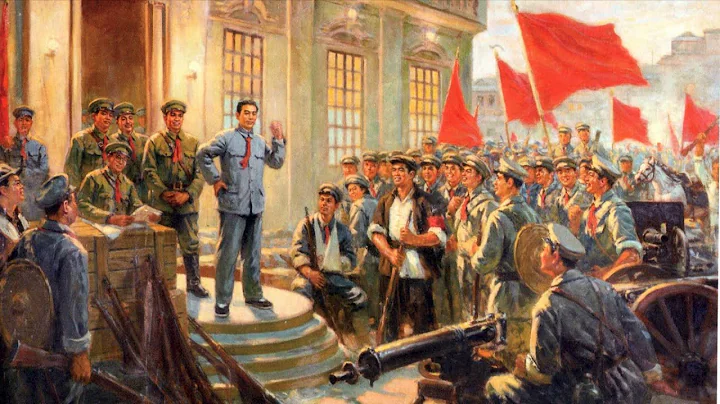
On April 23, 1945, as the War of Resistance Against Japan was about to win, the Seventh National Congress of the Communist Party of China was finally successfully held in Yan'an.
This conference has been held for 17 years since the Sixth National Congress of the Communist Party of China. After seventeen years, the Communist Party of China has overcome the most difficult decade of land revolution and the full-scale war of resistance, and the situation faced has also undergone earth-shaking changes.

7th Congress of the Communist Party of China
At the 6th Congress of the Communist Party of China, white terror in China was extremely serious, Communist Party members were massacred, and there were few revolutionary bases. By 1945, the People's Army had dozens of bases behind enemy lines, with a total population of nearly 100 million. The number of party members also increased from tens of thousands in 1928 to 1.21 million.
Therefore, after 17 years, the 7th National Congress held by the Communist Party of China is extremely grand and has extremely profound historical significance. Because, it was at this conference that we summarized the historical experience of China's new democratic revolution for more than 420 years and formulated the correct route and correct principles and strategies.
This conference not only allowed the whole party to achieve unprecedented unity and unity on the basis of Marxism-Leninism and Mao Zedong Thought, but also laid a solid foundation for the victory of the War of Resistance.
Therefore, the Seventh National Congress of the Communist Party of China is extremely critical. There were a total of 755 representatives attending the conference, including 547 formal representatives and 208 alternate representatives respectively. This conference also elected the Central Committee and the Central Leading Organization. Among them, 44 were elected as members of the Central Committee and 33 were elected as alternate members of the Central Committee.
So you can imagine how valuable the 44 Central Committee members is. These 44 members are either the main leaders of the party such as Chairman Mao and Zhou Enlai, or the generals and leaders of the Red Army who had experienced the Long March or stayed in the Southern 8 provinces and insisted on the three-year Red Army guerrilla war. Of course, there are exceptions among them. The most conspicuous one is Bo Yibo, who was named by Chairman Mao himself.
1945 when the Seventh National Congress of the Communist Party of China was held, Bo Yibo, born in 1908, was only 37 years old. His age was the youngest among the general very young members of the Central Committee at that time.
, and, most special, Bo Yibo is different from most Central Committee members. During the ten-year land revolution, Bo Yibo did not fight in the southern region of the Party and the Red Army, but always insisted on the North China region of the White terror and the Party's weak power.
Not only that, before the War of Resistance Against Japan, Bo Yibo never participated or led the Red Army. Therefore, when many senior Red Army generals with great military achievements and profound qualifications were not even alternate members of the Central Committee, the young and relatively low-qualified Bo Yibo was directly elected as a member of the Central Committee, which can be imagined.
You should know that Su Yu , the leader of the top ten founding generals, is also an alternate member of the Central Committee. So, why did Bo Yibo, who had never participated in the military struggle of the Red Army and was not familiar with most central leaders, come from behind and serve as a member of the Central Committee?
Bo, who had relatively weak qualifications and work experience, was elected as a member of the Central Committee. Some people did object to him at that time, some people thought that his qualifications were too shallow, and some people raised objections from the perspective of historical experience.
For example, General Chen Geng once bluntly pointed out that during the Agrarian Revolution, Bo Yibo, who insisted on the struggle in North China, was imprisoned many times, and the longest time was imprisoned for five years. According to the party’s hidden front regulations, his release procedures were not perfect.
General Chen Geng has made great achievements in the founding general of the People's Republic of China. As early as 1922, the second year of the founding of the Communist Party of China, he joined the party. Moreover, General Chen Geng's rich experience and legendary process are not as good as the many founding fathers.
After the establishment of the Whampoa Military Academy, Chen Geng entered the school and became a graduate of the first phase of the Huangpu , known as the disciple of the emperor. Moreover, during the first cooperation between the Kuomintang and the Communist Party, Chen Geng, who participated in the two Eastern Expeditions of the National Revolutionary Army, not only made many military achievements on the battlefield, but also saved the life of Chiang Kai-shek and became Chiang Kai-shek's life-saving benefactor.
In 1926, Chen Geng was sent to the Soviet Union to study. After the failure of the revolution, Chen Geng, who returned from the Soviet Union, participated in the August 1st Nanchang Uprising. Unfortunately, Chen Geng was seriously injured while following the rebel army to the south and had to leave the rebel army to go to Shanghai to heal his wounds.
After recovering from injury, Chen Geng, who was originally a soldier, entered the work of the Special Section of the Central Committee of the Communist Party of China in Shanghai. At that time, Chen Geng was one of the four section chiefs of the famous Central Committee of the Special Section 4. In Shanghai, where the white terror is the most serious, the activities of the underground party are led and the struggle against the Kuomintang reactionaries on a hidden front. Chen Geng has made great achievements with his strong party spirit and flexible skills.
Not only that, after working in the Central Special Branch for nearly 4 years, in September 1931, he was again sent to the second largest red base in China at that time, Hubei, Henan and Anhui Soviet Area.
After entering the Hubei-Henan-Anhui base, Chen Geng showed his outstanding military talent. He started with the commander of the Red Army and led his troops to win one battle after another, and his troops became stronger and stronger. As the base area continued to grow, Chen Geng served as commander of the Red 12th Division and chief of staff of the Red Fourth Front Army.
It can be said that with Chen Geng's military talent and military achievements, if it were not for the serious injuries in the fourth anti-encirclement and suppression battle and had to leave the army, Chen Geng would most likely have become one of the main leaders of the Red Fourth Front Army. With Chen Geng's achievements and qualifications, it is not surprising that he became the founding marshal of New China.
After leaving the troops seriously injured in the fourth anti-encirclement and suppression operation, and went to Shanghai again to treat the wounds, Chen Geng was arrested for the betrayal of the traitor. Originally, Chiang Kai-shek was never ruthless to the Communist Party, so there were many founders and senior leaders who died.
However, because he had saved Chiang Kai-shek's life and the pleading of the first-year students of Huangpu, Chen Geng finally successfully escaped from Nanjing and entered the Central Soviet Area.
In Central Red Army , Chen Geng has successively served as principal of the 1st Infantry School of the Red Army and head of the Red Army cadre regiment. After the Long March arrived in northern Shaanxi, Chen Geng successively served as commander of the 1st Division of the Red Army, brigade commander of the 386th Brigade of the 129th Division of the Eighth Route Army, commander of the Taiyue Military Region , commander of the Taiyue Column, etc.
In addition to his extremely legendary and rich work experience, General Chen Geng has always been known for his integrity and courage. Therefore, it is definitely not for private reasons that openly oppose Bo Yibo's election as an alternate member of the Central Committee at the Seventh National Congress.
In fact, Chen Geng, who has been fighting in the Central Special Forces, the Fourth Red Front Army, and the First Red Front Army, didn't even know Bo Yibo before this. The reason why he made objections outspoken is also related to his rich work experience. Chen Geng, who once led the enemy's heartland, in Shanghai, knew very well the importance of a party cadre working behind enemy lines, especially a senior party cadre. There have been too many incidents in the history of our party that caused heavy losses to the party organization after the betrayal of senior cadres.
For example, the Gu Shunzhang rebellion that Chen Geng personally experienced is one of the most heavy-than-lost rebellion incidents in the history of the party. At that time, Gu Shunzhang, who was the chief of the special department with Chen Geng, rebelled and almost lost all the party's party organizations in Shanghai and Jiangsu.
Therefore, it is precisely because of leading the party’s hidden front struggle that Chen Geng raised objections because of public sentiment.
However, Chairman Mao, who has a higher position and a longer-term consideration, not only rejected the objections of Chen Geng and others, but also further promoted Bo Yibo to a formal member of the Central Committee from a new perspective. Because Chairman Mao believes that although Bo Yibo is young, his qualifications and abilities are fully qualified for the position of a member of the Central Committee. As for Chen Geng’s concerns about the procedures for release from prison, Bo Yibo has long proved his loyalty to the party with his actual achievements.
has never participated in the Red Army struggle, and it was not until 1943 that Bo Yibo, who met Chairman Mao for the first time, had his qualifications and abilities that Chairman Mao would appreciate so much?
All this needs to be talked about with Shanxi and Yan Xishan .
Bo Yibo is from Shanxi, and his experience and ability are extremely outstanding.Originally, such talents from Shanxi were the most popular talents that King Yan Xishan of Shanxi liked to value, and all the generals under him were from Shanxi.
However, this outstanding Shanxi native is not on the same road as Yan Xishan. As early as 1925, Bo Yibo, who was only 17 years old, joined the Communist Party of China.
Because of long-term working in the harsh white area , Bo Yibo was arrested four times and was imprisoned twice. The longest time, he was imprisoned in the Kuomintang prison for five years. By 1935, Bo Yibo was almost executed by the Kuomintang.
The extremely arduous environment did not make Bo Yibo surrender, but further trained his ability and loyalty to the party. What really made Bo Yibo generous and glorious was during the War of Resistance Against Japan.
In September 1936, Bo Yibo and 54 other party members were rescued and released from prison by the party organization. Shortly after he was released from prison, he was sent to Shanxi. At this moment, facing the invasion of the Japanese invaders, Yan Xishan, who could not dance on the three eggs, decided to find a new allies.
Japan is ambitious and wants to occupy the entire Shanxi. Chiang Kai-shek is not only far stronger than himself, but also covets Shanxi for a long time. In desperation, Yan Xishan chose the slightly weaker Communist Party of China.
It is in this situation that Bo Yibo, a Communist Party member from Shanxi, became the bridge between Yan Xishan and the Communist Party of China. Therefore, Yan Xishan recruited Bo Yibo and others to discuss cooperation matters.
, and Bo Yibo seized the opportunity and proposed three rules without hesitation, and thus established a full mobilization of the masses with Yan Xishan Shanxi Sacrifice and Saving the Country Tongmenghui .
Taking advantage of Yan Xishan's fear of the Japanese invasion and urgently needed to develop strength, when Bo Yibo was hosting the Sacrifice Alliance, he greatly developed the strength of the party organization in Shanxi by "using Yan Xishan's noodle bag to completely contain our noodles".
At that time, under the leadership of Bo Yibo, 6 of the seven members of the Sacrifice League were Communist Party members, and among the 22 executive members, more than 80% of the Communist Party members and progressive members who tend to be Communist Party members accounted for.
It can be said that under Bo Yibo's effective work, Sacrifice Alliance has completely become an institution that tends to make progress and is controlled by the party organization. Moreover, Bo Yibo made full use of the organizational form of the Sacrifice Alliance and sent a large number of special commissioners to various counties in Shanxi to carry out anti-Japanese and national salvation activities.
At that time, among the 105 counties in Shanxi, the county magistrates of 70 counties were appointed as commissioners of the Sacrifice Alliance. Most of these special commissioners are Communist Party members.
It can be said that after the Eighth Route Army arrived behind enemy lines to fight against Japan, Shanxi became the first stop of the Eighth Route Army's anti-Japanese war and quickly opened up the situation in Shanxi, the sacrifice alliance of Bo Yibo's leaders played an extremely important role and laid a good mass foundation.
Not only that, while leading the Sacrifice Alliance to vigorously carry out the anti-Japanese and national salvation movement , Bo Yibo, based on the idea of using Yan Xishan's old army to fail and unable to stop the Japanese invaders' attack, and urgently needed to establish a combat-effective new army, he also used Yan Xishan's resources to establish the Shanxi Youth Anti-Japanese Death Squad.
At that time, Bo Yibo made full use of the situation where Yan Xishan's old army was scattered everywhere and guns were thrown everywhere, and proposed to Yan Xishan the "formation of a new army of 5 to 10 brigades." This suggestion was highly recognized by Yan Xishan, who was in urgent need of an army.
Soon, under Bo Yibo's organization, the Shanxi New Army quickly developed to 4 decisive columns, 50 regiments, and about 50,000 troops. At its peak, the weapons and numbers of Shanxi's new army even exceeded that of Yan Xishan's old army.
Moreover, although this Shanxi New Army with more than 50,000 people, although officers at all levels were old officers sent by Yan Xishan, Bo Yibo has always insisted on implementing the political commissar system in the Shanxi New Army, and therefore firmly controlled the leadership of most of the new army.
It is precisely because of Bo Yibo's correct leadership that Yan Xishan, after launching an anti-communist climax and trying to seize the leadership of the Shanxi New Army, the Shanxi New Army, with the assistance of the Eighth Route Army, not only smashed the attack of Yan Xishan's old army, but also, except for the third column of the Shanxi New Army, lost some of its troops, all 33 regiments left Yan Xishan, met with the Eighth Route Army, and were officially incorporated into the Eighth Route Army.
33 fully equipped and well-trained new troops joined not only greatly enhanced the Eighth Route Army's strength, but also made great contributions to the Eighth Route Army's development of bases behind enemy lines and the Japanese invaders' operations.
Therefore, the rapid development of the Eighth Route Army in the battlefield behind enemy lines in North China, especially in Shanxi, is closely related to Bo Yibo's effective work. This is probably also a key factor in Chairman Mao's appreciation of Bo Yibo, and even after someone raised objections, he directly promoted Bo Yibo to a formal member. Because, not judging from background, only talent, and qualifications have always been the key factor in Chairman Mao’s employment.