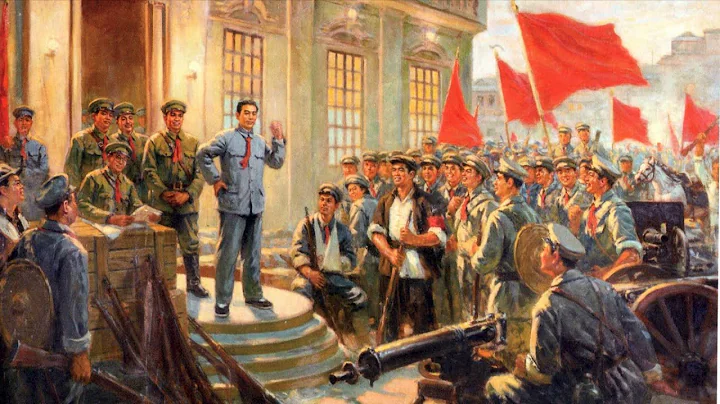
Wang Hongwen is one of the main members of the "Gang of Four". He was originally just a security officer of Shanghai National Cotton 17 Factory. After the special period of ten years began, Wang Hongwen initiated the establishment of the "General Office of Industry" and became the deputy director of the Shanghai Municipal Revolutionary Committee through armed struggles. Because Wang Hongwen was born in a poor family, served as a soldier, and was a worker, and was a combination of "workers, peasants and soldiers", he attracted the attention of his superiors. He performed well after the September 13th incident, so he was transferred to Beijing to work in 1972. After being transferred to Beijing, Wang Hongwen was promoted to vice chairman and served as a member of the Standing Committee, and was promoted to the national level. It is worth mentioning that since he became vice chairman, Wang Hongwen's treatment has suddenly improved a lot. For example, he originally lived in Diaoyutai html Building 416, where Zhang Chunqiao, Yao Wenyuan and other staff also lived, but later, Building 16 became Wang Hongwen's residence alone.
Not only that, Wang Hongwen is also equipped with 4 secretaries, other guards, chefs, etc. Speaking of this, let’s focus on Wang Hongwen’s guard. His guard is named Wang Aiqing. On October 6, 1976, Wang Hongwen went to Huairen Hall to attend the meeting and was accompanied by Wang Aiqing.

On the morning of October 6, Wang Dongxing issued a meeting notice, telling Wang Hongwen to hold a meeting at Huairen Hall at 8 o'clock in the evening. After dinner in the evening, Wang Hongwen watched it early and watched TV in the next office for a while. Wang Hongwen was fascinated by watching TV and forgot the time. Soon after, Wang Aiqing came in and called Wang Hongwen, reminding him that it was getting late and he set off quickly.
Before entering Huairen Hall, Wang Aiqing was stopped outside by members of the special operations team. After that, the special operations team arrested Wang Hongwen, and Wang Aiqing was also controlled. After that, Wang Aiqing and other staff members of Wang Hongwen's office were transferred to the study class. Their main task in this study class was to expose Wang Hongwen's crimes. So, as Wang Hongwen’s guard, what crimes did Wang Aiqing expose Wang Hongwen’s?
Wang Aiqing spends a lot of time with Wang Hongwen and is familiar with Wang Hongwen's daily life. According to his description, in 1976, when Chairman Mao was seriously ill, Wang Hongwen was ordered to be on duty in Zhongnanhai . He did not take Chairman Mao's condition seriously at the time, nor did he be at ease on duty. Since early July, he started fishing at Chairman Mao's residence, and sometimes even escaped from the duty room and ran to Beihai Park to fish.
In addition, starting from mid-July, Wang Hongwen took an shotgun to shoot birds at Chairman Mao’s residence. At that time, Chairman Mao was seriously ill and needed to rest, but Wang Hongwen ignored it and still shot birds. The guards dared not speak out when they saw this. Around July 20, during the duty period, Wang Hongwen suddenly wanted to swim, so he put down his work and went swimming several times. He was very happy during the swimming period and was not sad at all because Chairman Mao was seriously ill.
In addition, Wang Aiqing also recalled one thing, that is, the day after Marshal Zhu De's death, Wang Hongwen began to continue fishing during duty without any sadness. As soon as Chairman Mao’s memorial service ended, Wang Hongwen began to hold entertainment activities at his residence, such as playing poker, playing chess, watching movies, etc., without any sadness.
During the study class, Wang Aiqing used a sentence to describe her feelings: "It is seen in my eyes, and I hate it in my heart." It was just because of his identity that Wang Aiqing dared not speak out. It was not until after the "Gang of Four" was smashed and Wang Hongwen was arrested, the central government demanded that the "Gang of Four" continue to expose and criticize the "Gang of Four" that Wang Aiqing wrote down what he saw and heard during that period.
It should be noted that Wang Aiqing is just Wang Hongwen’s guard. From his perspective, what he sees is usually trivial matters in life. Wang Hongwen’s real crime is to persecute the founding fathers and revolutionary cadres, which is also the main reason why he was severely punished by law.