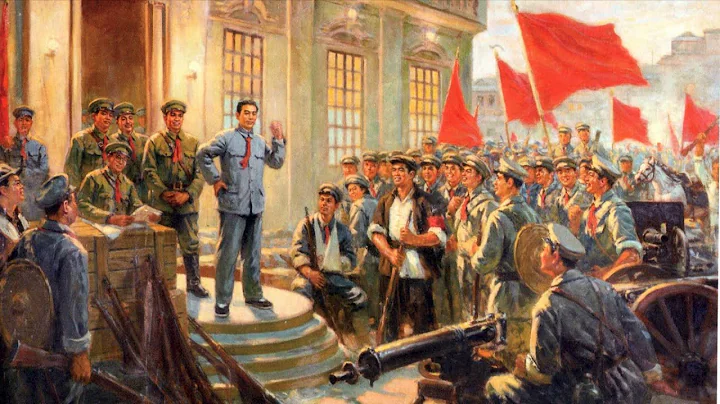
On the afternoon of September 27, 1955, after the ceremony of awarding the rank of the Chinese People's Liberation Army, some old coaches were arranged to rest in Huairen Hall . Chen Yi asked He Long in a strong Sichuan accent: "President He, have you ever thought about being a marshal today?"
He Long pondered for a while and said, "Don't say it's quite a marshal, I never thought about the first shot that fired! I just wanted to put that one The gun is good!"
After a while, Zhou Enlai walked in. When everyone asked for good news, He Long said sincerely: "Our Vice Chairman Zhou should also be awarded the title!"

Many students' first impression of Zhou Enlai is that he is the Prime Minister and in charge of diplomatic work. He believes that it is natural for Zhou Enlai to not evaluate the military rank. In fact, Zhou Enlai is one of the founders of the Chinese army and is fully qualified to select the marshal.
On August 1, 1927, the Communist Party of China launched an armed uprising in Nanchang . Zhou Enlai, secretary of the Nanchang Uprising Committee, deserves to be one of the founders of the Chinese People's Armed Forces. At the time of failure of the revolution, , why was Zhou Enlai, who was only 30 years old, able to become the leader of this historical node?
Zhou Enlai was one of the earliest important pioneers in the party to engage in military work. During Zhou Enlai's work-study work and study in France, he learned about the experience of the October Revolution in Russia and became aware of the importance of organizing a revolutionary army. In December 1922, Zhou Enlai wrote in the magazine "Youth": "A real revolution must have an extremely strong and extremely organized revolutionary army. Without a revolutionary army, warlords cannot be defeated."
Shortly after returning from Europe, Zhou Enlai was appointed by the party organization and served as the director of the political department at Whampoa Military Academy. Zhou Enlai was only 27 years old at the time. However, due to his outstanding personal charm, he was respected and loved by teachers and students during his time at Whampoa Military Academy.
As the director of the political department, Zhou Enlai established a political work system in the Whampoa Military Academy according to the experience of the Soviet Red Army, carried out a lot of political work, and set up and taught many political classes for military academy students. He also personally gave lectures to students, carried out anti-imperialist and anti-feudal education, guided students to support the Workers' and Peasants' Movement, and actively participated in the rising revolutionary struggle at that time.
When Zhou Enlai was in the military academy, he organized the Youth Military Federation with Communist Party members as the backbone. Many teachers and students participated. By August 1925, the Youth Military Federation had grown to more than 2,000 people.
It is precisely because of Zhou Enlai's teaching that many students devoted themselves to the revolutionary movement after graduation. Later, many senior generals of the People's Liberation Army of China worked or studied at the Whampoa Military Academy. A large number of military talents also made cadre preparations for the later Nanchang Uprising.
Zhou Enlai was presided over the leadership of the Political Department of the Whampoa Military Academy, and also participated in the activities of military construction. Due to the political turmoil at that time, the Whampoa Student Army also went to the battlefield, and Zhou Enlai personally led the Whampoa Student Army to participate in many battles.
In early 1925, Chen Jiongming launched a rebellion, conspiring to attack Guangzhou and overthrow the Guangzhou Revolutionary Government. In order to consolidate and develop the Guangdong Revolutionary Base, the Guangzhou Revolutionary Government carried out the first Eastern Expedition to attack Chen Jiongming with more than 3,000 people from two teaching groups of the Whampoa Military Academy as the main force.
Zhou Enlai personally led the main force of the right wing to carry out the Eastern Expedition. After less than two months of hard fighting, he defeated Chen Jiongming's main force and forced Chen Jiongming to trap Huizhou .
When the Eastern Expedition Army was preparing to siege Chen Jiongming's nest, the troops stationed in Guangzhou, Yang Ximin, the Yunnan warlords and Liu Zhenhuan, who were stationed in Guangzhou, launched an armed rebellion. The situation was once very tense. Zhou Enlai still personally led the army back to Guangzhou and put the rebellion in just two days.
, unwilling to accept the defeat, Chen Jiongming led the remnants to occupy the Dongjiang area again. Guangzhou National Government decided to hold the second Eastern Expedition . This time, Zhou Enlai served as the director of the General Political Department of the Eastern Expedition Army and the director of the Political Department of the First Army. Under Zhou Enlai's constraints, the entire army was disciplined and fought bravely. He soon wiped out the remnants of Chen Jiongming, successfully captured Huizhou, and achieved the final victory of the Eastern Expedition.
During the Eastern Expedition, Zhou Enlai established the "Iron Armored Convoy of the Grand Marshal of the Army and Navy" after obtaining the consent of Sun Yat-sen. This is also the first force directly controlled by our party. In addition to serving as a guard task, the Iron Armored Convoy also participated in revolutionary military struggles many times.
1925, according to the instructions of his superiors, Zhou Enlai, based on the armored chariot and students of the Whampoa Military Academy as the backbone, established the Independent Regiment of the Fourth Army of the National Revolutionary Army in Zhaoqing, Guangdong. The regiment commander was Ye Ting. Although the Independent Regiment of the Independent Regiment of the belonged to the Fourth Army, it was actually controlled by our party. The regiment commander Ye Ting and battalion commander, including the first-level cadres of the company, were mostly Communist Party members or young members of the League, and a party organization was established throughout the regiment.
Under the direct leadership of Zhou Enlai, Ye Ting's Independent Regiment quickly established a political work system, making the entire army appear completely different from the old army.
In the summer of 1926, before Northern Expedition Army officially set off, Ye Ting's Independent Regiment, as the vanguard force, took the lead in launching a path for the entire Northern Expedition Army.
Before the Independent Regiment set off, Zhou Enlai made a special trip to Zhu Di, the Independent Regiment, held a meeting of cadres above the company and conducted pre-war mobilization. After his speech, he shook hands with cadres above the company and encouraged everyone very cordially: "White Ma Yangtze River , meet in Wuhan." Ye Ting Independent Regiment fought bravely in the Northern Expedition , fought many victories, and was known as the "Iron Army".
While the Independent Regiment was fighting on the front line, in order to cooperate with the successful march of the Northern Expedition Army, Shanghai workers held two uprisings in December 1926 and February 1927 under the leadership of the Communist Party of China, but neither succeeded.
So the Party Central Committee sent Zhou Enlai to Shanghai to organize and command the third uprising. In March 1927, under the leadership of Zhou Enlai and others, they summarized the experiences and lessons of the first and second uprisings, reorganized the team, and conducted simple military training.
On March 21, when the Northern Expedition Army arrived in the suburbs of Shanghai, Zhou Enlai led the Shanghai workers to hold an armed uprising. After a day of fierce fighting, he annihilated the warlords' troops. On March 22, he took over Shanghai, established the Shanghai Special Provisional Government, and won the uprising.
In the three years from 1925 to 1927, Zhou Enlai not only participated in the establishment of the revolutionary army, but also commanded many major battles and accumulated some valuable experience, which laid the foundation for his later organization and command of the Nanchang Uprising.
1927 Chiang Kai-shek launched the April 12th counter-revolutionary coup in Nanjing, and Wang Jingwei launched the July 15th counter-revolutionary coup, resulting in the failure of the great revolution of the Kuomintang-Communist cooperation in 1924.
In order to resist the massacre of the Kuomintang reactionaries and save the Chinese revolution, the CPC Central Committee was determined to rely on the troops it controls and influences to carry out the Nanchang Uprising. Immediately, the CPC Central Committee appointed Zhou Enlai as secretary of the CPC Front Committee.
Why did the Party Central Committee arrange for Zhou Enlai to serve as secretary of the former enemy committee? This is because at the previous meeting of the Standing Committee of the Political Bureau of the CPC Central Committee, the Central Military Department of the CPC Central Committee was established, with Zhou Enlai as the Minister of the Military Department and serving as the Secretary of the Military Commission.
On July 27, Zhou Enlai arrived in Nanchang and the leaders stepped up preparations for the uprising.
On July 28, Zhou Enlai found He Long and explained to him that the Communist Party was preparing to organize an armed uprising. He Long, who had not yet joined the party, was moved by Zhou Enlai's sincerity and said, "I will do whatever the Communist Party told me to do."
Zhou Enlai immediately issued an order to lead more than 20,000 people in the 20th army to participate in the uprising, and appointed He Long as the commander-in-chief of the uprising. Then, with the assistance of Liu Bocheng, He Long immediately formulated a combat plan and closely cooperated with the National Revolutionary Army controlled by Zhu De and Ye Ting.
In the early morning of August 1, gunshots of the uprising started, and fierce battles for 5 hours were eliminated, the Kuomintang's Nanchang defenders were eliminated, and the uprising was won in one fell swoop.
Why is Zhou Enlai one of the founders of the Chinese People's Army?
In 1944, Zhu De said at a symposium on writing the history of the First Army Corps of the Red Army: "The source of the First Red Army began when the revolutionary government reorganized the army under its jurisdiction in 1925, and unified the army under its jurisdiction into the National Revolutionary Army. Comrade Ye Ting, our party, established an independent regiment, which was affiliated with the 12th Division of Zhang Fakui of the Fourth Army. During the Northern Expedition, the regiment had about 2,000 people, and most of the cadres were Communists. Nowadays, Comrades Lin Biao, Zhou Shidi, Chen Yi, Nie Heting , Xiao Ke and other comrades all came from the independent regiment. During the Nanchang Uprising, the regiment had developed into 6 regiments."
Then, Zhu De said: "In the Great Revolution, many military movements were carried out in the Great Revolutionary period. During the Great Revolutionary Uprising, the regiment had developed into 6 regiments."
Then, Zhu De said: "In the Great Revolution, many military movements were carried out in the Great Revolutionary period. During the rebellion of Nanchang, the regiment had developed into 6 regiments."
Then, Zhu De said: "In the Great Revolution, many of them were engaged in military movements in the Great Revolutionary period. During the rebellion of Nanchang, the regiment had developed into 6 regiments."
Then, Zhu De said: "In the Great Revolution, many of them were engaged in military movements in the Great Movement in the years of the Great Revolution. During the rebellion, the regiment had developed into 6 regiments."
Then, Zhu De said: "In the Great Revolution, many of them were engaged in military movements in the Great Movement. During the Great Revolution, the regiment had developed into 6 regiments."
Then, Zhu De said: "In the Great Revolution, many of them were engaged in military movements in the Great Move Comrades, Zhou Enlai, Nie Rongzhen, Li Fuchun, and other comrades of the secret military training class held by the Party at that time, and comrades in the secret military training class held by the Party, had made contributions to the creation of our army. Without the military movements they carried out, there would be no independent regiments, and there would be no uprisings in Nanchang, Autumn Harvest, Guangzhou, and Hunan."
After the Nanchang Uprising, the CCP's revolution entered the period of the Agrarian Revolutionary War. Zhou Enlai's main work was still responsible for the military. In February 1930, the Central Military Department and the Central Military Commission merged to establish a new Central Military Commission of the Communist Party of China (hereinafter referred to as the "Central Military Commission"). As the highest command body of the national Red Army , Zhou Enlai was appointed as the Secretary of the Central Military Commission.
1935 Zunyi Conference canceled the supreme military command power of Bogu and Li De. Zhou Enlai still commanded the military and did not "the person who made the last determination". After the meeting ended, the Central Committee of China decided to form a "three-person military team" by Mao Zedong, Zhou Enlai and Wang Jiaxiang to command the military operations of the entire army. From then on, Zhou Enlai did not leave the central leadership center and began close cooperation with Mao Zedong for 40 years.
1937 On July 7, 1937, the comprehensive war of resistance broke out. In order to strengthen the party's absolute leadership over the army under the new situation, the enlarged meeting of the Political Bureau of the CPC Central Committee decided to form the Revolutionary Military Committee of the CPC Central Committee. As the military leadership body for the Central Committee of the CPC leading the armed struggle and military construction of various anti-Japanese base areas, Mao Zedong served as chairman, and Zhou Enlai and Zhu De served as vice chairman.
In fact, Zhou Enlai also had military ranks within the Kuomintang. When he was at the Whampoa Military Academy, Zhou Enlai's military rank was the director of the Major General's Political Department. During the second cooperation between the Kuomintang and the Communist Party, the Military Committee of the National Government again established the Political Department, with Chen Cheng as the minister, and Zhou Enlai was specially invited as the lieutenant general and deputy minister
After the victory of the War of Resistance Against Japan, the Political Bureau of the CPC Central Committee held an enlarged meeting to form a new Central Military Commission, with Mao Zedong and the vice chairman being Zhu De, Liu Shaoqi, Zhou Enlai and Peng Dehuai.
In the early and mid-stage of the Liberation War, Zhou Enlai also acted as Chief of Staff of the Military Commission, and participated in the leadership and command of the three major battles of Liaoshen, Pingjin and Huaihai.
Until September 1954, the Central Committee of the Communist Party of China decided to re-establish the Central Military Commission, and the former People's Revolutionary Military Commission of the Central People's Government was abolished. Since then, Zhou Enlai focused his work on politics and foreign teachers, and he has never held a position directly related to the military.
Looking at Zhou Enlai's life, we can see his contribution to the Chinese revolutionary cause. He is one of the earliest pioneers and founders of military work in our party. The history of the founding of the People's Liberation Army of China and the majestic war history of the Chinese people embodies Zhou Enlai's hard work, wisdom and unique merits. He is a well-deserved old marshal who does not wear the rank of marshal.
Therefore, in September 1955, when Zhu De and 10 founding marshals all saluted Zhou Enlai with great respect and said, "You are also a marshal."
So, why didn't Zhou Enlai evaluate the rank of marshal? Before evaluating military ranks, according to the Regulations on the Service of Officers, leaders such as Mao Zedong, Zhou Enlai, and Liu Shaoqi should be awarded the title. Mao Zedong should be awarded the title of Grand Marshal, and Zhou Enlai, Liu Shaoqi, and Deng Xiaoping should be awarded the title of Marshal.
But after Mao Zedong learned about it, he waved his hand and said, "I won't be that great marshal!"
Chairman Mao said to the staff who evaluated military ranks: "Your rank evaluation is a big job and a very difficult job. I, the marshal, don't want it anymore. It's so uncomfortable to let me wear the marshal's uniform! It's so inconvenient to go to the masses to speak and engage in activities! According to my opinion, it's better not to evaluate the military ranks if you work in the local area now!"
Then Chairman Mao turned to Liu Shaoqi and said, "You have done it in the army, you are also a marshal."
Comrade Liu Shaoqi immediately said: Don't comment.
Chairman Mao asked Zhou Enlai and Deng Xiaoping again: "Do you want to evaluate your rank of marshal?"
Zhou Enlai waved his hands repeatedly and said: "Don't comment, don't comment!"
Deng Xiaoping smiled and said: "What kind of marshal is you, you won't be able to lead troops."
Song Renqiong wrote in his memoirs: Some central leaders led by Chairman Mao took the initiative to propose not to award ranks, which is a great education for all the cadres of the army and also solved many contradictions in the rank evaluation work.