Introduction
 949, after three major battles, the Chinese People's Liberation Army gradually eliminated the vital forces of the Kuomintang, and Chiang Kai-shek led the remnants of the forces to retreat to Taiwan. Under Chiang Kai-shek's promise, the second-level Kuomintang general Li Pinxian also came to Taiwan.
 After coming to Taiwan, Li Pinxian was appointed as an idle job by Chiang Kai-shek as an "advisor to the Strategic Advisory Committee". Two years later, Li Pinxian retired. In order to make a living, he sold his farm in Taipei and then built a built-in house in Taipei City, living a life without anyone's interest.
General Li Pinxian
987 General Li Pinxian died. Before his death, he said to his family sadly: "I was in war for the rest of my life, and I abandoned literature and practiced martial arts. Although I had no time to help the military, I was in a state of great shame, but I was sorry for it. I regret it. I am now 80 years old this year. I know that there is not much future, but I still live in the island of the sea. Looking west at my hometown, I can't help but feel sad. "
In fact, it is false to be upright in Li Pinxian's life. He felt too much guilt and too many regrets.
abandoned literature and became a tycoon of the Guangxi clan
When it comes to Li Pinxian, he is a giant among the Guangxi warlords, second only to Li Zongren , Bai Chongxi , and Huang Shaohong, and is deeply recognized by Chiang Kai-shek.
890 In 2019, Li Pinxian was born in a scholarly family in Cangwu, Guangxi. His father was a famous scholar who liked to dance and write. He also worked as a teacher in a local village school. Later, he served as the county magistrate of Cangwu County, and was the top figure of Cangwu . My father had high expectations for Li Pinxian since he was a child. Li Pinxian did not lose his father's face. At the age of 13, he passed all the examinations in the county and was surrounded by people. Compliment.
Scene of the Qing Dynasty imperial examination
According to the family's plan for him, Li Pinxian should have taken the imperial examination path. At the age of 13, Li Pinxian participated in the last imperial examination in the Qing Dynasty. Unfortunately, because he forgot to write one when answering the paper, he failed to get the imperial examination in his life.
was learning from his mistakes and was preparing to wait until the second year to attack the imperial examination again During the exam, the Qing government announced the cancellation of imperial examination , and Li Pinxian's dream of going to the official career through the imperial examination was shattered again.
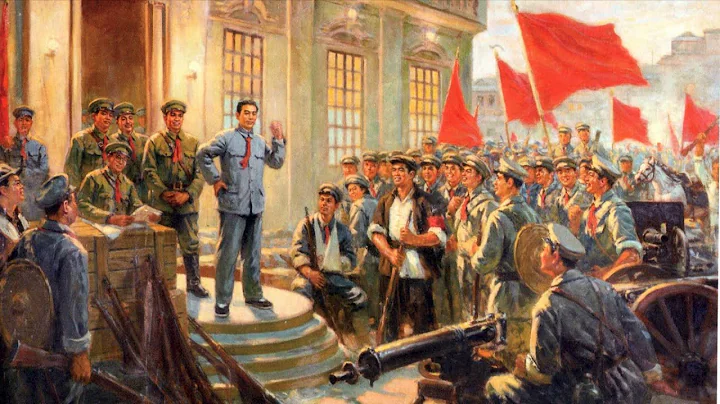
907, Cai E founded the Army Primary School in Guilin. After Li Pinxian learned the news, he decided to abandon literature and join the military, so he began his military career. After graduating from Army Primary School, Li Pinxian was admitted to the Third Army in Wuchang, Hubei with excellent results. The Wuchang Uprising (oil painting)
Wuchang Uprising (oil painting)
In the second year after he came to school, the Wuchang Uprising that shocked China and abroad broke out. After the uprising broke out, the old-style soldiers such as the general office, supervisor, and the commander of the team were afraid of the uprising because they opposed the revolution and were afraid of the uprising. Only one platoon leader and the assistant teacher sent by the new army stayed at the school.
At this moment, the students united and temporarily elected the platoon leader as the leader, drove the team into Wuchang City , actively responding to the revolutionary uprising. Li Pinxian also participated in the uprising, and the team he was in was ordered to occupy Snake Mountain . During this uprising, Li Pinxian performed well and was sent to Wuzhou Ordnance Bureau by the acting governor of the Guangxi Military Government to serve as an important position.
913, Li Pinxian applied for Baoding Lu Military Officer School became the first class student in the school. Here, he met the noble man Tang Shengzhi. After graduating from Baoding Military Academy , Li Pinxian was assigned to Guangxi to serve as the platoon leader of intern , but for two years, he did not receive any actual appointment. In the end, he decided to change to Hunan Army and obtained his first position in the army. —Lieutenant Platoon Leader.
Tang Shengzhi
At that time, his direct leader was Tang Shengzhi, a friend of Baoding Military Academy. During his time in the Hunan Army, with Tang Shengzhi's continuous promotion, Li Pinxian's position was greatly improved.
By 1927, Li Pinxian served as the commander of the Eighth Army. The reason why Li Pinxian was promoted to such a high position is inseparable from the promotion of Tang Shengzhi.
In August of the same year, Chiang Kai-shek failed steadily in commanding the Jinpu Road battle. Tang Shengzhi took the opportunity to get into trouble. He and Wang Jingwei
fought against Chiang in the east. However, he was betrayed by Wang Jingwei, and there were problems within the army, so Tang Shengzhi was forced to step down. As a subordinate and friend, Li Pinxian has always followed Tang Shengzhi's pace.930, after the outbreak of the Central Plains War of , Li Pinxian, as a famous general under Tang Shengzhi, entered the vision of Guangxi warlords such as Li Zongren. Li Zongren attached great importance to Li Pinxian's ability and directly appointed him as the Chief of Staff of the Fourth Army Headquarters.
Li Zongren
After Li Zongren was reused by Li Zongren, Li Pinxian was promoted very quickly with his outstanding military capabilities. After the outbreak of the Anti-Japanese War, Li Pinxian served as the commander-in-chief of the 11th Army of the New Guangxi Group, governing the 7th Army, the 31st Army and the 48th Army. This is already half of the troops of the New Guangxi Group
of the New Guangxi Group, which shows Li Zongren's trust in it.The famous anti-Japanese generals on the battlefield did not hesitate to dig graves in order to make money
After the outbreak of the Anti-Japanese War, Li Pinxian led 100,000 Gui Army , and participated in famous battles such as the Battle of Songhu, Xuzhou, , Wuhan, , and Zaoyi, , and made countless military achievements. Especially in the Battle of Wuhan, Li Pinxian's excellent performance was praised by everyone.
At that time, Li Pinxian had just participated in the Battle of Xuzhou. Before the soldiers could rest, they led their troops to participate in the Battle of Wuhan. At that time, the Japanese mobilized heavy troops to advance to Wuhan, and also mobilized a large number of aircraft to bomb, which made the Kuomintang army very passive on the battlefield.
A scene of the Wuhan Battle
At this critical moment, Li Pinxian received an order from Bai Chongxi to defend Guangji District, Wuhan. After receiving the task, Li Pinxian did not refuse and arrived at Guangji as the strategic location as soon as possible.
Li Pinxian mobilized more than 100,000 Gui troops and made full preparations for combat. Faced with the fierce artillery fire of the Japanese army, he led the soldiers to defend Guangji District for more than 30 days.
After this battle, Li Pinxian's reputation spread throughout the country and was even commended by Chiang Kai-shek.
However, although Li Pinxian is very good at fighting, he is also a good corruption. During the Anti-Japanese War, after Li Pinxian became the chairman of Anhui Province, he made great contributions to the national crisis.
General Li Pinxian
He set up an Anhui import and export cargo inspection office, but in fact he set up a checkpoint on the major transportation roads of each county. Due to the Japanese army's blockade, some essential items in the National District, such as salt, quilts, matches and other supplies were in short supply, so Li Pinxian seized this opportunity.
It is said that the Anhui Goods Inspection Office controlled by Li Pinxian alone has an income of more than two million yuan per month, and all of this money has been penetrated into Li Pinxian's personal pocket.
Li Pinxian's corruption is well known within the Kuomintang. However, he did a tomb robbery, which made people angry.
938, the War of Resistance Against Japan had entered a critical moment, and all defenders were preparing to fight. Li Pinxian led his troops to garrison in the area of Shouxian County. Local officials learned that Li Pinxian was very greedy for money, so they regarded his preferences and not only gave him some treasures, but also told Li Pinxian about the tomb of King Huai of Chu in the local area.
KMT army is digging treasures
Li Pinxian is greedy for money and likes antiques. He felt that if he did not take the treasures in these tombs as himself, there would be other people coming to rob the tombs, so he decided to take the opportunity to make a fortune before leaving.
After Li Pinxian made up his mind, he discussed the matter with the Chief of Staff of the Group Army He Xuan . They decided to send their confidants to Zhujiaji where King Huai of Chu to find out the situation, and then decide how to rob the tomb. After investigation, the confidants under
reported everything they saw and heard here to Li Pinxian. After grasping the specific situation, Li Pinxian decided to dispatch three companies of troops in the name of military exercises to dig tombs and rob treasures.
Under Li Pinxian's personal supervision, the soldiers did not dare to stop work and dig day and night. After more than three months of hard work, they robbed the tomb of King Huai of Chu.
Li Pinxian
In the tomb of King Huai of Chu, almost everyone is a treasure. Among the close-fitting funeral objects, there are one large green jade ball, two bronze swords, dozens of gold and silver bowls, and various strange treasures.
The most precious of them is a large number of Yin woods around the coffin called " Huangyan Tie Column ". These Yin woods are hard in texture, and ordinary sharp tools are even more difficult to cut off. After
excavated the treasure, he asked someone to transport all the treasures to Hong Kong and preserved them in an unknown mansion. At the same time, the soldiers were also asked to guard 24 hours a day, for fear that someone would take away his treasure. Although the matter of
is kept confidential, it was still exposed. Newspapers in various places are promoting the matter. His tomb robbery was strongly condemned by all parties, and it also triggered factional struggles in the military and political circles of the Republic of China. The treasure excavated by
(having nothing to do with this article)
The forces of all parties took this matter to make a big fuss. They took the opportunity to criticize the Guangxi clique, which also embarrassed Li Zongren and others. After Li Zongren learned about this, he contacted Li Pinxian as soon as possible and quickly asked what was going on.
It was the time of the national war of resistance, and the great rivers and mountains were occupied by the Japanese, but Li Pinxian was only thinking about how to make money. The people's anger towards him can be imagined. At the beginning, Li Pinxian pretended to be ignorant and ignored the responsibilities of Li Zongren and others.
As the incident fermented, Chiang Kai-shek also learned about this and quickly asked Dai Li to investigate. After obtaining enough evidence, Li Pinxian became in panic all day long because Sun Dianying is a lesson for the past. He was worried that he would follow Sun Dianying's footsteps, so he immediately took remedial measures and wrote a report for himself to defend himself.
In the report, Li Pinxian said shamelessly that the reason he excavated the ancient tomb was actually to protect the ancient tomb so that these treasures would not fall into the hands of the Japanese.
Chiang Kai-shek
While he was defending his words, he also actively carried out activities behind the scenes. He took out part of the stolen treasures and gave them to Chiang Kai-shek and Li Zongren respectively. Li Pinxian also gave gifts to some other Kuomintang political leaders. Soon, all parties were tacitly aware of it and did not continue to pursue Li Pinxian's crimes. After the storm of
subsided, Li Pinxian tasted the sweetness. So he turned his attention to another large tomb in Zhujiaji - the tomb of King Zhuang of Chu.
However, with the development of the war situation, the Japanese army launched an attack on the Anhui region. As the commander-in-chief of the army, Li Pinxian held an important position and had no choice but to stop.
Follow Chiang Kai-shek to retreat to Taiwan and eventually died in a foreign land
In December 1944, Li Zongren served as the commander-in-chief of the 10th War Zone, on an equal footing with Yan Xishan , Li Zongren and others. It was already the late stage of the Anti-Japanese War. Under Chiang Kai-shek's instructions, Li Pinxian pointed his finger at the Eighth Route Army and the New Fourth Army in the Dabie Mountains area, creating frictions many times to destroy the Anti-Japanese National United Front.
Li Pinxian
After the victory of the Anti-Japanese War, Li Pinxian actively cooperated with Bai Chongxi and others to lead the 11th Army to attack East China and the Central Plains Liberated Area.
946, he led the 7th, 46th and 48th armies of the Guangxi clique to attack the liberated areas, but he lost the 46th army in the East China region, causing severe damage to his vitality. He has been following Chiang Kai-shek's pace to implement the policy of "suppressing the Communist Party", and later served as the Chief of Staff of the National Army Central China Suppression General Office, encircling and suppressing Liu and Deng's army in the Dabie Mountains. 949, as the Kuomintang army retreated steadily on the battlefield, Li Pinxian sang harmony with Bai Chongxi in Wuhan, shouting slogans such as "total war" and "governing the river", hoping to stop the Chinese People's Liberation Army from moving south. For this reason, he divided Guangxi province into six military regions, launched a one-army, one-soldier and one-shot campaign, and wanted to be stubborn to the end. However, under the attack of the People's Liberation Army, even if Li Pinxian can fight, he will eventually be a mantis armed mantis.
Bai Chongxi
At this time, Chiang Kai-shek took the initiative to invite Li Pinxian to Taiwan and promised him a high-ranking official and generous salary.Under the temptation of power and money, Li Pinxian took the initiative to bring his family to Taiwan.
Shortly after Li Pinxian arrived in Taiwan, he sent a telegram to Bai Chongxi and others, inviting them to come here to discuss the plan. In this way, Bai Chongxi came to Taiwan because of Li Pinxian's telegram, and ended up dying in a foreign land.
After coming to Taiwan, things did not develop like Li Pinxian. Chiang Kai-shek was just a free agent to appoint him as an advisor to the Strategic Advisory Committee.
Since Li Pinxian was not Chiang Kai-shek's direct descendant, after he held a two-year idle position, Chiang Kai-shek ordered him to retire on the grounds that he had "existing his active service".
Li Pinxian in his later years (first right)
After retirement, Li Pinxian temporarily lived in an apartment in Taipei. In the winter of the same year, Li Pinxian was elected as the neighborhood chief by the neighborhood neighbors, that is, the president of the neighborhood committee. Although he refused several times, he was unable to step down.
In this free time, Li Pinxian opened a farm on the land outside Taipei City, named "Wollonggang Villa" to grow various vegetables.
At the same time, relatives and his subordinates often come here to visit. During the conversation, most of the conversations were about Cangwu’s hometown, which shows their longing for their hometown.
967, Li Pinxian's body turned sharply because of his age. In order to cure his illness, he had to sell the fish ponds and houses in Kowloon, Hong Kong as the cost of treatment. Later, he purchased a house in Taipei City and lived a life that no one cares about since then. Although he lived in secludedly at this time, he was unwilling to be lonely inside. He began to write memoirs and distributed them in a local book publisher in Taiwan. Li Pinxian (front) of combat command in
In his later years, he expressed his longing for his hometown many times, hoping to return to the mainland one day. However, his wish was ultimately unfulfilled.
In March 1987, Li Pinxian died in Taipei. Before his death, he kept sighing: "I spent my whole life on the battlefield, but I had too many regrets in my heart. I know that God has left me with less time, but unfortunately I can only stay on this island and never return to my hometown."
Li Pinxian's military ability is good, and his performance in the Anti-Japanese War is remarkable. However, his personality has obvious flaws. He stood against the people many times and ended up in a foreign land. Perhaps he would be retribution in the dark.