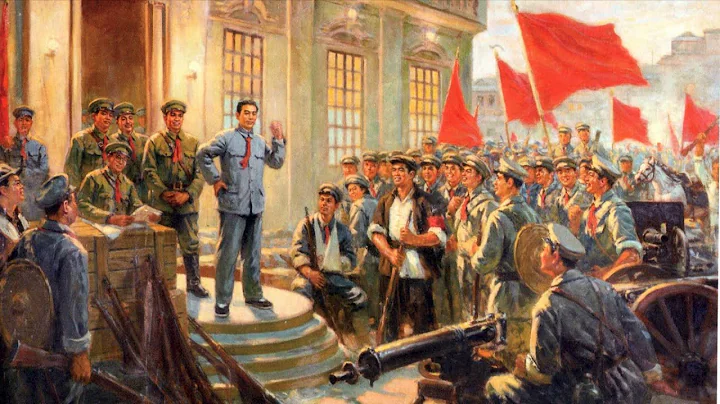
In 1955, New China held its first military award, among which there were as many as thousands of founding generals of all levels, most of whom graduated from military academies. Someone who is not from a professional background, but at the title evaluation meeting, everyone proposed to award the title of "He Grand Marshal".
This person is Chairman Mao, the founding leader. He said humorously at the meeting: "Where is me, I don't want the rank of Grand Marshal. If I were asked to wear the uniform of Grand Marshal, I would still feel uncomfortable. It would be not convenient for me to speak among the masses and do activities!" Chairman Mao politely rejected the rank of Grand Marshal in this way at that time.
We know that Chairman Mao graduated from Hunan No. 1 Normal School and has never had any relationship with the military academy. However, during the revolution, Chairman Mao led the Communist Party to fight and achieved revolutionary victory. His military level was even more outstanding than that of generals from top schools at that time. Why is that?

1. Cultural heritage and youth determination
Mao Zedong studied in a private school when he was young, and he read all kinds of classical literary classics in his childhood. The literary accumulation in his childhood made him stand out among children of the same age, and his familiarity with the Four Books and Five Classics and various historical classics can be seen in his later literary creations. In addition, the study of military strategy can be demonstrated during wartime.
's desire for knowledge prompted Mao Zedong to turn his attention to a farther place. In his youth, Mao Zedong came into contact with Western culture, and later, he came into contact with Marxist-Leninist thought, which further laid the foundation for Mao Zedong's path toward the revolution.
When Mao Zedong was young, the Xinhai Revolution was about to be nurtured in an extremely turbulent society. A young military officer suddenly came to the school to announce that he told the middle school students in the school: "Our emperor is still a 3-year-old child." This scene deeply affected Mao Zedong, and since then, he has been determined to serve the country. However, after graduating from junior high school, Mao Zedong found that the outside society was very chaotic, and the vast world and society could indeed increase his knowledge and broaden his horizons. However, wars could destroy everything in an instant at any time.
In order to fulfill the volunteer, Mao Zedong tried many methods.
First of all, he wanted to become a soldier who defended his country, but pedestrians on the street showed fear when they saw him wearing military uniforms; going to study medicine, but there were too many poor people who could not seek medical treatment during the war years; studying lawyers was not a good way, and survival was a problem, let alone thinking about the law-related matters; learning how to make soap may change the concept that foreigners think the Chinese are dirty... In short, Mao Zedong made many attempts on the road to serving the country.
Studying at Hunan Normal University is still a attempt by Mao Zedong. In this attempt, he met his mentor Yang Changji, revolutionaries Li Dazhao, Chen Duxiu and others. At this point, his life trajectory has completely changed.
2. Patience and reality
1918, when the trend of going abroad was launched, Mao Zedong was also moved. He consulted his teacher Yang Changji for advice on going abroad. Yang Changji replied: "If you are eager for knowledge, even in China, some foreign cultural knowledge can be learned in a curve. You don't have to rush to study abroad."
After hearing this, Mao Zedong decided to stay in China to explore the way to save the country.
Later, Zhou Enlai and others returned from studying abroad, and everyone gathered to save China from the fire and fire. Zhou Enlai once raised a question. He believed that although the Communist Party members were loyal and outstanding at all levels, they did not have professional military talents. If they really fought, who would lead them?
At that time, Mao Zedong replied to him: "We can combine the most populous peasant power of China. The farmers have been bullied for so many years, just like dry firewood covered with the land of China. As long as they are lit, it will undoubtedly be a sea of fire."
Autumn Harvest Uprising and the establishment of rural revolutionary bases have successfully proved that Mao Zedong's strategy was correct with facts.
Mao Zedong led the Communist Party to Jinggangshan, but in Chiang Kai-shek's eyes, he said that "the war cannot be fought and he must escape to the mountains and become a bandit." Faced with the encirclement and suppression of the Kuomintang, the guerrilla war that Mao Zedong led the army was enough to deal with. However, Bo Gu insisted on using the advanced military theoretical knowledge he had learned in the Soviet Union, believing that anti-encirclement and suppression and guerrilla warfare was outdated and positional warfare was more appropriate. As a result, the fifth anti-encirclement and suppression failed, and the Red Army lost as many as 50,000 people.
As a last resort, Mao Zedong led the Red Army to embark on the Long March.
This shows that Mao Zedong was not impatient when encountering things that were contrary to his own opinions in the revolutionary cause. He would patiently wait for the opportunity, use time, and use his ability to prove himself.
3. Courage and courage
Mao Zedong led his troops to fight, and his foresight and courage were often domineering. During the War of Liberation, Hu Zongnan led hundreds of thousands of troops to attack Yan'an from three directions. For Yan'an, which had only 30,000 defenders, the breakthrough was just around the corner. At that time, an American journalist was about to evacuate from Yan'an and asked Mao Zedong: "Now it seems that the situation of the Communist Party is very unoptimistic, and the future road seems to be not very bright. What will happen in the future?"
In response, Mao Zedong only smiled and replied: "Two years later, I can invite you to Beijing to see me."
Immediately afterwards, Mao Zedong decided: "Where is Chiang Kai-shek, he has always occupied a village and a house and was reluctant to throw it away. Now we give up Yan'an for the first time. Of course, we will take Yan'an back sooner or later."
it originally, Mao Zedong planned to evacuate from Yan'an, constantly lure the enemy in the mobile warfare, and then annihilate it in one fell swoop.
Mao Zedong's courage in this battle actually came from his understanding of the enemy. As the saying goes, "Know yourself and your enemy, you will never be defeated in a hundred battles." Mao Zedong's understanding of military tactics was applied to military affairs.
I have to say that Mao Zedong's courage is more reflected in his always convinced people with reason and virtue, and his willingness to respect the opinions of his revolutionary comrades. Zhou Enlai was deeply impressed by Chairman Mao’s various strategies of playing in domestic battles that were in line with domestic reality, and even lamented that his theoretical knowledge he had learned overseas was not as good as Chairman Mao’s practical knowledge.
In addition, Chairman Mao did a great job in listening to opinions from all parties. During the War of Liberation, Chairman Mao listened to Su Yu's opinion and decided to modify his combat plan, first letting the East China Field Army annihilate the enemy troops north of the Yangtze River, and then talk about crossing the river.
In addition, according to Ye Zilong's recollection, whenever Chairman Mao drafted an important telegram, he would arrange for him to send the telegram to Zhou Enlai and Zhu De and others in advance, and then send it out after they agreed.
It is precisely because of its profound cultural heritage, sufficient vision and courage, good at formulating strategies based on reality, and extremely tenacious will and revolutionary enthusiasm that Chairman Mao has the military ability to surpass generals who graduated from top prestigious schools on the basis of never attending a military academy.