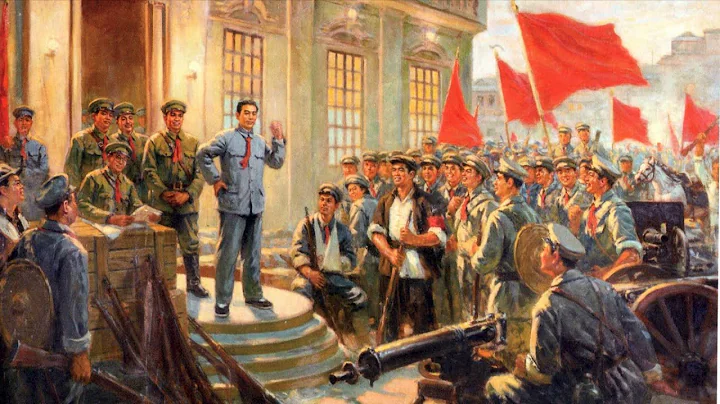
October 1, 1949 is a day in Chinese history that is proud and trembling. China has gained a new life. Tiananmen Square also ushered in a grand scene that has never been seen before. The Chinese nation has since opened a new era of history.

Since then, Tiananmen Square has witnessed the stability and prosperity of the Chinese nation. Every National Day, grand military parades and parades will be welcomed. People across the country have celebrated the anniversary of the founding of New China.
However, with the holding of the National Day celebration, the military parade and mass parade were also very different from the past, and some changes were made. The command center also ordered: " Yangko " is not allowed in front of Tiananmen Square. Why is this?
Changes in National Day commemoration
In the early days of the founding of New China, the National Day commemoration Activities were grand, and Beijing and major cities held military parades and people's gatherings and parades.
On October 1, 1949, the People's Republic of China was founded and the founding ceremony of was held in Tiananmen Square. 300,000 national leaders and 300,000 workers, farmers, intellectuals and other people from Beijing participated in this grand celebration.
At 3 pm, with Chairman Mao’s solemn declaration to the world: “The Central People’s Government of the People’s Republic of China has been established today.”
Accompanied by the national anthem "March of the Volunteers ", Mao Zedong pressed the button to raise the national flag, followed by 54 salutes and 28 sounds, and then a grand military parade and mass parade were held.
On the same day, major cities that have been liberated across the country also held grand celebrations. " People's Daily " published an editorial on the same day, introducing in detail the contents of " Common Program " and "Organization Law of the Central People's Government of the People's Republic of China".
On this day, the founding ceremony was broadcast live on the Tiananmen Gate Tower by Beijing Xinhua Radio Station. The speeches and military parades of the national leaders were also transmitted to the whole country through radio wave .
After this, the content and operation methods of the founding ceremony were used by the subsequent National Day commemorative activities.
0000000000000000000000000000000000000000000000000000000000000000000000000000000000000000000000000000000000000000000000000000000000000000000000000000000000000000000000000000000000000000000000000000000000000000000000000000000000000000000000000000000000000000000000000000000000000000000000000000000000000000000000000000000000000000000000000000000000000000000000000000000000000000000000000000000000000000000000000000000000000000000000000000000000000000000000000000000000000000000000000000000000000000000
Although the founding ceremony attracted worldwide attention, this was not the first official National Day event in New China, because on December 2, 1949, the fourth meeting of the Central People's Government Committee determined that October 1 of each year was National Day.
Therefore, the National Day in 1950 was the first official National Day commemoration event. On September 8, the "Central Regulations on the Commemoration of National Day" was promulgated, requiring military parades and mass parades to be held in Beijing and major administrative center cities during the National Day. The statue of Chairman Mao should be hung at the venue for the celebration ceremony, and photos of Sun Yat-sen and Mao Zedong should be published, etc.
On October 1, 1950, a grand National Day ceremony was held in Tiananmen Square, with more than 400,000 people participating. The first military parade was cheered by the audience, and a mass parade was held after the military parade.
On October 5, 1950, the Central Committee of the Communist Party of China made the strategic decision to resist U.S. aggression and aid Korea. Therefore, on the eve of National Day in 1951, the Central Committee of the Communist Party of China instructed that the key points of the propaganda on National Day should have the idea of resisting U.S. aggression and aiding Korea.
1951's National Day commemorative activities are still dominated by military parades and mass parades. As China and foreign exchanges deepen, the number of foreign guests participating in the National Day anniversary has increased significantly, reaching 300.
In August 1952, the National Day commemorative activities were further standardized, and the arrangement of leaders' portraits during mass parades was stipulated. Newspapers should be on the most prominent position on the front page on the National Day. National Day must be hung on all national flags. Military organs and military camps can be hung outdoors. Only Chairman Mao’s portraits can be hung on the memorial ceremony venue, etc.
However, the National Day commemoration activities during this period were relatively large. Military parades and mass parades were held in Beijing and all over the country. With the development of Sino-Soviet relations, National Day commemoration activities have also become one of the ways to promote the development of bilateral relations.
From 1953 to 1959, the scale of National Day commemorative activities decreased, and the military parade was only held in Beijing, and publishing editorials and commemorative articles became one of the important commemorative methods.
1953, Korean War ended, and the economic construction of New China was carried out on a large scale. Although the National Day commemorative activities have decreased, Hong Kong and Macao also held National Day celebrations, and Chinese embassies and consulates abroad also held National Day receptions.
1954 is the fifth anniversary of the founding of New China. A grand ceremony was held, and more than 1,500 foreign guests attended the National Day commemorative conference. During this National Day ceremony, Khrushchev also climbed to the Tiananmen Gate Tower and watched the military parade and mass parade with Chairman Mao.
1959 was the 10th anniversary of the founding of New China. For this reason, the propaganda department of the Central Committee of the Communist Party of China began to prepare for this grand ceremony one year in advance. On the eve of National Day, articles introducing the achievements and experiences of the 10th anniversary of the founding of New China were published in newspapers and magazines such as People's Daily and Red Flag to show the development achievements of the Chinese nation over the past ten years.
In order to celebrate the tenth anniversary of National Day, all localities have increased their investment in manpower, material resources and financial resources to prepare for the National Day. Guangzhou has invested 44 million yuan in infrastructure construction to build Science and Technology Museum , TV tower, opera house, etc.
For this reason, Zhou Enlai also wrote a commemorative article "The Great Decade", pointing out that China has undergone earth-shaking changes over the past decade,
"The leap development of the people in China is fundamentally due to the most thorough democratic revolution and the socialist revolution of Chinese society."
From 1953 to 1959, National Day commemorative activities gradually became standardized, the scale of commemorative activities was reduced, and large-scale mass parades were only held in provincial capitals and municipalities directly under the central government.
So what changes have been made in the military parade?
Changes in military parade
1949, at the first plenary meeting of the preparation meeting for the new CPPCC on the eve of the founding ceremony, a grand celebration ceremony was determined.
At the same time, Commander-in-Chief Zhu De was determined to be the commander-in-chief of the parade , Nie Rongzhen acted as the commander-in-chief of the military parade, and Comrades Yang Chengwu , Tang Yanjie and other comrades were the deputy commander-in-chief.
Military Commission Head of the head instructed to draft the "military parade plan" first.
For the New China, holding a military parade is the first and very important event.
This military parade not only represents millions of Chinese People's Liberation Army, but also represents the image of the new China. Therefore, the central leadership also attaches great importance to it. After listening to Nie Rongzhen's basic idea of the military parade ceremony, Chairman Mao said: "We have always advocated being cautious in the first battle. This military parade is also the first battle. It is the first time the country was founded. We must do it well."
Yang Chengwu felt a great responsibility, so he checked many relevant military parade materials and asked Commander Liu Bocheng, who had studied in the Soviet Union.
Liu Bocheng told him the details and issues of attention in the military parade. After that, Yang Chengwu visited the commander of Chen Yi and . Seeing that he was so nervous, Chen Yi encouraged him:
"It's nothing great. I have won many major battles, and I'm still worried that I might be able to do a military parade? Isn't it just a queue! Through the queue, we show our military authority and let the people see that this is our army, and this is the army of New China."
Liu Bocheng and Chen Yi's words also gave Yang Chengwu a moment of confidence. Afterwards, he selected troops to participate in the military parade according to the instructions of the head of the Military Commission.
In order to be foolproof at the founding ceremony, in July 1949, Zhu De and Nie Rongzhen personally supervised the training of artillery and armored soldiers . When it was late at night on September 25 and 27, the parade troops conducted two military parade drills in front of Tiananmen Square. The night before the founding ceremony, they had already entered the preparation position and stood on standby, and completed all preparations at 10 a.m. on October 1.
0010 at 3:00 pm on October 1st, after Chairman Mao pressed the flag-raising button on the city tower, Lin Boqu officially announced the beginning of the military parade.
Zhu De, wearing a military uniform and wearing the "Chinese People's Liberation Army", walked down the Tiananmen Gate Tower and took a convertible to walk through Jinshui Bridge . Nie Rongzhen solemnly reported to him: the inspected land, sea and air representative troops have been prepared, please ask the commander-in-chief to review.
Amid the solemn military music, Zhu De, accompanied by Nie Rongzhen, took a convertible and followed the stern and clean three armies along the East Chang'an Street and Dongdan Square to East Jiaomin Lane , and then inspected the solemn and clean three armies in turn. After
, Commander-in-Chief Zhu De climbed the Tiananmen Gate Tower again and announced the start of a parade.
military parade was held for two and a half hours, and during these two and a half hours, the long battle course of our army was condensed. After the military parade, the mass parade passed through Tiananmen Square to greet the leaders of the Central People's Government.
1954 was a year of great significance in the history of New China and a year of perfection between various systems in our country. This year marks the fifth anniversary of the founding of New China, and the capital Beijing also held a grand National Day military parade.
However, this military parade is very different from the military parade during the founding ceremony.
Compared with the founding ceremony, this military parade has undergone major changes in terms of the organization of the troops and weapons and equipment. During the founding ceremony, the military parade was mainly composed of the army, navy and air force. The number of naval and air force is relatively small, but five years later, the navy and air force have developed to a certain extent.
The weapons and equipment at the founding ceremony were all kinds of different types, , but today's weapons and equipment are all unified Su-style weapons .
Defense Minister Peng Dehuai, accompanied by Commander-in-Chief Yang Chengwu, began to review the troops. Although the military parade was relatively short, only 63 minutes, these 63 minutes condensed the development of the Chinese People's Liberation Army over the past five years.
October 1, 1959, the tenth anniversary of the founding of the People's Republic of China, and a grand National Day military parade was still held in Tiananmen Square.
Tiananmen Square had been expanded at that time, twice as large as before.
The 10th anniversary ceremony of the National Day is a major festival for our country and an opportunity to fully demonstrate our country's economic development. In order to celebrate the tenth anniversary, the central leaders had already approved the military parade plan in 1958.
This time the parade was composed of three large teams, namely the hiking team, the vehicle team and the air echelon.
In previous years, cavalry, tricycle, ground cannon and anti-aircraft artillery have been cancelled.
But the number of people who are interviewed has increased by one third compared to five years ago. This time, their weapons are no longer Su's weapons, but replaced with weapons made in China, which directly illustrates the great achievements made in my country's military construction.
At the same time, the Air Force parade formation increased from the original 3 aircraft to 5 aircraft, and the total number of aircraft increased from the original 111 aircraft to 155 aircraft.
At the beginning of the military parade, Marshal Lin Biao, accompanied by Commander-in-Chief Yang Yong, parade in a domestic car to inspect the PLA's navy, army and air force.
Compared with the previous military parade, the sailors teams were added. They wore white sailor suits , erectile banters and sailor hat , and held the domestic semi-automatic rifle , which became a unique landscape in the military parade.
This military parade has also decreased compared to before last year. Although the time has become shorter, it can also reflect the development and huge changes of the People's Liberation Army of China, as well as the mature military parade organization of our army.
In the following National Day, in addition to the changes in the military parade organization, there were also changes in mass parades.
"Yangko" is not allowed in front of Tiananmen Square
National Day parade is an indispensable and important event for the National Day ceremony since the founding of New China, and it is also a window for the self-display of our country's national strength. Therefore, the leaders of the Beijing Municipal Party Committee pay great attention to implementing the political guiding ideology and to show the prosperity and prosperity of the Chinese nation to the whole world, the Chinese people have also made a lot of efforts.
On October 1, 1949, after the military parade of the founding ceremony, under the guidance of hundreds of red flags, the parade team shouted slogans in unison and walked towards Tiananmen Gate with the music of "Unity is Strength" and "Defend the Fruit of Victory".
The workers' team was at the forefront of the mass parade, and followed them were more than 8,000 representatives of farmers. Their huge team rushed into Tiananmen Square together, shouting "Long live Chairman Mao!" "Long live the Communist Party!"
According to a farmer present, when they saw Chairman Mao, their voices became hoarse and they couldn't help crying.
The student team is full of youth. In order to meet Chairman Mao, they rushed across the Jinshui Bridge and rushed downstairs of Tiananmen Gate.
In the early 1950s, on the eve of National Day, the Ministry of National Day Mass Parade mobilized lesbians to participate in the parade to mobilize them to wear some flowery clothes.
At that time, they were not willing to wear fancy clothes, and they preferred the monotonous image of the blue one. The staff participating in the preparations for the National Day Parade Command made changes after several mobilizations, which also added a lot of color to the parade.
The parade team should show full enthusiasm of patriotism, pride, enthusiasm, liveliness and confidence, and reflect the political outlook of the people of New China.
Because the mass parade is large and there are many people participating, we must pay special attention to the design of the team, which also brings great difficulties to the organizers. They are generally very successful during the rehearsal, but make mistakes several times during the parade. Where the error occurs is usually before the parade appears, the 500-meter section of Jinshui Bridge east-west section, each parade team must show its industry characteristics and unique skills here before the parade team appears.
Although this key force is only 500 meters short, everyone cannot control their emotions as soon as they arrive here.
Usually, the team of the parade troops marched from east to west, passed Tiananmen Square, waiting for Chairman Mao's review. The parade masses always want to get closer and closer to Chairman Mao.
So the team that should have been going straight began to approach the rostrum, and the team was distorted so that the team behind did not follow up and there was chaos. In response, some people joked: Yangge was twisted in front of Tiananmen Gate, and played with dragons.
And at the end of the parade, there will always be mistakes in each column. When you walk to the Jinshui Bridge, the tails of the parade are sparse, and everyone no longer walks according to discipline, losing their original momentum, which is very different from the state before the parade.
Although these problems are difficult for people in Tiananmen Square to see, the leaders on the city tower can see clearly, and the shape of the team is also very chaotic.
To this end, Peng Zhen specifically instructed the mass parade command center and asked them to find solutions to these problems as soon as possible, so as to strive to avoid such errors in the next parade. In order to be uniform, the command center ordered: is not allowed to "dance Yangko" in front of Tiananmen .
In order to avoid the phenomenon of "dragging Yangge" and "dance of dragons", the command center adopted the method of setting up a model soldier and set up a model line on the one-kilometer route from Nanchizi Road to Nanchang Street. In this way, under the supervision of the model, all the parade teams can only follow the model line, which avoids the confusion of the team and the idea of approaching the rostrum .
In order to solve the phenomenon of uneven "tails", the command center designated some personnel from Dahua University and Renmin University team to station troops in the Nanheyan South exit. Before the final game, the command personnel will lead them to run into the Tiananmen area and fill the fault phenomenon in the team maneuver and flexibly.
These students have reported that they have a fast pace and strong organizational discipline. When problems arise, they can move forward at a speed of 100 meters. Therefore, under the maintenance of these students, they can always successfully complete the "finishing" task.
These methods are effective, not only solving the appearance of key teams, but also winning unanimous praise from national leaders.